


















Lesson 1 of 46 · Getting Started
Course Map: How to Study Social Psychology
Start here: who the social psychology course is for, what you need, how the nine chapters fit together and how to study with evidence and demonstrations.
You are a social animal. Right now, even if you are alone, your thoughts are full of other people: what a friend meant by a message, how you look to a teacher, whether a team will accept you. Social psychology is the science that studies exactly this: how our thoughts, feelings and behavior are shaped by the real, imagined or implied presence of other people.
This course is a complete, evidence-based introduction. It is written for learners from about age 14, for first-year university students, and for adults who want to understand why people (including themselves) act the way they do. You do not need any earlier psychology. You do need curiosity, a willingness to question your first explanation, and basic comfort with percentages and simple graphs.
This course is educational information about research findings. It is not therapy, a diagnosis or personal advice. If you or someone you know is struggling, speak to a qualified professional or a trusted adult.
What you will learn
- What social psychology is and how it differs from sociology and personality psychology.
- How researchers design studies to find out what causes what.
- The classic and modern findings on the self, thinking, attitudes, persuasion, conformity, groups, prejudice, relationships, aggression and helping.
- Why some famous findings did not hold up, and how to judge evidence yourself.
- How to apply the ideas to everyday life with small, honest demonstrations.
Key terms
Social influence is any change in thoughts, feelings or behavior caused by other people. Situationism is the idea that circumstances often shape behavior more than we expect. Construal is how a person interprets a situation, which matters more than the objective facts. Replication means repeating a study to see whether the result appears again. Effect size is how big an effect is, not just whether it exists.
The big idea: person plus situation
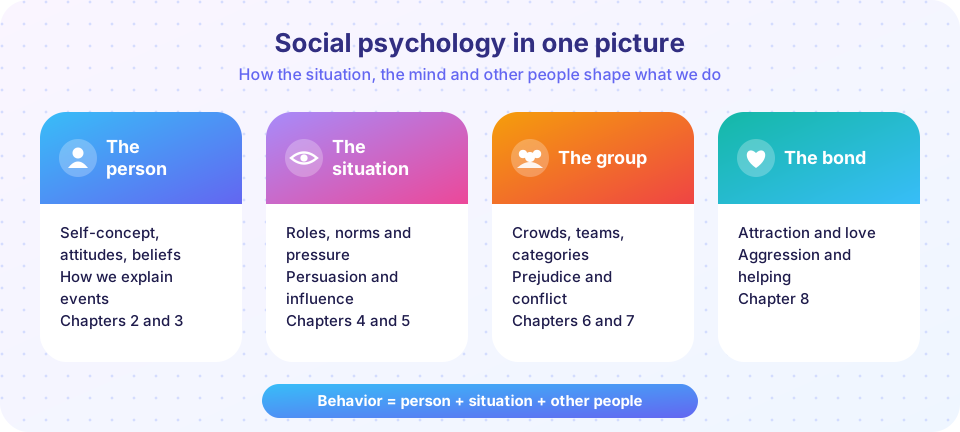
In 1936 Kurt Lewin summarized the whole field in a sentence that you can read as a formula: behavior is a function of the person and the environment, written B = f(P, E). Early in the course you will see why this is more subtle than it looks. People differ, and situations differ, but the two interact. A friendly person can act coldly in a harsh workplace; a shy person can become the life of a party among close friends.
Social psychologists add a second big idea: construal. What matters is not the situation as an outsider sees it, but how the person interprets it. A joke can feel affectionate or cruel depending on how it is construed. Much of the field is the study of these interpretations: how we explain behavior (attribution), how we think about groups (stereotypes), how we judge ourselves (comparison).
The nine chapters
Foundations
- Getting Started
- The Social Self
- Social Cognition
Influence
- Persuasion
- Conformity and Obedience
- Group Behavior
Between people
- Prejudice
- Relationships
Practice
- Projects and Practice
How to study
How every lesson is built
Each content lesson has the same shape so you always know where you are. It opens with outcomes and key terms, teaches with worked examples and named studies, warns about common misconceptions, offers small interactive demonstrations, then checks your understanding with a quiz and a summary. Chapter overviews give you the map; chapter reviews give you a one-page recap and a longer mixed quiz.
The interactive blocks are demonstrations, not diagnostic tests. A reaction-time game shows how an effect works; it does not measure your personality. Wherever a demo is a simplified model, the lesson says so.
Common misconceptions
"Social psychology is just common sense." Many findings seem obvious after you hear them, which is called hindsight bias. Try predicting results beforehand: you will often be surprised, and sometimes the common-sense proverbs contradict each other ("absence makes the heart grow fonder" versus "out of sight, out of mind").
"One famous study settles it." Single studies can be wrong. The field learned this the hard way, which is why Chapter 1 covers replication.
Try it
Plan how you will study. The first demonstration is a simple chapter picker; the second turns your weekly time into a schedule. Both are tiny models, not tests.
Press Run (or Ctrl + Enter) to see the console output here.
No output.
Check your understanding
Quick check · 4 questions
of 4 answered You scored / 4 · perfect!
-
1. Which sentence best describes social psychology?
Social psychology studies the influence of real, imagined or implied others on how we think, feel and act. -
2. What does Lewin's formula B = f(P, E) say?
Behavior arises from the interaction of the person and the situation. -
3. What is construal?
Construal is the subjective interpretation of a situation, which often matters more than the objective facts. -
4. The interactive demos in this course are...
They are teaching demonstrations, never diagnoses.
Summary
- Social psychology studies how other people, real or imagined, shape thoughts, feelings and behavior.
- Behavior comes from the person and the situation together, filtered by how the person construes it.
- The course has nine chapters: foundations, the self, cognition, persuasion, conformity, groups, prejudice, relationships and practice.
- Predict, retrieve and apply: that is how to learn the material.
- Demos are demonstrations, and nothing here is therapy or diagnosis.
Track your progress
Create a free account to tick off lessons and pick up where you left off on any device.
of Social Psychology lessons completed