


















Lesson 45 of 46 · Projects and Practice
Cheat Sheet: Chapters 5 to 8
A one-page recap of conformity, obedience, group behavior, prejudice, attraction, aggression and helping, with key studies, numbers and cautions.
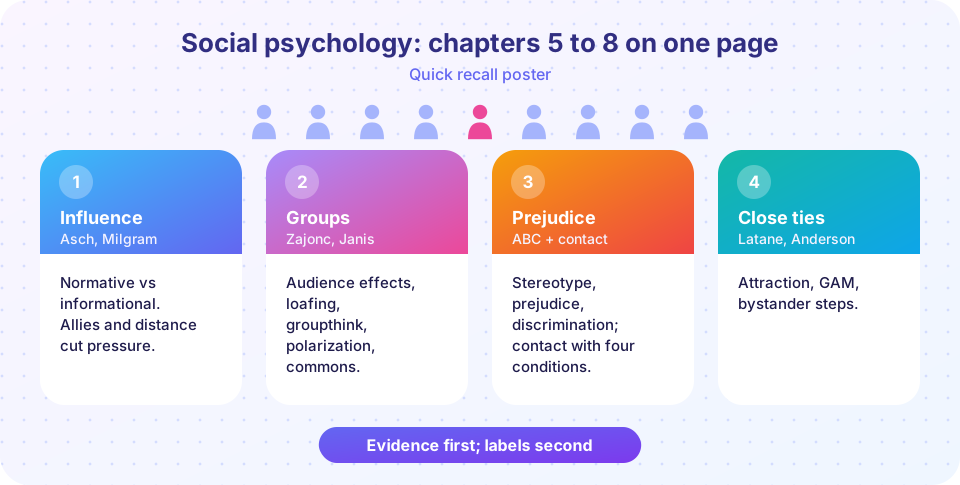
Here is the whole second half of the course on one page. Use it for revision, then go back to any lesson where a line feels thin.
What you will learn
- The key idea, study and caution for every chapter.
- The handful of numbers worth remembering.
Key ideas at a glance
Influence (chapter 5). Conformity responds to peers; obedience to authority. Asch: about a third of critical answers followed a wrong majority, and one ally reduced it. Normative influence is about being liked, informational about being right; Kelman: compliance, identification, internalization. Milgram: 65 percent to 450 V in the baseline; distance and defiant peers cut it; critics point to ethics, realism and engaged followership.
Groups (chapter 6). Others' presence helps easy tasks and hurts hard ones (Zajonc). Effort drops when output is pooled and unidentifiable (Latané). Groupthink: cohesion, a directive leader and pressure to agree; evidence is mostly case studies. Polarization strengthens the average lean. Anonymity increases the weight of group norms (SIDE). Social dilemmas pit self-interest against group interest; communication, reciprocity, sanctions and local rules help (Axelrod, Ostrom).
Prejudice (chapter 7). Stereotype (belief), prejudice (feeling), discrimination (behavior). Sources: categorization, competition, identity, learning. Stereotype content: warmth and competence. IAT scores are noisy for individuals; stereotype threat effects are debated. Contact reduces prejudice most with equal status, common goals, cooperation and support.
Close ties (chapter 8). Proximity, familiarity, similarity and responsiveness shape attraction. Sternberg: intimacy, passion, commitment. Rusbult: satisfaction, alternatives, investment. Aggression: learned, triggered, constrained; venting does not help. Bystanders: notice, interpret, take responsibility, know how, act; hurry and ambiguity block helping.
Numbers worth remembering
| Fact | Number (approximate) |
|---|---|
| Asch critical answers following the majority | about one third |
| Participants who conformed at least once | about three quarters |
| Milgram baseline, 450 V | 65 percent (26 of 40) |
| Seizure study, reported when alone | about 85 percent |
| Seizure study, four others present | about 31 percent |
| Good Samaritan, no hurry versus high hurry | about 63 percent versus 10 percent |
| 4-player public goods game, all give / free rider | 16 each / 22 versus 12 |
Common misconceptions
"The classic studies are facts about everyone." They are patterns in specific samples and settings.
"A cheat sheet replaces the lessons." It is a memory aid, not an explanation.
Try it
Press Run (or Ctrl + Enter) to see the result here.
Program input · what you'd type while the program runs
Type the answers before you press Run, one per line. Each time the program reads a line (with input()), it gets the next line from this box.
Press Run (or Ctrl + Enter) to see the console output here.
No output.
Check your understanding
Quick check · 4 questions
of 4 answered You scored / 4 · perfect!
-
1. Which pair is correct?
Conformity follows peers; obedience follows an authority. -
2. Which is NOT among the five steps of helping?
The steps are notice, interpret, take responsibility, know how, act. -
3. Which factor most reliably increases contact's benefits?
Allport's conditions. -
4. Social facilitation tends to help on...
Arousal strengthens the dominant response.
Summary
- Four chapters, four sets of anchors: influence, groups, prejudice, close ties.
- Remember the key numbers as approximate and tied to specific studies.
- Always add the caution: sample, setting and size of effect.
Next: Further study
Track your progress
Create a free account to tick off lessons and pick up where you left off on any device.
of Social Psychology lessons completed