


















Lesson 25 of 46 · Conformity and Obedience
Chapter 5 Review: Conformity and Obedience
A one-page recap of conformity and obedience: Asch, normative and informational influence, Kelman, Milgram and their critics, followed by a ten-question quiz.
This review pulls the chapter together. First a picture, then a table you can use as a revision sheet, then a drill and a longer quiz that mixes all the lessons.
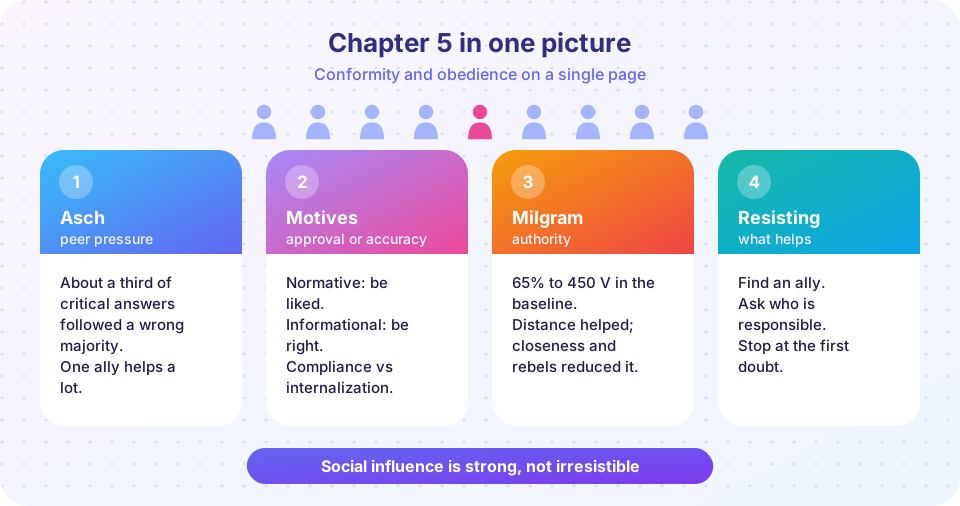
What you will learn
- Which findings are the best anchors for each topic.
- How to compare the three big explanations of why people go along.
- How to spot the limits of each classic study.
Recap table
| Topic | Key idea | Anchor finding | Main caution |
|---|---|---|---|
| Asch | Peers can sway even easy judgments | About a third of critical answers followed a wrong majority | Low stakes, 1950s US sample |
| Normative influence | We conform to be accepted | Written answers cut conformity | Hard to separate from informational |
| Informational influence | Others are evidence | Sherif's group norms in the autokinetic effect | Strongest when the task is ambiguous |
| Kelman | Three depths of change | Compliance, identification, internalization | Inside states are hard to measure |
| Milgram | Authority can drive harmful acts | 65 percent to 450 V in the baseline | Ethics, belief, generalization |
| Resistance | Allies, distance, questions | Defiant peers cut obedience | Context-dependent |
Common misconceptions
"Conformity is weakness." It is also how groups coordinate and learn.
"If a study is criticized it is worthless." Criticism refines what a study can tell us; the Asch and Milgram patterns still guide research, with care.
"Individuals have no say." Allies, reflection and structure change outcomes.
Try it
Press Run (or Ctrl + Enter) to see the console output here.
No output.
Press Run (or Ctrl + Enter) to see the result here.
Program input · what you'd type while the program runs
Type the answers before you press Run, one per line. Each time the program reads a line (with input()), it gets the next line from this box.
Check your understanding
Quick check · 10 questions
of 10 answered You scored / 10 · perfect!
-
1. Which situation shows normative influence?
Normative influence is about acceptance. -
2. Asch's strongest effect-reducing variation was...
An ally breaks unanimity. -
3. Which level of Kelman's model changes private belief?
Internalization means the belief becomes your own. -
4. Which statement about Milgram's baseline is correct?
26 of 40 went to the maximum; the shocks were not real. -
5. Which prod did Milgram's data suggest was least effective?
A direct order tended to prompt refusal. -
6. Engaged followership suggests people obeyed because they...
They believed in a worthwhile project. -
7. Which criticism fits Asch's original work?
The task was low stakes and the sample narrow. -
8. A descriptive norm states...
Descriptive norms report behavior, injunctive norms report approval. -
9. Why is the Stanford prison study handled with caution?
Later archival work found coaching and the BBC study found no automatic role adoption. -
10. Which of these helps people resist pressure?
Allies make dissent easier, as in Asch and Milgram variations.
Summary
- Peer pressure and authority both shape behavior, usually through approval or information.
- Asch and Milgram variations show that allies and distance matter.
- Always read classic studies with their ethics and critiques in mind.
- Resistance is possible and can be designed into situations.
Next: Group behavior overview
Track your progress
Create a free account to tick off lessons and pick up where you left off on any device.
of Social Psychology lessons completed