


















Lesson 21 of 46 · Conformity and Obedience
Chapter 5 Overview: Conformity and Obedience
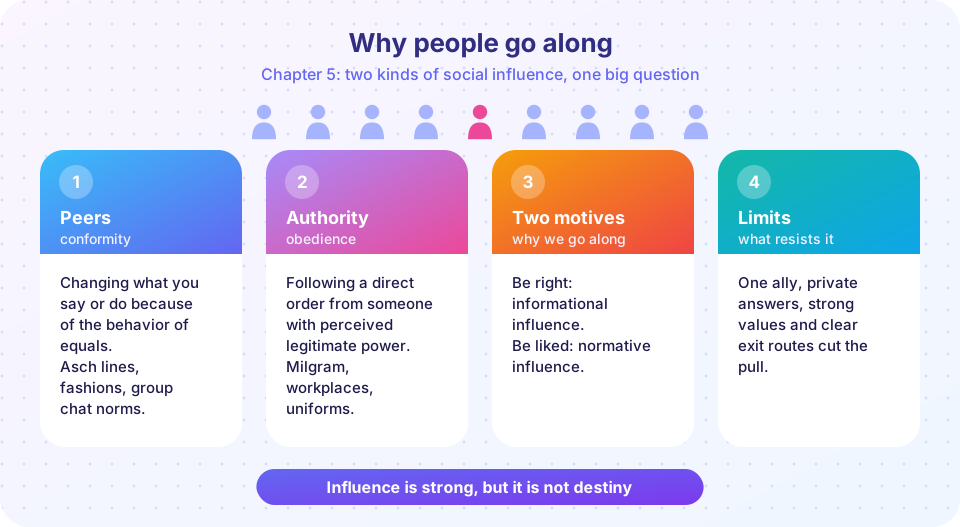
A map of chapter 5: how peers and authority shape what we say and do, why people go along, and what the classic Asch and Milgram studies really showed.
Most of what you do each day is shaped by other people. You pick a clothing style because friends wear it, you lower your voice in a library, you follow a manager's instruction without asking for a reason. Social psychologists call this social influence, and it is one of the oldest and most studied topics in the field. This chapter looks at two forms of it: conformity, which is change in behavior or belief because of real or imagined pressure from peers, and obedience, which is following a direct order from someone seen as having legitimate authority.
The studies in this chapter are famous because their results surprised people. They are also famous because they raised ethical alarms and, in recent years, careful criticism. A good student of social psychology learns the headline findings and also the limits, so you will meet both here.
This course is educational. It describes research on groups of people and is not a way to diagnose yourself or anyone else.
What you will learn
- The difference between conformity, compliance and obedience.
- How the Asch line studies were run and what they found.
- Why normative and informational influence are different, and how Kelman's three levels of change fit in.
- What Milgram's obedience studies showed, the variations he ran, and the main criticisms.
- What helps people resist pressure.
Key terms
Social influence: any change in thoughts, feelings or behavior caused by other people.
Conformity: changing your behavior or belief to match a group or norm.
Obedience: following a direct command from an authority.
Norm: an unwritten rule about what is expected in a situation.
A quick tour
Social influence is everywhere
Why people go along
Classic studies
How to resist
What each lesson covers
- Asch and conformity: the line study, its results, and what changes the effect.
- Normative and informational influence: the two motives and Kelman's levels of change.
- Milgram and obedience: the baseline study, the variations, criticisms, and the Stanford prison study.
- Chapter review: a recap and a ten-question quiz.
Common misconceptions
"These studies prove people are sheep." In Asch's study most answers were still correct, and about a quarter of participants never conformed.
"Obedience means people are evil." Milgram's participants were often visibly distressed. Situations can push ordinary people to do harm, but they can also be redesigned to push the other way.
Try it
Press Run (or Ctrl + Enter) to see the result here.
Program input · what you'd type while the program runs
Type the answers before you press Run, one per line. Each time the program reads a line (with input()), it gets the next line from this box.
Press Run (or Ctrl + Enter) to see the console output here.
No output.
Check your understanding
Quick check · 4 questions
of 4 answered You scored / 4 · perfect!
-
1. Which pair is matched correctly?
Conformity responds to pressure from equals, obedience to a direct order from an authority. -
2. Which of these is a social norm?
A norm is an unwritten rule about what is expected, such as how to stand in an elevator. -
3. What was the main reason these studies became famous?
The surprise was how powerful the situation was, not that people are fixed or groups are always wrong. -
4. Which statement is accurate?
Roughly a quarter never followed the majority on critical trials, and a control group answered alone.
Summary
- Social influence changes what people think and do.
- Conformity responds to peers; obedience responds to authority.
- Two motives drive it: wanting to be right and wanting to be accepted.
- The classic studies are powerful but also criticized, so read them with care.
Next: Asch and conformity
Track your progress
Create a free account to tick off lessons and pick up where you left off on any device.
of Social Psychology lessons completed