


















Lesson 6 of 46 · The Social Self
The Social Self: Chapter Overview
A map of chapter 2: self-concept, self-esteem, social comparison, identity, self-presentation and self-perception, with a slide deck and a self-description demo.
Ask yourself, "Who am I?" and notice what happens. You probably reach for roles ("a student, a sister, a goalkeeper"), traits ("curious, a bit messy"), and groups ("from Lagos," "a fan of a club"). Almost every answer refers to other people. The self is not a private object we discover in solitude; much of it is built in the company of others.
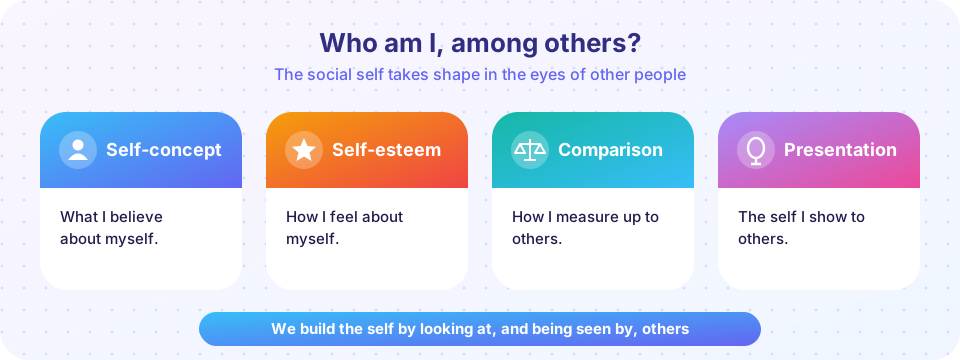
Chapter 2 explores that social self: how we form a picture of ourselves, how we feel about it, how we measure ourselves against others and how we manage the picture others see.
What you will learn
- Why the self is a social product.
- A preview of each lesson in this chapter.
- How to describe yourself using personal and social identities.
- Why self-knowledge is less direct than it feels.
Key terms
Self-concept is the set of beliefs a person holds about themselves. Self-esteem is the overall evaluation of oneself, positive or negative. Looking-glass self is Charles Cooley's idea (1902) that we imagine how others see us and form our self-image from it. Social identity is the part of the self based on group membership.
The big picture
Who am I?
How do I feel about me?
Compared to whom?
What do I show?
Lessons in this chapter
- Self-Concept and Self-Esteem: schemas, independent and interdependent selves, the sociometer.
- Social Comparison and Identity: Festinger, upward and downward comparison, social identity theory.
- Self-Presentation and Self-Perception: impression management, self-monitoring, Bem and the spotlight effect.
- Chapter 2 Review: a one-page recap and a mixed quiz.
Self-knowledge is not direct
You might think you know yourself by looking inward. The research is humbling. In 1977 Richard Nisbett and Timothy Wilson reviewed studies suggesting that people often cannot report the real causes of their behavior; they offer plausible theories instead. We also notice ourselves through the reactions of others. A child who is repeatedly praised for being "clever" builds a different self-concept from a child who is told they are "slow," even if the facts are the same.
Common misconceptions
"There is one true self hidden inside." Most psychologists see the self as multifaceted, changing across roles and contexts, while keeping a core of continuity.
"High self-esteem always helps." The evidence is more mixed; Chapter 2 covers when it does and does not.
Try it
Write your own description and notice how many answers involve other people, then simulate the looking-glass effect.
Press Run (or Ctrl + Enter) to see the console output here.
No output.
Check your understanding
Quick check · 4 questions
of 4 answered You scored / 4 · perfect!
-
1. Which best describes the looking-glass self?
Cooley (1902) said our self-image is shaped by imagined views of others. -
2. Self-esteem is...
Self-concept is what we believe; self-esteem is how we evaluate it. -
3. What did Nisbett and Wilson (1977) suggest?
Introspection is less reliable than it feels. -
4. Social identity refers to...
It is the self drawn from groups we belong to.
Summary
- The self is largely built in relation to others.
- The chapter covers self-concept, self-esteem, comparison, identity, self-presentation and self-perception.
- Introspection is limited; we infer the self from behavior and feedback.
- The self varies across contexts but keeps continuity.
Track your progress
Create a free account to tick off lessons and pick up where you left off on any device.
of Social Psychology lessons completed