


















Lesson 30 of 46 · Group Behavior
Chapter 6 Review: Group Behavior
A recap of chapter 6: social facilitation, social loafing, groupthink, polarization, deindividuation and cooperation, with a revision table and a ten-question quiz.
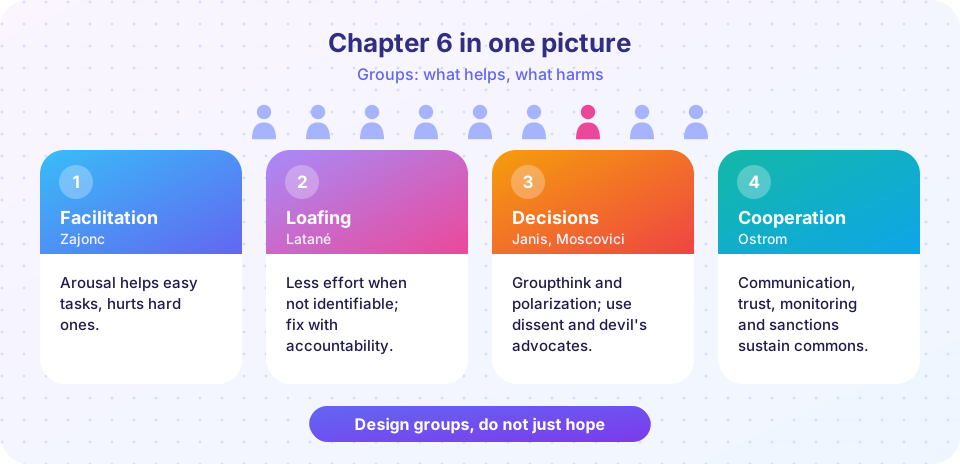
This review ties together how audiences, teams, decision groups, crowds and shared resources change behavior. Use the picture and the table as a revision sheet, then test yourself with the drill and the longer quiz.
What you will learn
- A one-line anchor and a caution for each topic.
- How to choose a remedy for a group problem.
Recap table
| Topic | Key idea | Anchor | Remedy or caution |
|---|---|---|---|
| Social facilitation | Others' presence raises arousal | Easy tasks improve, hard tasks suffer (Zajonc, Bond and Titus) | Practice until tasks are easy; reduce evaluation threat |
| Social loafing | Less effort when output is pooled | Latané, Williams and Harkins (1979) | Make contributions identifiable and meaningful |
| Groupthink | Cohesion plus pressure to agree | Janis (1972) | Evidence is mostly case studies; use procedures and dissent |
| Polarization | Discussion amplifies the lean | Moscovici and Zavalloni (1969) | Mix viewpoints; collect independent input |
| Hidden profiles | Shared information dominates | Stasser and Titus (1985) | Ask for unique facts |
| Deindividuation | Anonymity shifts norms | Zimbardo (1969), Diener et al. (1976) | SIDE: group norms matter |
| Social dilemmas | Self-interest vs group interest | Hardin (1968), Axelrod, Ostrom | Communication, reciprocity, sanctions, local rules |
Common misconceptions
"A bigger team is a better team." Extra members add output but can add loafing and coordination costs.
"Anonymity always brings out the worst." It makes the group's norms weigh more.
"Cooperation needs a strong central authority." Ostrom's work shows that user-designed rules can work.
Try it
Press Run (or Ctrl + Enter) to see the console output here.
No output.
Press Run (or Ctrl + Enter) to see the result here.
Program input · what you'd type while the program runs
Type the answers before you press Run, one per line. Each time the program reads a line (with input()), it gets the next line from this box.
Check your understanding
Quick check · 10 questions
of 10 answered You scored / 10 · perfect!
-
1. A well-practiced pianist plays better with an audience. This best fits...
An easy or well-learned task benefits from the arousal of an audience. -
2. Which finding is the key evidence for social loafing?
Latané, Williams and Harkins found lower individual output in groups. -
3. Janis's groupthink model lists which condition?
Directive leaders, cohesion, insulation, lack of procedure and stress. -
4. Group polarization is best described as...
Discussion tends to amplify what members already believed. -
5. In a hidden-profile task, groups often fail because they...
Unique information tends to be mentioned less. -
6. According to SIDE, anonymity tends to...
Shared identity becomes more important when personal identity fades. -
7. Which does NOT belong to Ostrom's principles?
Rules should be clear and known; secrecy does not help monitoring. -
8. Tit for tat starts by...
It cooperates first and then copies the other player's last move. -
9. In the four-player game described, everyone contributing leads to each player ending with...
Pot 40 x 1.6 = 64, split four ways = 16. -
10. Which is the best remedy for loafing in a group project?
Visibility and accountability reduce loafing.
Summary
- Audiences help on easy tasks and hurt on hard ones; pooled effort invites loafing.
- Cohesion and a directive leader can silence dissent; discussion can polarize.
- Anonymity increases the weight of group norms.
- Cooperation is supported by communication, reciprocity, sanctions and fit-for-purpose rules.
Track your progress
Create a free account to tick off lessons and pick up where you left off on any device.
of Social Psychology lessons completed