


















Lesson 46 of 46 · Projects and Practice
Further Study: Where to Go Next
Next steps after this course: deeper theory, research methods and statistics, applied fields, and related tracks on this site, plus habits for reading research.
You have now covered a wide stretch of social psychology, from conformity and obedience to groups, prejudice, relationships, aggression and helping. This final lesson suggests where to go next, how this subject connects to other tracks on the site, and which habits will keep you a careful reader of research.
What you will learn
- Which topics deepen what you learned.
- Which tracks on this site connect most closely.
- Habits for reading and judging research.
Direction 1: Deeper psychology
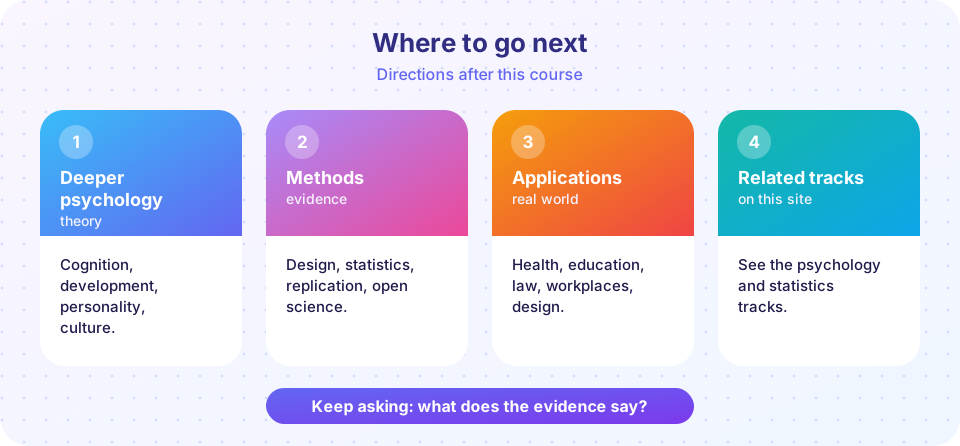
Social psychology borrows from and feeds other areas. Good companions are the introduction to psychology, cognitive psychology (memory, attention and judgment, which underlie social cognition), developmental psychology (how attachment, prejudice and helping develop) and clinical psychology (when social patterns become distress).
Direction 2: Methods and statistics
The most useful upgrade is learning how to judge evidence. Research methods in psychology covers design, measurement, ethics and replication. Statistics and probability gives you the tools behind effect sizes, confidence intervals and meta-analysis. If you enjoyed the projects, the next step is to write small simulations and analyses of your own, and to read a few preregistered replications.
Direction 3: Applications
Social psychology is applied in health campaigns, education, law, organizations, public policy, design and online communities. Behavioral economics links closely with the lessons on norms and cooperation. Sociology, anthropology and political science offer large-scale and cross-cultural views of the same questions about groups, identity and conflict.
Habits of a careful reader
- Ask what the sample was. Who took part, where and when?
- Ask what was measured. A questionnaire, a reaction time, real behavior?
- Look at the size of the effect, not just whether it was found.
- Look for replication. One study is a lead; several independent ones are a pattern.
- Separate description from explanation. A pattern can have several causes.
- Watch for overclaiming. Headlines love single causes and sweeping conclusions.
- Hold your own beliefs to the same standard.
Common misconceptions
"Once a study is famous, it is settled." Fame and quality are different things; several classic findings have been revised.
"Social psychology only studies weird situations." It studies everyday life, in and out of the lab.
Try it
Press Run (or Ctrl + Enter) to see the console output here.
No output.
Press Run (or Ctrl + Enter) to see the result here.
Program input · what you'd type while the program runs
Type the answers before you press Run, one per line. Each time the program reads a line (with input()), it gets the next line from this box.
Check your understanding
Quick check · 3 questions
of 3 answered You scored / 3 · perfect!
-
1. Why is one small study a weak basis for a strong claim?
Random variation is large in small samples. -
2. Which track would best strengthen your skill at judging evidence?
It covers design, measurement and replication. -
3. Which habit helps most against overclaiming?
Effect size and replication show how solid a finding is.
Summary
- Go deeper into cognition, development and clinical topics, or outward into methods, statistics and applications.
- Read research by checking sample, measure, design, effect size and replication.
- Keep learning, and keep your own beliefs open to evidence.
Track your progress
Create a free account to tick off lessons and pick up where you left off on any device.
of Social Psychology lessons completed