


















Lesson 23 of 46 · Conformity and Obedience
Normative and Informational Influence
Why people go along: Deutsch and Gerard's two motives, Sherif's norm-formation study, Kelman's three levels of change, and how descriptive and injunctive norms work.
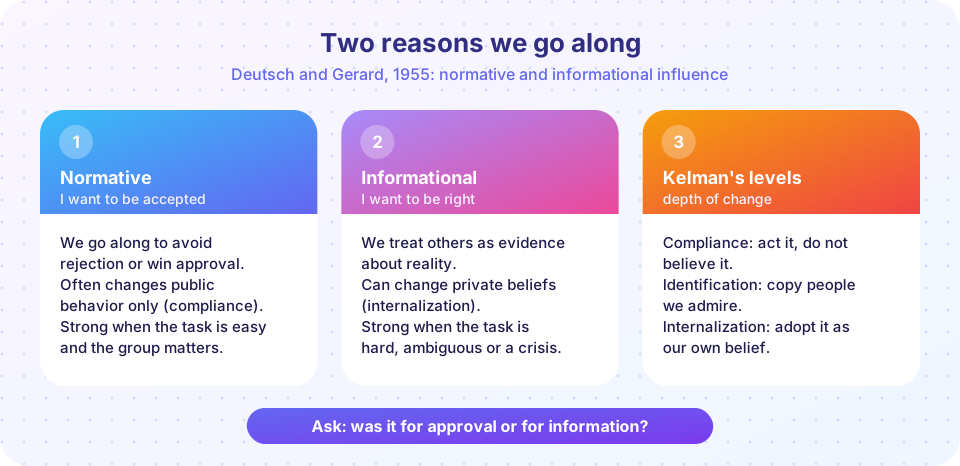
Why did people in Asch's study go along with a wrong majority? There is no single answer, and that is the useful point. In 1955 Morton Deutsch and Harold Gerard proposed that two different motives are at work. Sometimes we follow others because we assume they know something we do not. Sometimes we follow them because we want to be accepted. Separating these motives helps you predict when conformity will be private and lasting, and when it will be public and shallow.
What you will learn
- The difference between normative and informational influence, with examples of each.
- How Sherif's autokinetic study showed norm formation.
- Kelman's three levels: compliance, identification, internalization.
- Descriptive versus injunctive norms and how campaigns use them.
Key terms
Normative influence: conforming to be accepted, liked or to avoid rejection.
Informational influence: conforming because others' behavior is evidence about what is true or correct.
Descriptive norm: what most people actually do.
Injunctive norm: what most people approve or disapprove of.
Informational influence: other people as evidence
Imagine you are in a foreign airport and cannot read the signs. You follow the crowd and it leads you to the right gate. That is rational: the crowd carries information. Informational influence is strongest when a situation is ambiguous, when the task is hard, when there is an emergency and no time to think, and when the others seem knowledgeable.
A classic demonstration is Muzafer Sherif's autokinetic experiment (1935). In a dark room a single point of light looks as if it moves, though it is stationary (the autokinetic effect). People estimated how far it moved. Alone, each person settled on their own range. In groups, the estimates converged to a shared group norm. People were uncertain, used each other as a guide, and a norm emerged. Later follow-ups found that such norms could persist after the group was gone, which suggests the change was more than lip service.
Informational influence usually produces private acceptance: you really believe the new answer.
Normative influence: the need to belong
Normative influence relies on a different engine. Humans are a social species, and being excluded is costly, so we are alert to approval and disapproval. We may laugh at a joke we do not find funny or stay quiet when we disagree. Normative influence is strongest when the group matters to us, when we are observed, and when the task is easy so that private doubt is not a reason to speak. It tends to produce public compliance without necessarily changing private belief.
How can you tell the two apart in Asch's results? When answers were written privately, conformity dropped, which implicates normative pressure. When the task was harder, conformity rose, which implicates informational pressure. Both operate in real life, and many situations mix them.
Kelman's three levels of change
Herbert Kelman (1958) described what happens inside a person when they change:
| Level | What it looks like | Why it happens | Lasts when watched? | Lasts in private? |
|---|---|---|---|---|
| Compliance | You act on the surface | Reward or avoiding punishment | Yes | Usually no |
| Identification | You adopt the views of someone you admire | You want to be like them | While the relationship lasts | Often |
| Internalization | The belief becomes your own | You find it correct and consistent with your values | Yes | Yes |
A person who wears a uniform only while the manager is in the building is showing compliance. A teenager who takes on a favorite musician's style shows identification. A person who changes diet after reading evidence and finding it convincing shows internalization.
Norms in action: descriptive and injunctive
Robert Cialdini and colleagues distinguish two kinds of norm. A descriptive norm says what most people do ("most guests reuse their towels"). An injunctive norm says what people approve of ("people disapprove of littering"). Messages that state descriptive norms have been shown to boost behavior such as hotel towel reuse, and the effect tends to be larger when the norm is specific to the reader's own situation.
A famous caution comes from household energy research (Schultz and colleagues, 2007). Telling households that their energy use was above average cut use; telling households that were below average that they were doing well tended to push their use up (a "boomerang effect"). Adding an approving smiley face to low-use households (an injunctive signal) removed the boomerang. The lesson for anyone designing campaigns: pick the norm carefully, and avoid announcing that "many people do the bad thing."
Common misconceptions
"Conformity is always irrational." Often it is a sensible way to use others' knowledge.
"Public agreement means private agreement." Compliance can look identical to internalization from the outside.
"Telling people that lots of others misbehave will shock them into acting." It can normalize the misbehavior instead.
Try it
Press Run (or Ctrl + Enter) to see the result here.
Program input · what you'd type while the program runs
Type the answers before you press Run, one per line. Each time the program reads a line (with input()), it gets the next line from this box.
Press Run (or Ctrl + Enter) to see the console output here.
No output.
Check your understanding
Quick check · 5 questions
of 5 answered You scored / 5 · perfect!
-
1. A person copies the crowd in an unfamiliar airport because the crowd probably knows the way. This is mainly:
They use other people's behavior as evidence about the right thing to do. -
2. Which pair best matches Kelman's levels with their depth?
Compliance changes behavior, internalization changes belief. -
3. In Sherif's autokinetic study, groups tended to...
Uncertain individuals used each other as guides and formed a group norm. -
4. Which is an injunctive norm?
Injunctive norms describe approval or disapproval, not just what people do. -
5. Why can a message that says 'many people skip this' backfire?
It communicates a descriptive norm that may make the unwanted behavior look normal.
Summary
- Informational influence: others as evidence; normative influence: need for acceptance.
- Informational influence tends to change private belief; normative influence tends to change public behavior.
- Kelman's levels: compliance, identification, internalization.
- Descriptive and injunctive norms can be used, and misused, to change behavior.
Next: Milgram and obedience
Track your progress
Create a free account to tick off lessons and pick up where you left off on any device.
of Social Psychology lessons completed