


















Lesson 11 of 46 · Social Cognition and Attitudes
Social Cognition and Attitudes: Chapter Overview
A map of chapter 3: how we think about other people with schemas and shortcuts, explain behavior with attributions, and form attitudes, with a slide deck and demos.
Every day you meet dozens of people, read their faces, guess their moods and decide whether to trust them, often in a fraction of a second. How does the mind manage it? Social cognition is the study of how we perceive, remember, think about and make sense of other people and ourselves. It asks how fast we judge, how well we judge and why we sometimes judge wrongly.
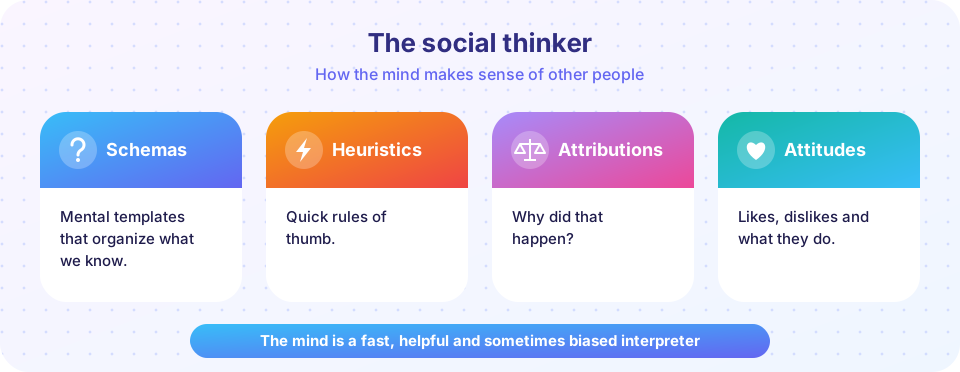
This chapter follows one theme: the mind is a busy, efficient and imperfect interpreter. It uses shortcuts to cope with an overwhelming world. Those shortcuts usually work, and sometimes lead to predictable errors.
What you will learn
- The big picture of social cognition.
- A preview of each lesson in the chapter.
- The difference between automatic and controlled thinking.
- Why accuracy and speed trade off.
Key terms
Social cognition is how people think about and make sense of social information. Cognitive miser is the idea (Susan Fiske and Shelley Taylor) that people conserve mental effort and use shortcuts. Automatic processing is fast, effortless, outside deliberate control. Controlled processing is slow, effortful and intentional. Bias here means a systematic, predictable tendency to err in one direction.
The chapter at a glance
Schemas
Shortcuts
Explaining behavior
Attitudes
Lessons in this chapter
- Schemas and Heuristics: templates, priming, availability, representativeness, anchoring, and when we think carefully.
- Attribution and Bias: Heider, Kelley, the fundamental attribution error, self-serving bias and culture.
- Attitudes and Dissonance: what attitudes are, when they predict behavior, and cognitive dissonance.
- Chapter 3 Review: a one-page recap and a mixed quiz.
Two systems of thinking
Many researchers describe two broad modes of thought (the exact labels and detail differ between theories). The fast, automatic mode handles first impressions and gut feelings. The slow, controlled mode is used for effortful reasoning. Daniel Kahneman popularized labels for them in Thinking, Fast and Slow (2011), which draw on decades of work by himself, Amos Tversky and others. Most social life runs on the fast mode, and we switch to the slow mode when stakes are high, when we are motivated and when we have the time and energy.
Common misconceptions
"Biases mean people are stupid." Shortcuts are efficient most of the time; errors are the price of speed.
"If I know about a bias, I can avoid it." Awareness helps a little, but many biases persist; better to change procedures, such as using checklists.
"Fast thinking is wrong and slow thinking is right." Both can err; experts often have well-tuned intuition.
Try it
First, try a short reaction-time demonstration showing how a prime can speed word recognition; then see how a tiny simulation of fast versus slow decisions trades speed and accuracy. Both are classroom models.
Press Run (or Ctrl + Enter) to see the result here.
Program input · what you'd type while the program runs
Type the answers before you press Run, one per line. Each time the program reads a line (with input()), it gets the next line from this box.
Check your understanding
Quick check · 4 questions
of 4 answered You scored / 4 · perfect!
-
1. What is social cognition?
It is the study of how we perceive and interpret people and social events. -
2. The cognitive miser idea says that people...
Fiske and Taylor proposed that we economize mental effort. -
3. Automatic processing is...
It runs without deliberate control. -
4. Which statement about biases is most accurate?
Shortcuts are often useful and sometimes lead to errors.
Summary
- Social cognition studies how people interpret others and the social world.
- The mind uses fast, automatic processes and slower, controlled ones.
- Shortcuts are efficient and sometimes biased.
- The chapter covers schemas, heuristics, attribution and attitudes.
Next: Schemas and Heuristics
Track your progress
Create a free account to tick off lessons and pick up where you left off on any device.
of Social Psychology lessons completed