


















Lesson 40 of 46 · Relationships, Aggression and Helping
Chapter 8 Review: Relationships, Aggression and Helping
A recap of chapter 8: attraction factors, love and commitment theories, aggression and the GAM, and bystander helping, with a recap table and a ten-question quiz.
This review brings together attraction, aggression and helping. Use the picture and table as a revision sheet, then try the drill and quiz.
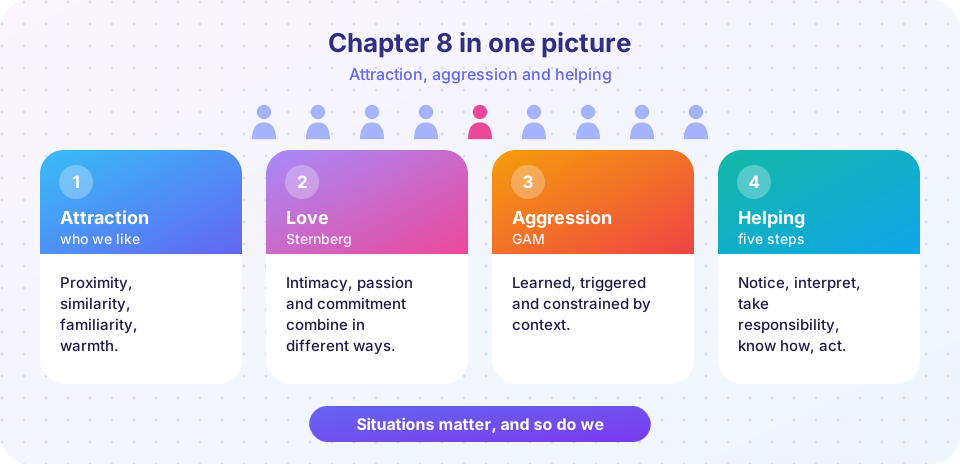
What you will learn
- A one-line anchor and caution for every topic in the chapter.
- How the same person-by-situation logic runs through all three topics.
Recap table
| Topic | Key idea | Anchor | Caution |
|---|---|---|---|
| Proximity | Closeness breeds friendship | Festinger, Schachter and Back (1950) | Opportunity, not destiny |
| Familiarity | Exposure raises liking | Zajonc (1968) | Too much can bore |
| Similarity | Alike attracts | Byrne; later perceived-similarity work | Perceived vs actual |
| Triangle of love | Intimacy, passion, commitment | Sternberg (1986) | Descriptive framework |
| Investment model | Satisfaction, alternatives, investment | Rusbult | Self-report limits |
| Aggression | Intended harm | Bandura et al. (1961); GAM | Media effects debated |
| Catharsis | Venting does not drain anger | Bushman (2002) | Lab settings |
| Bystander effect | Others present, less help | Darley and Latané (1968) | Real life shows more helping |
| Situation | Hurry cuts helping | Darley and Batson (1973) | Small sample, 1970s |
Common misconceptions
"Opposites attract." Similarity predicts more.
"Venting reduces anger." It tends to keep anger alive.
"Bystanders never help." Real-world data show frequent intervention.
Try it
Press Run (or Ctrl + Enter) to see the console output here.
No output.
Press Run (or Ctrl + Enter) to see the result here.
Program input · what you'd type while the program runs
Type the answers before you press Run, one per line. Each time the program reads a line (with input()), it gets the next line from this box.
Check your understanding
Quick check · 10 questions
of 10 answered You scored / 10 · perfect!
-
1. Friendship was most common between residents who were...
Proximity predicted friendship in Festinger et al.'s study. -
2. Which is NOT a component of Sternberg's triangle?
The components are intimacy, passion and commitment. -
3. Rusbult's investment model predicts commitment from...
Those three combine to predict commitment. -
4. In the Bobo doll study, children...
Observational learning of aggression. -
5. Which statement about venting is best supported?
Bushman's studies found more aggression after venting. -
6. In the GAM, 'inputs' include...
Person and situation both feed in. -
7. In the seizure study, which condition produced the most helping?
Reporting fell as perceived bystanders rose. -
8. Which step comes right after 'interpret as an emergency'?
Notice, interpret, take responsibility, know how, act. -
9. Hurry in the Good Samaritan study...
Only a small share of hurried students stopped. -
10. A reasonable view of real-world bystander behavior is that...
CCTV analyses found frequent intervention.
Summary
- Attraction grows from proximity, familiarity, similarity and responsiveness; commitment follows rewards, alternatives and investments.
- Aggression is learned, triggered and constrained; venting is not a cure.
- Helping needs five steps and is easily blocked by situations.
- In all three topics, the person and the situation work together.
Track your progress
Create a free account to tick off lessons and pick up where you left off on any device.
of Social Psychology lessons completed