


















Lesson 3 of 46 · Getting Started
Research Methods: How We Find Out
Learn observation, surveys, correlation and experiments, plus random assignment, variables, validity and bias, with a runnable correlation explorer.
A friend says, "People who use social media a lot are lonelier." Another says, "No, lonely people just use it more." A third says, "It depends on how you use it." Who is right? You cannot decide by arguing. You need evidence, and the quality of evidence depends on how it was collected.
This lesson walks through the toolkit of social psychology: from watching people to running experiments. It also introduces the vocabulary you will need to read any study without being fooled.
What you will learn
- The four main designs and what each can show.
- Why correlation does not equal causation.
- What random assignment is and why it matters.
- Independent and dependent variables, operational definitions and validity.
- Common biases that creep into studies.
Key terms
Independent variable (IV) is what the researcher changes or compares. Dependent variable (DV) is what is measured as the outcome. Random assignment puts participants into conditions by chance. Correlation coefficient (r) is a number from -1 to +1 describing how two measures move together. Operational definition states exactly how an abstract idea will be measured. Confound is an extra factor that varies with the IV and could explain the result.
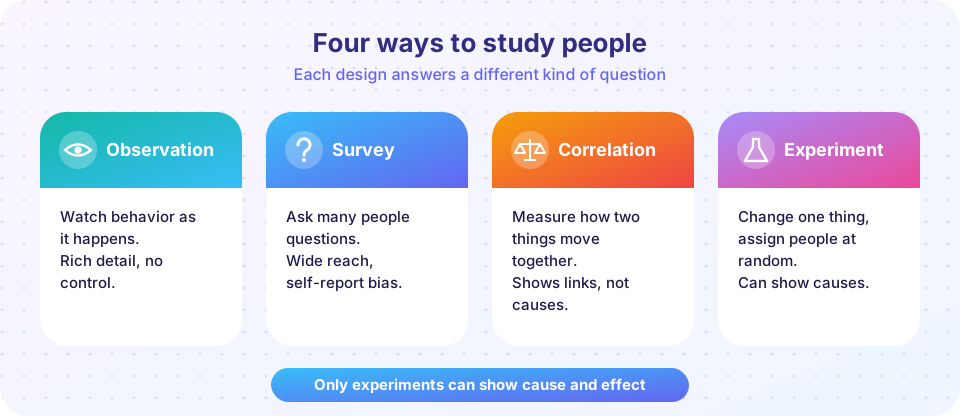
Four designs
Observation
Researchers watch behavior, in public places or in a lab. In a field study, an observer might count how many people hold a door for the person behind them. Observation shows what people do rather than what they say, but it gives little control, and observers can be biased. People also change behavior when they know they are watched (reactivity).
Surveys and self-report
Questionnaires reach many people cheaply. A common tool is the Likert scale, where respondents rate statements from "strongly disagree" to "strongly agree." Surveys depend on honesty and memory. People may give socially desirable answers, and they often do not know why they act as they do (Nisbett and Wilson, 1977). Wording matters too: asking "How fast was the car going when it smashed into the other?" gives higher estimates than "hit," as Loftus and Palmer found in 1974 for memory research.
Correlational studies
A correlational study measures two things and checks whether they go together. The coefficient r runs from -1 (perfect opposite movement) through 0 (no link) to +1 (perfect same movement). Ice cream sales and drownings are positively correlated, but ice cream does not cause drowning: a third variable, hot weather, drives both. This is the third-variable problem. There is also the directionality problem: does A cause B, or B cause A? Do lonely people use social media more, or does social media make people lonelier?
Experiments
An experiment manipulates an independent variable and measures a dependent variable, while participants are randomly assigned to conditions. Random assignment means that, on average, groups are alike in everything else: age, mood, personality. So a difference in the outcome can be attributed to the manipulation. Without random assignment (a quasi-experiment) you cannot be sure.
A classic example: in a field experiment, one person asks to cut in line at a copy machine either with no reason, with a real reason ("because I'm in a rush") or with a meaningless reason ("because I have to make copies"), as in Langer, Blank and Chanowitz (1978). The IV is the type of reason; the DV is compliance. Participants were assigned to conditions by chance.
Random assignment is not random sampling
These two phrases are often mixed up.
| Idea | What it does | What it protects |
|---|---|---|
| Random sampling | Picks participants from a population by chance | External validity: results generalize |
| Random assignment | Places participants into conditions by chance | Internal validity: causes can be inferred |
Most social psychology uses convenient samples (such as students) but random assignment.
Validity and reliability
Reliability means consistency: a good bathroom scale gives the same weight twice. Validity means accuracy: does the measure capture what it claims to? Internal validity asks whether the study really shows cause and effect within its setting. External validity asks whether the result extends to other people and places. Construct validity asks whether the manipulation and measure match the idea. For example, a stranger's frown in a lab is a limited stand-in for real social rejection.
Biases to watch for
- Demand characteristics: participants guess the hypothesis and act accordingly.
- Experimenter bias: the researcher's expectations leak into results. A double-blind design hides conditions from both participants and experimenters.
- Cover stories: researchers sometimes mislead participants about the purpose so that behavior stays natural. This is deception, which has ethical rules (see the next lesson).
- Publication bias: results that are not significant are less likely to be published, which distorts the record.
Statistics in two minutes
A difference between conditions is statistically significant if it is unlikely to have arisen by chance alone, usually defined as a p-value below 0.05. But a significant result can be tiny. That is why researchers report effect size, a measure of how big the difference is. A common one is Cohen's d: roughly, 0.2 is small, 0.5 medium and 0.8 large, but these are only rules of thumb. And a small sample makes any estimate noisy.
Common misconceptions
"A strong correlation proves a cause." It never does by itself. Always ask about third variables and direction.
"A significant result is an important result." Significance is about chance; importance is about effect size and context.
"Experiments are always better." They answer cause-and-effect questions, but some topics cannot be manipulated ethically, so careful correlational and longitudinal work is essential.
Try it
Experiment with correlation, then simulate random assignment. Both are demonstrations with generated data.
Press Run (or Ctrl + Enter) to see the result here.
Program input · what you'd type while the program runs
Type the answers before you press Run, one per line. Each time the program reads a line (with input()), it gets the next line from this box.
Press Run (or Ctrl + Enter) to see the result here.
Program input · what you'd type while the program runs
Type the answers before you press Run, one per line. Each time the program reads a line (with input()), it gets the next line from this box.
Check your understanding
Quick check · 5 questions
of 5 answered You scored / 5 · perfect!
-
1. Which design can best support a claim of cause and effect?
Random assignment makes the groups equivalent on average, so the manipulated variable can be credited with the difference. -
2. A study finds that people who sleep less have higher stress. Which is a third-variable explanation?
A third variable (the job) could produce both. -
3. What does random assignment protect?
It makes groups comparable, supporting causal inference within the study. -
4. An independent variable is...
The IV is what the researcher changes; the DV is what is measured. -
5. A correlation of r = -0.6 means...
A negative correlation means the measures move in opposite directions; it says nothing about cause.
Summary
- Observation, surveys, correlation and experiments answer different questions.
- Correlation shows links; third variables and direction prevent causal claims.
- Random assignment, not random sampling, supports causal conclusions.
- Reliability, validity and bias determine whether a measure can be trusted.
- Look at effect size, not only significance.
Track your progress
Create a free account to tick off lessons and pick up where you left off on any device.
of Social Psychology lessons completed