


















Lesson 10 of 46 · The Social Self
Chapter 2 Review: The Social Self
Review self-concept, self-esteem, social comparison, social identity, impression management and self-perception, with a recap table and a ten-question mixed quiz.
You now have a toolkit for thinking about the self as a social product. Before moving on to social cognition, recall the main ideas without looking: Who built the looking-glass self idea? What did Festinger say? What is the spotlight effect? Then check yourself with the picture, the table and the quiz.
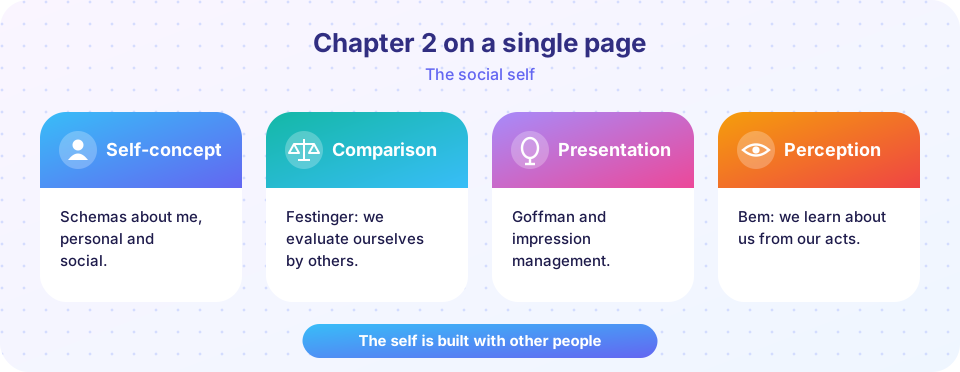
What you will review
- Self-concept, self-esteem and cultural views of self.
- Comparison and social identity.
- Self-presentation and self-perception.
Recap table
| Lesson | Key ideas | Names and studies |
|---|---|---|
| Self-concept and esteem | Self-schemas, independent versus interdependent self, sociometer | Markus, Kitayama, Leary, Baumeister |
| Comparison and identity | Upward and downward comparison, social identity | Festinger, Tajfel, Cialdini |
| Presentation and perception | Impression management, self-monitoring, overjustification, spotlight | Goffman, Snyder, Bem, Gilovich |
Common misconceptions
"High self-esteem always leads to success." Evidence shows weak causal effects.
"The self is a fixed core." It is multifaceted and context-sensitive, though it shows continuity.
"Everyone notices my flaws." The spotlight effect shows otherwise.
Try it
Check your recall with a short matching game, then sketch your own comparison profile.
Press Run (or Ctrl + Enter) to see the console output here.
No output.
Check your understanding
Quick check · 10 questions
of 10 answered You scored / 10 · perfect!
-
1. Cooley's looking-glass self says our self-image comes from...
We imagine how others see us and incorporate it. -
2. Which term refers to the overall evaluation of oneself?
Self-esteem is evaluation; self-concept is belief. -
3. An interdependent self emphasizes...
It is a self-view built around connections. -
4. Festinger said we prefer to compare with...
Similar others give the most informative comparisons. -
5. Downward comparison often...
Feeling better than someone worse off can soothe. -
6. The minimal group paradigm showed in-group favoritism based on...
Even trivial groups caused favoritism. -
7. A high self-monitor tends to...
High self-monitors adapt to social cues. -
8. The spotlight effect is overestimating...
We think we are noticed more than we are. -
9. The overjustification effect can occur when...
Expected rewards for an enjoyed activity can reduce intrinsic interest. -
10. Baumeister and colleagues concluded that boosting self-esteem...
Esteem is mostly a result of success, not a major cause.
Summary
- The self-concept (what I believe) and self-esteem (how I feel) are different and both social.
- We compare, usually with similar others; direction and target shape feelings.
- Social identity gives groups a place in the self and fuels in-group favoritism.
- We manage impressions and infer our attitudes from behavior.
- People notice us less than we think.
Track your progress
Create a free account to tick off lessons and pick up where you left off on any device.
of Social Psychology lessons completed