


















Lesson 20 of 46 · Persuasion and Influence
Chapter 4 Review: Persuasion and Influence
Review source, message and audience, the elaboration likelihood model, compliance techniques, Cialdini's principles and resistance, with a recap and ten-question quiz.
Chapter 4 covered how attitudes and behavior are changed by communication and requests, and how we defend ourselves. Before you move on to the next slice of the course, recall the main ideas: What are the two routes of the ELM? Which compliance technique starts with a huge request? How does inoculation work? Then use the picture, table and quiz.
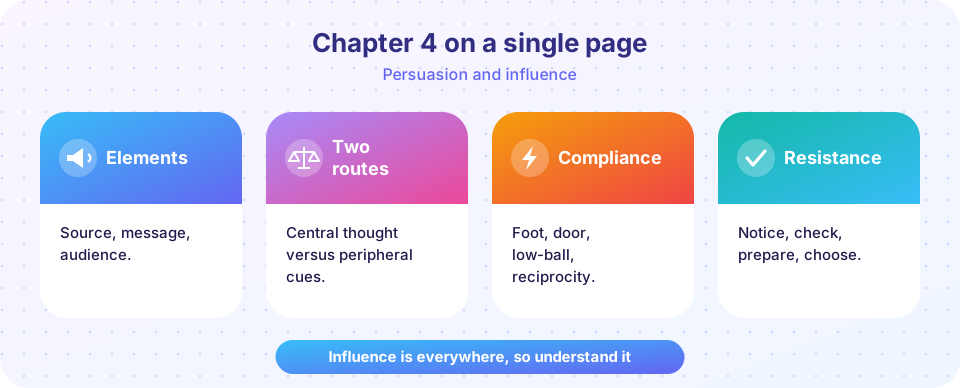
What you will review
- The source-message-audience framework.
- The central and peripheral routes.
- Compliance techniques and Cialdini's principles.
- Reactance, inoculation and resistance skills.
Recap table
| Lesson | Key ideas | Names |
|---|---|---|
| Overview | Source, message, audience; fear appeals | Hovland, Leventhal |
| Routes to persuasion | ELM, central and peripheral routes, need for cognition | Petty, Cacioppo, Chaiken |
| Compliance techniques | Foot in the door, door in the face, low-ball, six principles | Freedman, Fraser, Cialdini |
| Resisting influence | Reactance, forewarning, inoculation, prebunking | Brehm, McGuire, van der Linden |
Common misconceptions
"Persuasion tricks always work." They are tendencies with modest average effects.
"The peripheral route is stupid." Cues are useful shortcuts when time is limited.
"Being persuaded means being weak." Updating beliefs on good evidence is a strength.
Try it
Practice recognizing techniques, then plan a respectful persuasive message.
Press Run (or Ctrl + Enter) to see the console output here.
No output.
Check your understanding
Quick check · 10 questions
of 10 answered You scored / 10 · perfect!
-
1. The Yale approach analyses persuasion by...
Who says what to whom. -
2. The ELM central route requires...
It is high-elaboration processing. -
3. Attitudes formed by the peripheral route tend to be...
Cue-based change tends to fade. -
4. In foot-in-the-door, the first request is...
Agreeing to a small request raises compliance with a large one. -
5. Door-in-the-face relies on...
The smaller request appears as a concession, aided by reciprocity. -
6. Which principle is 'Only 3 left'?
Limited availability increases desire. -
7. Social proof means...
We use others' behavior as guidance. -
8. Reactance is triggered by...
Controlling messages can provoke opposite reactions. -
9. Inoculation builds resistance by...
Threat plus refutational preemption. -
10. A fear appeal is most effective when it also provides...
Efficacy information helps people act.
Summary
- Persuasion depends on source, message, audience and channel.
- Motivated, able audiences follow the central route; others rely on cues.
- Compliance tactics use the order and framing of requests, supported by reciprocity, commitment, social proof, liking, authority and scarcity.
- Reactance, forewarning and inoculation explain and build resistance.
Track your progress
Create a free account to tick off lessons and pick up where you left off on any device.
of Social Psychology lessons completed