


















Lesson 28 of 46 · Group Behavior
Groupthink and Group Polarization
How cohesive groups make poor decisions, how discussion pushes opinions to extremes, what the evidence says, and practical ways to make group decisions better.
Groups are supposed to make better decisions than individuals. More information, more viewpoints, more checks on mistakes. Sometimes that works. But history has plenty of cases where a smart, well-meaning team made a poor choice, and research on discussions shows that groups can end up more extreme than any member started out. Two ideas help explain these problems: groupthink and group polarization.
What you will learn
- Janis's groupthink model: conditions, symptoms and outcomes.
- The evidence for and against it.
- Group polarization: what it is, classic studies, and two explanations.
- Why groups often miss unshared information.
- Concrete practices that improve group decisions.
Key terms
Groupthink: a style of thinking in tightly knit groups where the drive for agreement overrides realistic appraisal of alternatives.
Self-censorship: keeping doubts to yourself so as not to upset the group.
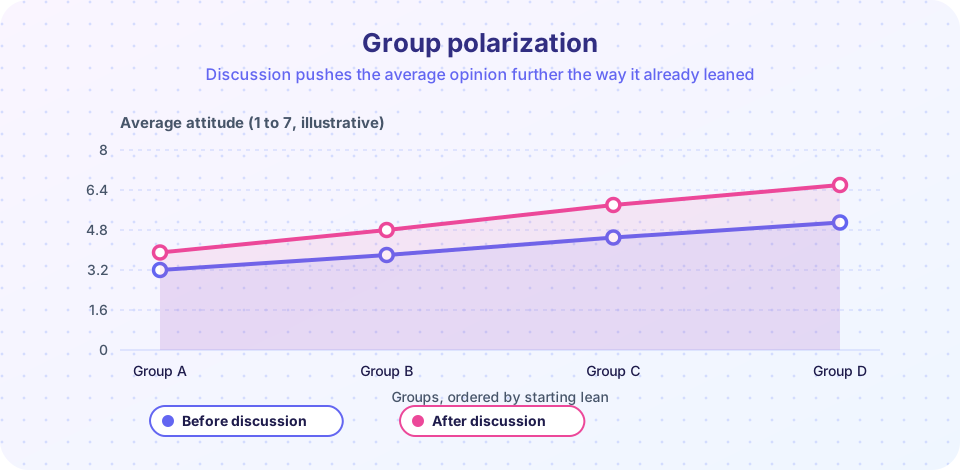
Group polarization: the tendency for group discussion to strengthen the average initial leaning of members.
Hidden profile: a decision problem where the key information is spread across members, so it is only found if people share it.
Groupthink
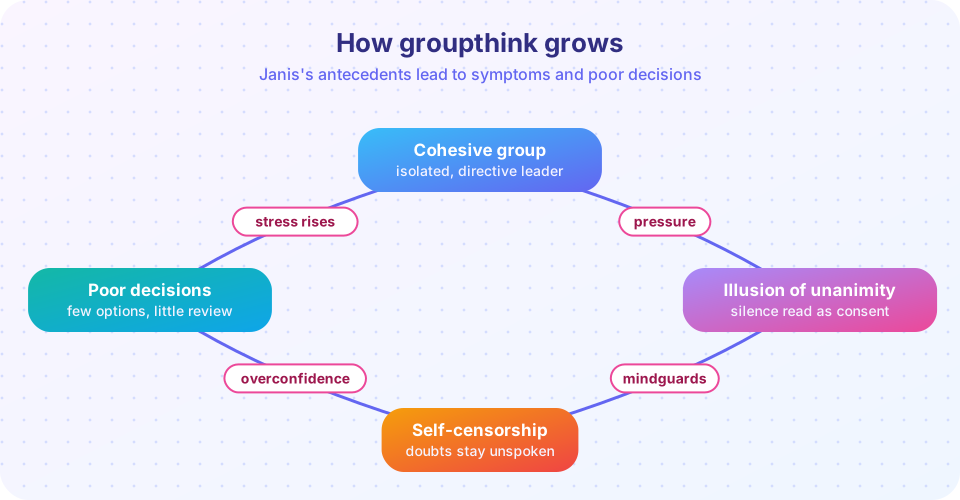
Irving Janis, in Victims of Groupthink (1972), studied several policy failures, including the 1961 Bay of Pigs invasion of Cuba, which was approved by a capable team around President Kennedy. Janis argued that the group's closeness and shared desire for unity led members to suppress doubts.
He listed conditions that make groupthink more likely: a cohesive group, insulation from outside opinions, a directive leader who signals a preferred option, lack of systematic procedures for weighing alternatives, and high stress with little hope of a better solution.
Symptoms fall into three families:
- Overestimating the group: illusion of invulnerability, and unquestioned belief in the group's morality.
- Closed-mindedness: collective rationalization of warnings, and stereotypes of outsiders.
- Pressure toward uniformity: self-censorship, an illusion of unanimity (silence is read as agreement), direct pressure on dissenters, and self-appointed "mindguards" who shield the leader from bad news.
Outcomes: few options considered, goals and risks not fully examined, information searched selectively, and no contingency plans.
Janis also looked at a counter-example: during the 1962 Cuban Missile Crisis Kennedy changed how his team worked, encouraging criticism, splitting into subgroups, and inviting outsiders. The outcome was better.
How strong is the evidence?
Groupthink is influential, but the evidence is uneven. Most support comes from case studies, which can be chosen after the fact, and reviews of experimental work (for example by James Esser in 1998) found mixed support: cohesion alone did not reliably cause poor decisions, while directive leadership and lack of procedures looked more important. Treat groupthink as a useful warning list rather than a proven law. Disasters such as the 1986 Challenger shuttle loss have also been analyzed with other lenses, such as organizational culture and the gradual acceptance of risk.
Group polarization
In the 1960s James Stoner found that groups seemed to choose riskier options than individuals did, which was called the "risky shift". Later research showed the pattern is broader: the group's decision tends to move further in the direction in which members were already leaning. If members start cautious, groups can become more cautious; if members start in favor, groups become more in favor. Serge Moscovici and Marisa Zavalloni (1969) found French students who were mildly positive about a national figure and mildly negative about another became more extreme after discussion. In a study by David Myers and George Bishop (1970), high school students with moderately prejudiced attitudes became more prejudiced after talking with like-minded peers, while those with low prejudice became less prejudiced after talking.
Two main explanations:
- Persuasive arguments: in a group of people leaning the same way, most arguments heard support that side, and some are new to each member. Hearing them strengthens the view.
- Social comparison: people want to be seen as at least as committed as the group norm, so they shift a little beyond the average.
Both can operate at once. Polarization matters for juries, committees, online communities and political groups, and it is a reason to worry about echo chambers where everyone already agrees.
Why groups miss information
Garold Stasser and William Titus (1985) set up "hidden profile" decision tasks, where the best option could only be identified if members shared the unique pieces of information they each held. Groups tended to discuss the information everyone already had and mention unique facts less often, so they often missed the best choice. More talk does not guarantee more information.
Making group decisions better
- Leaders should withhold their preference until others speak.
- Collect opinions individually (in writing, anonymously) before discussion.
- Assign a devil's advocate or a red team to argue against the plan.
- Break into subgroups, then compare.
- Bring in outside experts and invite criticism.
- Hold a "second chance" meeting after the first decision.
- Ask explicitly for information only one person holds.
- Use structured methods such as the Delphi technique (rounds of anonymous estimates and feedback).
The "wisdom of crowds" works when members are independent and diverse. Francis Galton in 1907 noticed that the average of many visitors' guesses of an ox's weight at a fair was very close to the real value. If people hear each other first and anchor, that independence is lost.
Common misconceptions
"Groupthink means a group of fools." Janis studied capable groups. Smart groups can fail because of the pressures between members.
"Polarization means moving to the extreme from the middle." It strengthens the initial lean; it does not take everyone to the extreme.
"More discussion always improves decisions." Unstructured discussion often repeats shared information.
Try it
Press Run (or Ctrl + Enter) to see the result here.
Program input · what you'd type while the program runs
Type the answers before you press Run, one per line. Each time the program reads a line (with input()), it gets the next line from this box.
Press Run (or Ctrl + Enter) to see the console output here.
No output.
Check your understanding
Quick check · 5 questions
of 5 answered You scored / 5 · perfect!
-
1. Which is a symptom of groupthink?
Silence is taken as agreement and doubts go unspoken. -
2. Group polarization means that discussion tends to...
The average initial lean tends to be amplified after discussion. -
3. Which action best reduces groupthink?
Independent opinions avoid early anchoring. -
4. Stasser and Titus found that groups often...
Shared facts are mentioned more, so unique facts get lost. -
5. A fair assessment of the groupthink evidence is that it is...
It is a useful warning list rather than an established law.
Summary
- Groupthink: cohesion, a directive leader and pressure to agree can suppress doubts and lower decision quality.
- The evidence is mixed, so treat the model as a checklist.
- Polarization: discussion amplifies the average initial lean through new arguments and social comparison.
- Better decisions come from independent input, devil's advocates, outside views and structured procedures.
Track your progress
Create a free account to tick off lessons and pick up where you left off on any device.
of Social Psychology lessons completed