


















Lesson 7 of 46 · The Social Self
Self-Concept and Self-Esteem
How the self-concept forms, how self-schemas guide attention, how cultures shape the self, and what research says about self-esteem, narcissism and self-compassion.
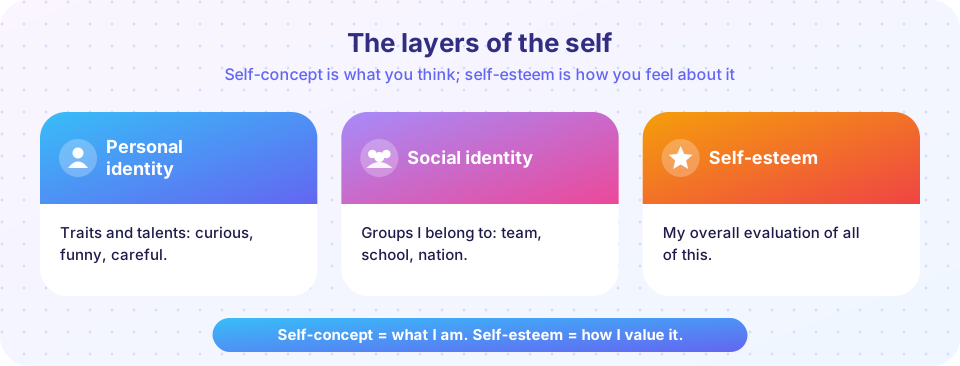
Two students receive the same exam grade, a B. One thinks, "I am a bright person who had a bad day." The other thinks, "I am just not smart." The grade is identical, but what it means for each depends on their self-concept and on how they feel about it: their self-esteem. These two ideas are close relatives, but they are not the same thing, and the difference explains a lot of everyday behavior.
This lesson explains how a self-concept is built, how it steers our attention and memory, why cultures describe the self differently, and what research really says about self-esteem, a topic where popular beliefs and evidence often disagree.
What you will learn
- The difference between self-concept and self-esteem.
- How self-schemas shape attention and memory.
- The independent and interdependent self across cultures.
- Where self-esteem comes from, and the sociometer idea.
- Why raising self-esteem is not a cure-all.
Key terms
Self-schema is a mental structure of beliefs about a trait that is important to you (Hazel Markus, 1977). Independent self is a self-view that stresses uniqueness and personal traits. Interdependent self is a self-view that stresses relationships and roles. Contingencies of self-worth are the domains a person's esteem depends on (Jennifer Crocker). Sociometer is Mark Leary's idea that self-esteem tracks how accepted we feel. Narcissism is an inflated, fragile self-view needing admiration.
How the self-concept forms
A self-concept grows from several sources.
- Other people's reactions. Charles Cooley's looking-glass self (1902) and George Herbert Mead's ideas about taking the "role of the other" say we learn who we are from feedback.
- Comparison. We judge ourselves against others (next lesson).
- Our own behavior. We infer traits from what we do (Bem, covered later).
- Roles and groups. Being a "captain" or a "refugee" or a "daughter" tells us who we are and what is expected.
- Culture and stories. The narratives we tell about our lives give them coherence.
Self-schemas
Markus (1977) found that people who consider themselves independent, for example, answer questions about independence faster and remember related events better than people who do not. A self-schema is like a lens that picks out relevant information. If "athlete" is central to your self-concept, you will notice sports news, remember training sessions and care strongly about a lost match.
Multiple selves and possible selves
We are not one fixed self. Markus and Nurius (1986) described possible selves: images of who we hope or fear to become. A teenager imagining a future as a doctor may study harder. E. Tory Higgins's self-discrepancy theory (1987) says we compare the actual self with an ideal self (hopes) and an ought self (duties). A gap with the ideal tends to bring sadness; a gap with the ought self tends to bring anxiety.
Culture and the self
Markus and Kitayama (1991) contrasted two broad styles. In many Western settings, an independent self is common: people describe themselves by traits ("I am creative"), value uniqueness and express personal preferences. In many East Asian and other collectivist settings, an interdependent self is common: people describe themselves through relationships and roles ("I am my parents' child, a team member") and value harmony. These are tendencies, not rules. Individuals vary within every culture, and the contrast is a continuum with considerable debate about its size.
Self-esteem: where it comes from
Morris Rosenberg's 10-item scale (1965) is a widely used measure: statements such as "On the whole, I am satisfied with myself" rated from strongly agree to strongly disagree. Here are the main ideas about what drives it.
- Sociometer theory (Leary and colleagues, 1995): self-esteem works like a gauge of how valued we are by others. A drop in esteem signals social risk, motivating us to repair relationships.
- Contingencies of self-worth (Crocker and Wolfe, 2001): people base esteem on different domains (appearance, academics, approval from others, virtue). Esteem tied heavily to one domain, such as grades, rises and falls with it.
- Stable versus fragile esteem: High but unstable or defensive esteem is linked to anger when criticized; secure esteem is calmer.
Is high self-esteem good for you?
For decades, schools and parents tried to raise self-esteem, assuming it would improve grades and behavior. In 2003 Roy Baumeister and colleagues reviewed the evidence and concluded that high self-esteem is associated with feeling good and with initiative, but does not cause better academic performance, and that efforts to boost it directly have limited results. Performance tends to raise esteem more than the other way around. A related idea, self-compassion (Kristin Neff), means treating yourself kindly when you fail, and has been linked to resilience without the downsides of inflated self-views. Research here is still developing, so treat effect claims cautiously.
Narcissism
Narcissism involves grandiosity, entitlement and a need for admiration. It is not the same as healthy self-esteem. Researchers distinguish grandiose and vulnerable forms; scores on questionnaires are not diagnoses, and the label should never be used loosely.
Positive illusions
Most people rate themselves as above average on desirable traits, which is statistically impossible for everyone: this is the better-than-average effect. Shelley Taylor and Jonathon Brown (1988) argued that mildly positive illusions can be adaptive. The tension is that very inflated views can lead to poor decisions.
Common misconceptions
"Self-esteem and self-concept are the same." One is what you believe about yourself; the other is how you feel about it.
"Raising self-esteem will fix grades or bad behavior." Evidence shows weak causal effects; better performance often raises esteem.
"East Asian people have no individuality." The independent-interdependent difference is a tendency, and individuals vary widely.
Try it
Explore a Rosenberg-style scorer with different items (not the original), then see how a self-schema speeds up decisions. Both are classroom demonstrations.
Press Run (or Ctrl + Enter) to see the result here.
Program input · what you'd type while the program runs
Type the answers before you press Run, one per line. Each time the program reads a line (with input()), it gets the next line from this box.
Check your understanding
Quick check · 5 questions
of 5 answered You scored / 5 · perfect!
-
1. What is a self-schema?
Self-schemas guide attention, memory and judgments about oneself. -
2. Which contrast is described by Markus and Kitayama (1991)?
They contrasted self-views emphasizing uniqueness with those emphasizing relationships. -
3. According to sociometer theory, self-esteem is...
Leary proposed it tracks social acceptance. -
4. What did Baumeister and colleagues (2003) conclude?
Esteem correlates with feeling good but is not a strong cause of achievement. -
5. The better-than-average effect means...
It is a common self-enhancing bias.
Summary
- Self-concept is what we believe about ourselves; self-esteem is how we evaluate ourselves.
- Self-schemas direct attention and memory; possible selves guide goals.
- Cultural styles of self range from independent to interdependent, as tendencies.
- Self-esteem tracks acceptance and depends on valued domains; boosting it directly has limited effects.
- Self-compassion and secure esteem are healthier than inflated esteem.
Track your progress
Create a free account to tick off lessons and pick up where you left off on any device.
of Social Psychology lessons completed