


















Lesson 22 of 46 · Conformity and Obedience
Asch and the Conformity Experiments
How Solomon Asch tested peer pressure with a simple line task, what he found, which factors raise or lower conformity, and what later research adds.
In the early 1950s the psychologist Solomon Asch wanted to test a bold idea. Many people thought conformity only happens when a task is vague or confusing, so that following others is reasonable. Asch designed a situation where the correct answer was obvious, then asked: will people still follow a wrong majority? His answer shaped how we talk about peer pressure to this day.
This lesson walks through the design, the numbers, the factors that raise or lower conformity, and the honest caveats.
What you will learn
- How the line-judgment task worked and why confederates were used.
- The headline results and how to read them correctly.
- What increases or decreases conformity.
- Later criticism and cultural differences.
Key terms
Confederate: a person who secretly works with the researcher and acts according to a script.
Critical trial: a trial where the confederates deliberately give a wrong answer.
Control group: people who do the same task without any group pressure.
Unanimity: everyone in the majority gives the same answer.
The design
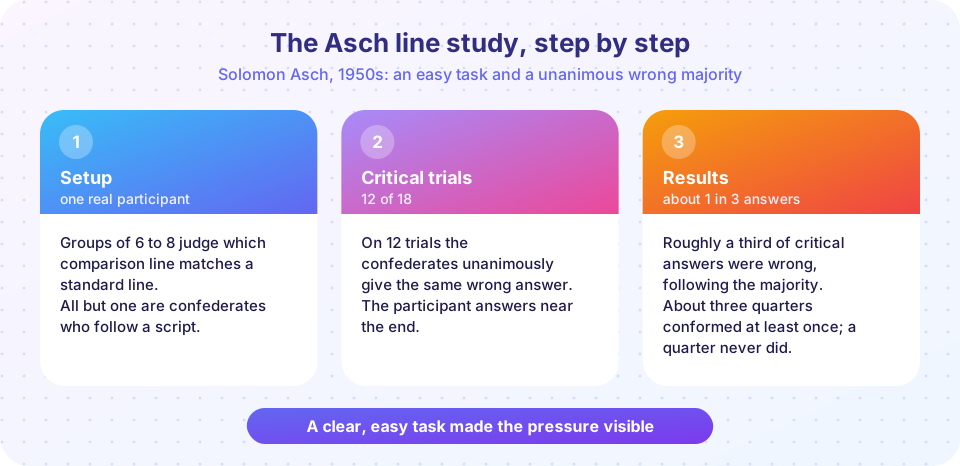
A participant arrived at what they thought was a study of visual perception. Seated with six to eight others, they were shown a standard line on one card and three comparison lines on another. The job was to say aloud which comparison line matched the standard. The differences were large, so the task was easy.
The other people in the room were confederates. For the first couple of trials they answered correctly. On 12 of the 18 trials (the critical trials) they all gave the same wrong answer, one after another, and the real participant answered near the end. Imagine hearing five people confidently say line 1 when you can see that line 2 is the match. That tension is what Asch wanted to study.
The results
Asch's group had a control condition too: people answered the same questions alone or in writing. Errors there were very rare, less than 1 percent. So the task really was easy.
In the main condition the pattern changed:
- Across critical trials, roughly one third of answers (about 37 percent) went with the wrong majority.
- About three quarters of participants conformed at least once.
- About a quarter never conformed on any critical trial.
- Most individual people gave a mix of independent and conforming answers.
Read these carefully. They do not say that most people always go along. They say that a large share of people go along some of the time on a trivial task, even with no reward or punishment for being right.
What changes conformity
Asch ran many variations. The patterns below are among the best known. The chart shows illustrative values that match the direction of the findings, not exact percentages for each condition.
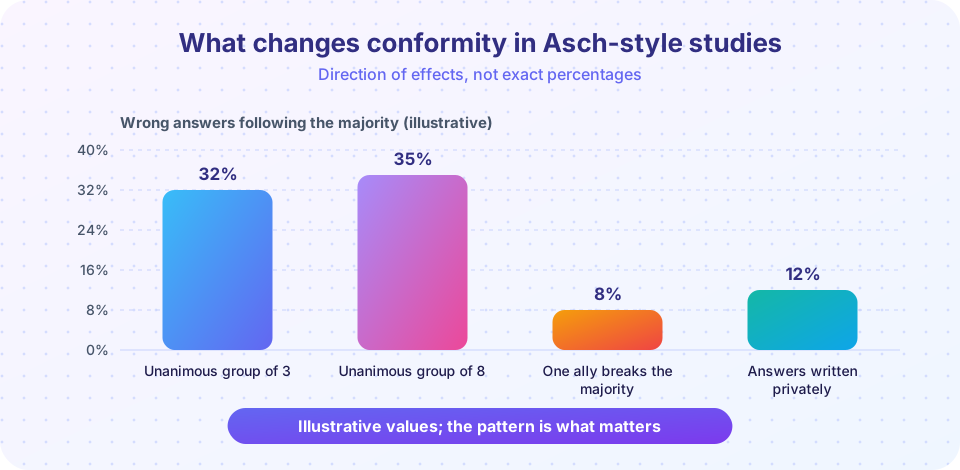
- Group size. Conformity rose as the majority grew from one to about three, then leveled off. One confederate had little effect; three had a clear effect; more than that added little.
- Unanimity. This was the most important. When just one confederate broke from the majority, whether by giving the correct answer or even a different wrong one, conformity fell sharply. One ally makes it much easier to speak.
- Privacy. When answers were written rather than spoken aloud, conformity dropped a lot. Public pressure matters.
- Task difficulty and ambiguity. When lines were harder to compare, conformity rose, because others' answers became useful evidence. This links to the next lesson on informational and normative influence.
Why did people conform?
After the study Asch interviewed participants. Some said they believed the majority was right and doubted their own eyes. Others said they saw the lines correctly but did not want to look foolish or break the group. This hints at two different mechanisms, which later researchers named informational and normative influence.
Criticism and limits
Good science is open about weaknesses. Here are the main ones:
- A historical and cultural snapshot. The studies used American college men in the 1950s. Later reviews of many studies found that conformity in this task has varied across time and culture, with generally higher levels in collectivist societies than in individualist ones, and some evidence of lower levels in later decades in the US. The differences are not huge, and methods varied between studies, so treat them as tendencies.
- Low stakes. A line judgment is a toy task. Real-life conformity can involve far higher stakes in either direction.
- Deception. Participants were misled about the nature of the study, which raises ethical questions that modern review boards would examine.
- Independence is also real. The fact that most answers were correct and a quarter of participants never conformed matters as much as the conformity.
Common misconceptions
"Asch showed that most people follow the crowd all the time." Most answers were correct. About a third of critical answers followed the majority.
"Conformity always means weakness." Following others can be wise when they know more than you, and it keeps social life coordinated.
Try it
Press Run (or Ctrl + Enter) to see the result here.
Program input · what you'd type while the program runs
Type the answers before you press Run, one per line. Each time the program reads a line (with input()), it gets the next line from this box.
Check your understanding
Quick check · 4 questions
of 4 answered You scored / 4 · perfect!
-
1. In the Asch study, what did confederates do on critical trials?
On critical trials the confederates unanimously gave the same wrong answer. -
2. Roughly what share of critical answers followed the wrong majority?
Around 37 percent of critical answers conformed. Less than 1 percent in the control group were wrong. -
3. Which change reduced conformity the most?
A single ally broke the unanimity and sharply reduced conformity. -
4. Which is a valid criticism of the original Asch studies?
The task was low stakes and the sample was American college men in the 1950s.
Summary
- Asch showed that people sometimes follow a wrong unanimous majority even on an easy task.
- About a third of critical answers conformed; about a quarter of people never did.
- One ally, or answering privately, reduces conformity.
- Results vary by culture and era, so treat them as patterns, not laws.
Track your progress
Create a free account to tick off lessons and pick up where you left off on any device.
of Social Psychology lessons completed