


















Lesson 17 of 44 · Measure Words and Questions
Yes/no questions: 吗, V不V, 吧, 呢 and 还是
Learn the five ways to ask yes/no and choice questions in Mandarin: 吗, verb-not-verb, 吧, 呢 and 还是, how to answer them, and when to use each.
In English, forming a question often means rearranging words: "You are a student" becomes "Are you a student?" Mandarin leaves the word order alone. A statement becomes a question when you add a small word at the end, repeat the verb with a negative, or offer two choices. This makes Mandarin questions easy to build, and it means you can turn almost any sentence you already know into a question right now.
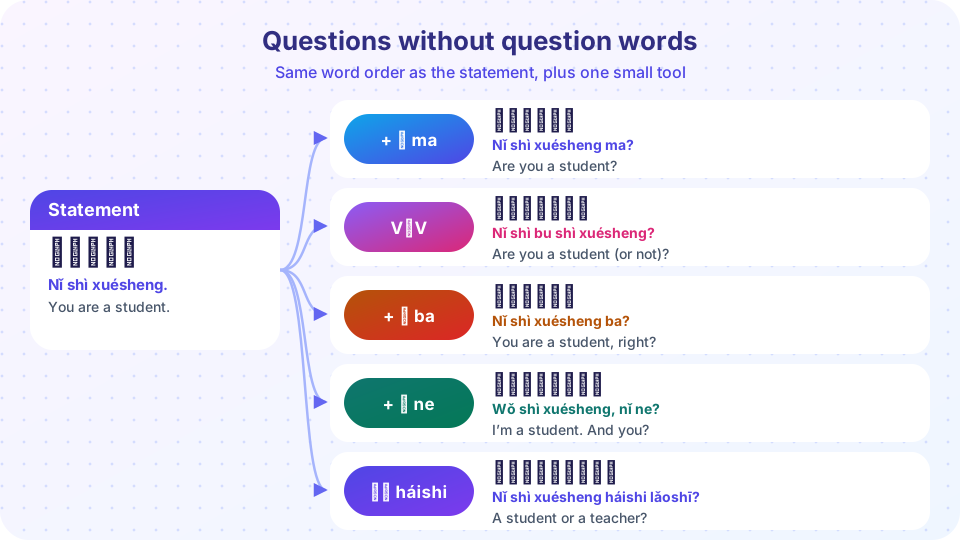
What you will learn
- how to ask with 吗 and when not to use it
- the verb-not-verb pattern (是不是, 有没有, 好不好)
- the suggestion and guess particle 吧 and the follow-up particle 呢
- how to ask a choice question with 还是
- how to answer: Mandarin has no single word for yes or no
Key terms
吗 (ma) is the question particle for yes/no questions.
V不V is the affirmative-negative question: 是不是, 好不好.
吧 (ba) softens a statement into a suggestion or a guess.
呢 (ne) asks a follow-up: "and you?", "what about...?", "where is...?".
还是 (háishi) means "or" in a choice question.
Tool 1: add 吗
The simplest tool. Put 吗 (ma, always neutral tone) at the end of a statement.
| Statement | Question |
|---|---|
| 你是学生。Nǐ shì xuésheng. | 你是学生吗?Nǐ shì xuésheng ma? Are you a student? |
| 你有手机。Nǐ yǒu shǒujī. | 你有手机吗?Nǐ yǒu shǒujī ma? Do you have a phone? |
| 她很忙。Tā hěn máng. | 她很忙吗?Tā hěn máng ma? Is she busy? |
| 你喜欢茶。Nǐ xǐhuan chá. | 你喜欢茶吗?Nǐ xǐhuan chá ma? Do you like tea? |
吗 asks a plain yes/no question and implies nothing about the answer. Do not add 吗 to a question that already has a question word (谁, 什么, 哪儿...) or to a V不V question. "你是什么人吗?" is wrong; say 你是什么人? (nǐ shì shénme rén?).
Tool 2: the verb-not-verb (V不V) pattern
You can also ask by stating the verb in its positive and negative forms next to each other. It sounds a little more direct and is very common in speech.
| Chinese | Pinyin | English |
|---|---|---|
| 你是不是学生? | Nǐ shì bu shì xuésheng? | Are you a student (or not)? |
| 你有没有手机? | Nǐ yǒu méi yǒu shǒujī? | Do you have a phone (or not)? |
| 她忙不忙? | Tā máng bu máng? | Is she busy? |
| 好不好? | Hǎo bu hǎo? | OK? Is that good? |
| 你去不去学校? | Nǐ qù bu qù xuéxiào? | Are you going to school? |
Notes:
- The middle 不 is said in the neutral tone (bu), so there is no tone change: shì bu shì, not shì bú shì.
- For 有, the negative is 没, not 不: 有没有, never "有不有".
- With two-syllable verbs, speakers often shorten the first part: 喜不喜欢 (xǐ bu xǐhuan), though the full 喜欢不喜欢 is also correct.
- Never combine V不V with 吗.
Tool 3: 吧 for suggestions and guesses
吧 (ba, neutral tone) has two jobs.
- A suggestion or soft command. 我们走吧。 (Wǒmen zǒu ba. Let's go.) 你喝茶吧。 (Nǐ hē chá ba. Have some tea.)
- A guess you expect to be confirmed. 你是学生吧? (Nǐ shì xuésheng ba? You're a student, right?) 她很忙吧? (Tā hěn máng ba? She's busy, isn't she?)
Compare: 你是学生吗? is a neutral question. 你是学生吧? shows that you think the answer is "yes".
Tool 4: 呢 for "and you?" and "where?"
呢 (ne, neutral tone) asks a follow-up question that carries over the subject of the previous sentence.
| Chinese | Pinyin | English |
|---|---|---|
| 我很好。你呢? | Wǒ hěn hǎo. Nǐ ne? | I'm fine. And you? |
| 我是学生。你呢? | Wǒ shì xuésheng. Nǐ ne? | I'm a student. And you? |
| 我喝茶。她呢? | Wǒ hē chá. Tā ne? | I drink tea. And she? |
| 我的书呢? | Wǒ de shū ne? | Where is my book? |
The last row shows a second use: after a noun alone, 呢 asks "where is it?" It is a short, friendly way to ask about something missing.
Tool 5: 还是 for choices
To offer two or more alternatives, put 还是 (háishi) between them: A 还是 B? The question carries no 吗.
| Chinese | Pinyin | English |
|---|---|---|
| 你喝茶还是咖啡? | Nǐ hē chá háishi kāfēi? | Do you drink tea or coffee? |
| 你是学生还是老师? | Nǐ shì xuésheng háishi lǎoshī? | Are you a student or a teacher? |
| 我们今天去还是明天去? | Wǒmen jīntiān qù háishi míngtiān qù? | Shall we go today or tomorrow? |
还是 is for questions. In statements, "or" is 或者 (huòzhě): 我喝茶或者咖啡 (I drink tea or coffee). Do not mix them up.
A final everyday pattern is the tag question: a statement plus a short question: 我们明天去,好吗? (Wǒmen míngtiān qù, hǎo ma? We'll go tomorrow, OK?), 对吗? (duì ma? Right?), 可以吗? (kěyǐ ma? May I? Is that OK?).
How to answer
Mandarin has no all-purpose "yes" or "no". You answer by repeating the verb (or adjective) of the question, positive or negative.
| Question | Yes | No |
|---|---|---|
| 你是学生吗? | 是。Shì. | 不是。Bú shì. |
| 你有手机吗? | 有。Yǒu. | 没有。Méiyǒu. |
| 你累吗? | 累。Lèi. | 不累。Bú lèi. |
| 你喜欢茶吗? | 喜欢。Xǐhuan. | 不喜欢。Bù xǐhuan. |
For statements that you confirm, you can say 对 (duì, correct, right) or 不对 (bú duì, not right). A polite reply often adds a short phrase: 是的,我是学生 (Shì de, wǒ shì xuésheng), 不是,我是老师 (Bú shì, wǒ shì lǎoshī).
Choosing the right tool
For a beginner, 吗 is the default: it is polite, neutral and works almost everywhere. The V不V form sounds a little more direct, like asking "is it so, or not?", and you will hear it often between friends and in quick service exchanges. Use 吧 when you already have a good idea of the answer, or when you want to make a suggestion sound gentle: 我们走吧 is much softer than a bare command. Use 呢 to keep a conversation moving without repeating yourself, and 还是 whenever the listener has to choose.
A few polite habits help. Start a question to a stranger with 请问 (qǐngwèn). Add 一下 (yíxià, "a little") to soften a request, as in 请问一下 (qǐngwèn yíxià). Use 可以吗? (kěyǐ ma?) when you ask permission, as in 我可以坐这里吗? (wǒ kěyǐ zuò zhèlǐ ma? May I sit here?). With 您 and elders, choose 吗 over V不V, which can sound abrupt. And remember that the answer is not "yes" or "no" but the verb itself, so listen for the verb in the question: that is the word you will repeat.
A dialogue at a party
| Speaker | Chinese | Pinyin | English |
|---|---|---|---|
| A | 你是新同学吗? | Nǐ shì xīn tóngxué ma? | Are you a new classmate? |
| B | 是,我是新同学。你呢? | Shì, wǒ shì xīn tóngxué. Nǐ ne? | Yes, I'm new. And you? |
| A | 我也是。你喝茶还是咖啡? | Wǒ yě shì. Nǐ hē chá háishi kāfēi? | Me too. Do you drink tea or coffee? |
| B | 我喝茶。你喜欢咖啡吗? | Wǒ hē chá. Nǐ xǐhuan kāfēi ma? | I drink tea. Do you like coffee? |
| A | 喜欢。我们明天去咖啡店,好吗? | Xǐhuan. Wǒmen míngtiān qù kāfēidiàn, hǎo ma? | I do. Shall we go to a café tomorrow? |
| B | 好!明天见。 | Hǎo! Míngtiān jiàn. | Great! See you tomorrow. |
Try it
Pick a statement and see the question forms side by side, with typical answers. Say each aloud.
Next, a small Python question-maker that builds the 吗 form and the V不V form for any subject-verb-object triple. Notice that it turns 有 into 有没有.
Press Run (or Ctrl + Enter) to see the result here.
Program input · what you'd type while the program runs
Type the answers before you press Run, one per line. Each time the program reads a line (with input()), it gets the next line from this box.
Common misconceptions
"You need a rising tone to ask a question." The particles and patterns mark the question. A slight rise in pitch at the end is optional.
"Use 吗 and V不V together." Never: 你是不是学生吗? is wrong. Choose one.
"有不有" is the V不V of 有. It is 有没有.
"还是 and 或者 are the same." 还是 is for questions; 或者 for statements.
"Say 是 or 不是 to everything." Repeat the verb of the question: 有 / 没有, 累 / 不累, 喜欢 / 不喜欢.
Check your understanding
Quick check · 6 questions
of 6 answered You scored / 6 · perfect!
-
1. Which sentence asks 'Do you have a brother?' using 吗?
吗 goes at the end of the statement: 你有哥哥吗? -
2. What is the V不V question for 有?
有 is negated with 没, so the pattern is 有没有. -
3. How do you offer a choice: 'Tea or coffee?'
还是 joins the choices in a question: 你喝茶还是咖啡? -
4. What does 你呢? mean?
呢 turns the subject into a follow-up: 'And you?' -
5. What is the best short answer to 你累吗? if you are tired?
You repeat the adjective: 累. 是 is not used with adjectives. -
6. What does the particle 吧 do in 你是学生吧?
吧 turns the question into a guess: 'You're a student, right?'
Summary
- Questions keep statement order. Add 吗, repeat the verb with 不 (没 for 有), add 吧 for guesses, 呢 for "and you?", or use 还是 for choices.
- Do not combine 吗 with V不V or with question words.
- Answer by repeating the verb: 是 / 不是, 有 / 没有, 累 / 不累.
- Tag questions such as 好吗? and 对吗? ask for agreement.
Next: Question words
Track your progress
Create a free account to tick off lessons and pick up where you left off on any device.
of Mandarin Chinese for Beginners lessons completed