


















Lesson 25 of 44 · Time, Aspect and Complements
Chapter 6 Overview: Time, Aspect and Complements
A map of chapter 6: telling time and dates, the aspect markers 了, 过, 着 and 在, and result and degree complements, with a sample dialogue.
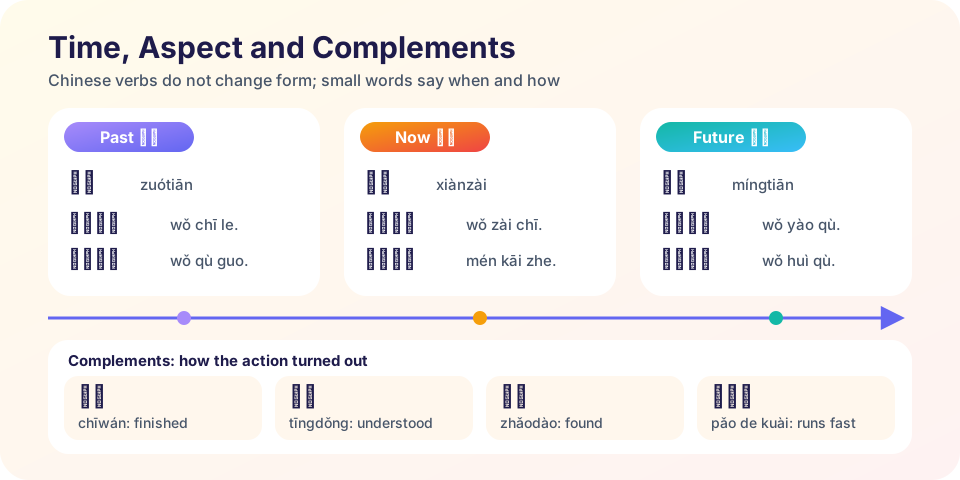
English verbs change shape to say when something happens: "eat", "ate", "eaten", "will eat". Mandarin verbs never change. 吃 (chī) is 吃 whether you ate yesterday, are eating now or will eat tomorrow. Instead, Chinese says when with time words, and how the action unfolds with small helper words called aspect markers and complements. That is the subject of this chapter, and it is where beginners feel the language start to work like a real system.
What you will learn
- How to tell the time, name days, dates and months, and place time words in a sentence.
- How 了, 过, 着 and 在 mark completion, experience, continuing state and ongoing action.
- How complements show the result, direction, degree or ability of an action.
- Why Chinese does not need verb tenses.
Key terms
时间词 (shíjiāncí): time word, such as 今天, 明天, 下午.
体 (tǐ), aspect: how an action is viewed (finished, ongoing, experienced), not when it happened.
补语 (bǔyǔ), complement: a word after a verb that tells the result, degree or direction.
了, 过, 着, 在: the four most important aspect words.
The chapter in slides
No tenses, no problem
Time words say when. Helper words say how.
Clock and calendar
Four aspect words
Complements
A first taste
Read this dialogue about making plans. Every line uses something from this chapter: a time word, an aspect marker or a complement.
| Speaker | Chinese | Pinyin | English |
|---|---|---|---|
| 小王 | 你今天几点下班? | Nǐ jīntiān jǐ diǎn xiàbān? | What time do you finish work today? |
| 小李 | 六点。你吃饭了吗? | Liù diǎn. Nǐ chī fàn le ma? | Six. Have you eaten yet? |
| 小王 | 还没吃。我们一起去吃吧。 | Hái méi chī. Wǒmen yìqǐ qù chī ba. | Not yet. Let's go eat together. |
| 小李 | 好啊。你去过那家新饭馆吗? | Hǎo a. Nǐ qù guo nà jiā xīn fànguǎn ma? | Sure. Have you been to that new restaurant? |
| 小王 | 没去过,听说那儿的菜做得很好。 | Méi qù guo, tīngshuō nàr de cài zuò de hěn hǎo. | No, but I hear the food there is cooked very well. |
| 小李 | 那我们七点见。 | Nà wǒmen qī diǎn jiàn. | Then let's meet at seven. |
Spot the helpers: 吃饭了 (a new situation: has eaten), 还没吃 (not yet), 去过 (have been), 做得很好 (degree), 七点见 (a time word before the verb).
What each lesson covers
- Dates, days and the clock: years, months, weekdays, hours, minutes, and where time words go in a sentence.
- Aspect markers: 了, 过, 着 and 在: the four words that show completion, experience, state and progress, with negation.
- Complements: result, degree, direction and ability:
吃完,说得好,走进来,听得懂and how to negate them. - Chapter 6 review: a summary poster and a ten-question quiz.
How to study this chapter
The central idea is easy to say and takes practice to feel: stop looking for a Chinese "past tense". When you want to say "I ate", ask yourself two questions instead. Is the time clear from a time word (昨天) or from the situation? And is it important that the action is complete (了), experienced (过), in progress (在) or ongoing as a state (着)? Once you ask those questions, the grammar stops being a puzzle. Many learners find it helpful to say a sentence aloud, change one element (the time word, the aspect, the result) and notice how the meaning shifts; that experiment is the fastest route to a feel for the system.
Do not try to learn 了 as "the past tense marker". It is the most misunderstood word in Chinese for English speakers. The lesson on aspect treats it carefully, with examples where 了 does not mean "past" at all.
Check your understanding
Quick check · 3 questions
of 3 answered You scored / 3 · perfect!
-
1. How does Mandarin show that an action happened yesterday?
Verbs never change. A time word or context says when. -
2. Which word marks 'have ever done' (experience)?
过 (guo) after a verb means the experience has happened at least once: 去过 'have been to'. -
3. In 做得很好, what does 得 introduce?
得 (de) links the verb to a description of how the action is done.
Summary
- Chinese verbs do not change; time words say when, aspect words say how the action unfolds.
- Date and clock order runs from large to small; time words go before the verb.
- 了, 过, 着, 在 mark completion, experience, state and progress.
- Complements follow the verb to show result, degree, direction or ability.
Track your progress
Create a free account to tick off lessons and pick up where you left off on any device.
of Mandarin Chinese for Beginners lessons completed