


















Lesson 44 of 44 · Projects and Practice
Further Study: What to Learn Next
Plan your next steps after beginner Mandarin: what you can do now, skills to build, HSK and other tests, resources, study habits and related tracks on this site.
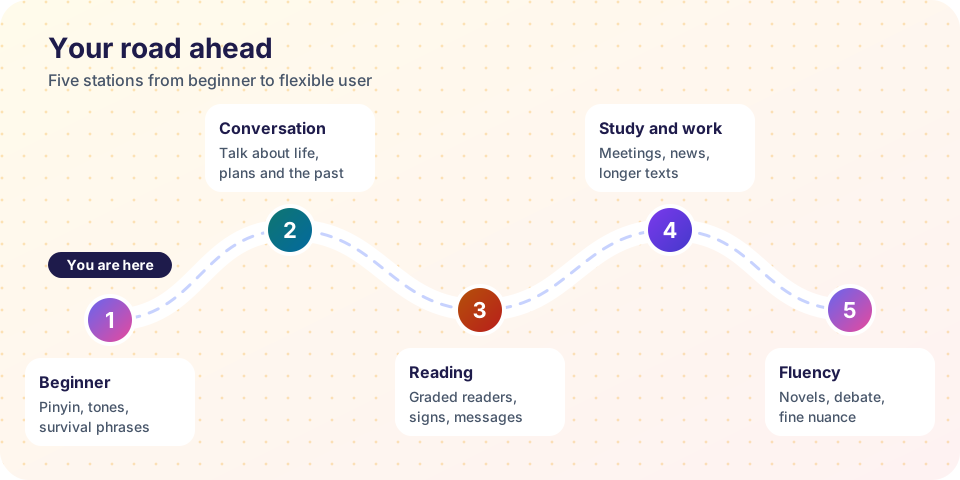
Finishing a beginner course is a real milestone, and also the start of the more interesting part. You can now greet people, count, shop, tell the time, read common signs, ask for directions and follow the basic grammar of a Mandarin sentence. What comes next is building volume: more words, more listening, more conversations, more reading. This final lesson maps the road ahead, explains the standard tests, suggests practical resources and routines, and connects Mandarin to related tracks on this site. A course cannot replace speaking with people, so the single best next step is to find someone to talk to.
What you will learn
- What you can already do and where the gaps are.
- The four skills to grow next and how much of each to practice.
- What the HSK and other tests measure, and whether you need one.
- Practical resources and habits that keep progress steady.
- Which other tracks on this site connect to Mandarin.
Key terms
水平 (shuǐpíng): level, proficiency.
考试 (kǎoshì): exam, test.
听说读写 (tīng shuō dú xiě): the four skills: listening, speaking, reading, writing.
沉浸 (chénjìn): immersion.
Where you are now
Take a moment to list what you can do. After this course you can probably:
- introduce yourself, your family and your work or studies;
- count, give prices, use money words and order simple food;
- tell dates and times and say when things happen with time words;
- use the aspect words 了, 过, 在 and 着, and basic complements like
听不懂; - recognize a few hundred characters and many common signs and app buttons;
- ask for and understand simple directions, and use public transport;
- behave politely and understand basic Chinese etiquette.
Be generous with yourself when you list these: each item took real work. Do you also notice the gaps? Probably: understanding fast speech, talking about abstract topics, reading longer texts, and writing more than a few lines. Those gaps define your next steps.
The four skills
| Skill | Chinese | What to practice next |
|---|---|---|
| Listening | 听 tīng | Slow, learner-friendly audio first; then podcasts, videos with subtitles and real conversations. Repeat what you hear (shadowing). |
| Speaking | 说 shuō | Regular talks with a tutor or language partner; record yourself; describe your day aloud in Chinese. |
| Reading | 读 dú | Short graded stories, signs, menus, messages from friends; then news headlines and longer articles. |
| Writing | 写 xiě | Type a short diary in Chinese every day; handwrite the characters you most want to remember. |
A sensible balance for most learners is to give about a third of study time to listening and speaking each, and the remaining third to reading, writing and vocabulary review. Adjust by goal: a traveler wants more speaking and listening; a student preparing for an exam wants more reading and vocabulary.
Tests: the HSK and others
The best-known Mandarin test is the HSK (汉语水平考试, Hànyǔ Shuǐpíng Kǎoshì), the official proficiency test for non-native speakers, administered by an organization under China's Ministry of Education. It has long been organized in levels from beginner to advanced, with each level requiring more vocabulary and character knowledge. The system has been undergoing revision, with a newer standard adding more levels and new test formats, so check the official HSK website for the current structure, vocabulary lists and test dates. Other tests exist too: the YCT is designed for younger learners, and the TOCFL is the test run in Taiwan, which uses traditional characters.
Should you take a test? Tests give you a concrete goal and a clear syllabus, which can be very motivating. They are required for many universities and jobs in Chinese-speaking regions. If you simply want to talk with friends and read signs, you can skip them, but the official word lists are a useful guide to which words to learn next.
Resources and habits
- A good dictionary app that lets you look up by pinyin, by drawing and by camera. Add the example sentences to your flashcards.
- A spaced-repetition app (see the flashcard project) for steady vocabulary growth.
- Graded readers and learner podcasts, written for the level you are at, so you meet new words in a story.
- A tutor or language exchange partner. Even one weekly conversation changes everything, because real people ask you things you did not prepare.
- A pinyin keyboard on your phone. Chat with friends in Chinese, even in short messages.
- Films, songs and videos you actually enjoy. Start with Chinese subtitles when you can, and replay short scenes.
- A "street list" of characters you meet in real life, as in chapter 7.
Habits matter more than hours. Thirty minutes a day beats four hours on Sunday. Set small, specific goals ("this week: describe my weekend aloud, five sentences, no notes"), review them each Sunday and celebrate what you can now do.
Connections to other tracks on this site
Learning a language is easier when you understand how languages work. If you are curious, these tracks on this site connect well with Mandarin:
- Language Learning Methods: techniques for memory, practice and motivation that apply to any language.
- Linguistics: how sounds, words and grammar work across languages, which makes tones, measure words and aspect easier to understand.
- Japanese for Beginners: Japanese uses many Chinese characters (kanji), so your knowledge of radicals and components carries over, even though pronunciations, some shapes and many meanings differ.
Common misconceptions
"I must master all the characters before I speak." Speaking and reading grow together; use pinyin and typing to get started.
"Tests measure my fluency." They measure particular skills on a particular day. They are useful tools, not a verdict on your Chinese.
"I will be fluent in a year." Chinese takes many learners several years to reach comfortable fluency. Progress is steady but not rapid; plan for the long term.
"If I understand the textbook, I can understand people." Real speech is fast and messy. You need hours of real listening.
Try it
Press Run (or Ctrl + Enter) to see the result here.
Program input · what you'd type while the program runs
Type the answers before you press Run, one per line. Each time the program reads a line (with input()), it gets the next line from this box.
Press Run (or Ctrl + Enter) to see the console output here.
No output.
Check your understanding
Quick check · 5 questions
of 5 answered You scored / 5 · perfect!
-
1. What does HSK stand for in Chinese?
HSK is 汉语水平考试, the Chinese Proficiency Test for non-native speakers. -
2. Which test is run in Taiwan and uses traditional characters?
TOCFL is Taiwan's Test of Chinese as a Foreign Language. -
3. What is the best next step after a beginner course?
Balanced practice with real people and real content builds fluency. -
4. What does 听说读写 refer to?
听说读写 means listening, speaking, reading and writing. -
5. Why does Japanese for Beginners connect to Mandarin?
Kanji come from Chinese characters, so radicals and components carry over, though pronunciation and many meanings differ.
Summary
- You can now handle basic daily communication; your next steps are more listening, speaking, reading and writing.
- Balance study time across the four skills (听说读写), tilted toward your goal.
- The HSK, YCT and TOCFL are optional tests that give structure and goals; check official sources for current formats.
- Short, regular practice, a dictionary, spaced repetition, graded reading and a conversation partner build progress.
- Related tracks: Language Learning Methods, Linguistics and Japanese for Beginners.
Congratulations on finishing the course. Keep speaking, keep listening and enjoy the journey.
Track your progress
Create a free account to tick off lessons and pick up where you left off on any device.
of Mandarin Chinese for Beginners lessons completed