


















Lesson 8 of 44 · Pinyin, Tones and Greetings
Greetings and politeness: your first conversation
Learn how to greet people, ask how they are, introduce yourself, say thanks, apologize and say goodbye in Mandarin, with pinyin, dialogues and cultural notes.
Now you can use your new sounds. In this lesson you will learn the phrases that start almost every conversation: hello, how are you, my name is, nice to meet you, thanks, sorry and goodbye. These are short, they use the sounds and tones from the previous lessons, and you will hear them again and again. Each phrase comes with characters, pinyin and English, so say each one out loud before reading on.
What you will learn
- how to greet people at different times of day and with different levels of politeness
- how to ask and answer "How are you?" and introduce yourself
- how to thank, apologize, ask for help and say goodbye
- a few cultural habits that make you sound natural
Key terms
你好 (nǐ hǎo) is the standard "hello", literally "you good".
您 (nín) is the polite form of 你 (nǐ, "you").
姓 (xìng) means family name, and 名字 (míngzi) means name.
请 (qǐng) means "please" and also "to invite".
Saying hello
The classic greeting is 你好 (nǐ hǎo). Remember the tone change: two third tones in a row, so say ní hǎo. Respelling: "nee how". It works at any time of day and with almost anyone, though close friends often say something lighter, such as 嗨 (hāi, "hi").
| Characters | Pinyin | When to use it |
|---|---|---|
| 你好 | nǐ hǎo | hello, to one person |
| 您好 | nín hǎo | hello, polite (elders, customers, teachers) |
| 你们好 | nǐmen hǎo | hello, to several people |
| 大家好 | dàjiā hǎo | hello, everyone |
| 早上好 / 早 | zǎoshang hǎo / zǎo | good morning |
| 下午好 | xiàwǔ hǎo | good afternoon |
| 晚上好 | wǎnshang hǎo | good evening |
| 晚安 | wǎn'ān | good night (when parting for bed) |
The polite 您 is used for people you respect: older people, customers, teachers and strangers you want to address formally. For friends, peers and children, use 你. Note the apostrophe in wǎn'ān, which shows that the syllable boundary comes before an.
On the phone, mainland speakers answer with 喂 (wéi) rather than 你好. When you meet someone, a nod or a smile with 你好 is entirely fine.
How are you?
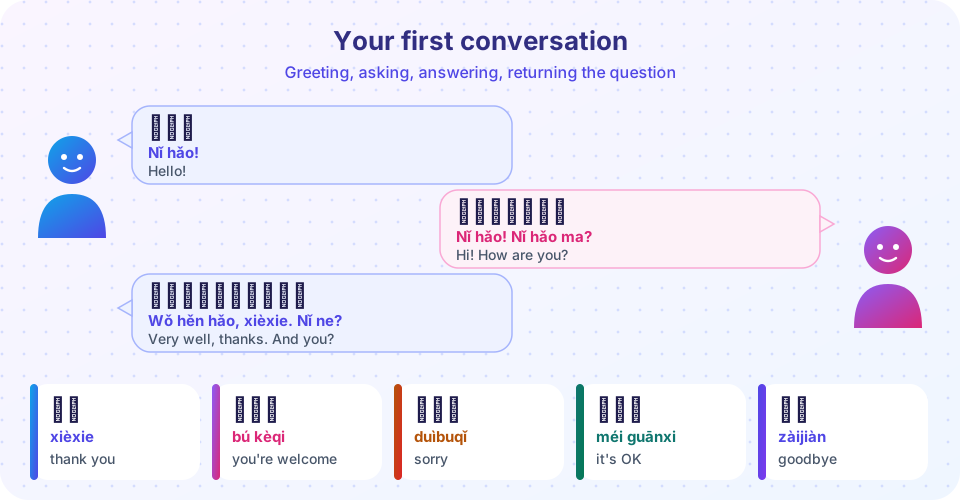
To ask "How are you?" say 你好吗? (nǐ hǎo ma?). The particle 吗 (ma) turns a statement into a yes/no question. You will study it in chapter 4. A typical answer is:
| Characters | Pinyin | English |
|---|---|---|
| 我很好,谢谢。 | wǒ hěn hǎo, xièxie. | I'm very well, thanks. |
| 还不错。 | hái bú cuò. | Not bad. |
| 还可以。 | hái kěyǐ. | So-so, OK. |
| 马马虎虎。 | mǎmǎhūhū. | Just so-so. |
| 你呢? | nǐ ne? | And you? |
Here 很 (hěn) means "very", but in a plain "I'm fine" sentence it is nearly empty. It is the normal way to link 我 to a describing word, as chapter 3 explains. The question 你呢? (nǐ ne?) is a handy "and you?" and returns the question without repeating it.
A cultural note: 你好吗? is natural for someone you have not seen for a while. People who meet every day tend to use other openers, such as 你吃了吗? (nǐ chī le ma, "Have you eaten?"), which is a caring greeting in some regions, or a comment on the weather. You do not need those yet, but do not be surprised when you hear them.
Introducing yourself
Chinese names put the family name first and the given name second. The basketball player 姚明 (Yáo Míng) has the family name Yáo and the given name Míng. In the same way, the surname Wáng (王) with the given name Míng (明) gives 王明 (Wáng Míng), "Wang Ming". Family names are often a single character, given names one or two.
| Characters | Pinyin | English |
|---|---|---|
| 你叫什么名字? | nǐ jiào shénme míngzi? | What is your name? |
| 我叫王明。 | wǒ jiào Wáng Míng. | My name is Wang Ming. |
| 我姓王,叫王明。 | wǒ xìng Wáng, jiào Wáng Míng. | My family name is Wang; I am called Wang Ming. |
| 您贵姓? | nín guì xìng? | What is your (honorable) surname? (formal) |
| 认识你很高兴。 | rènshi nǐ hěn gāoxìng. | Nice to meet you. |
| 我是美国人。 | wǒ shì Měiguórén. | I am American. |
| 我是学生。 | wǒ shì xuésheng. | I am a student. |
The verb 叫 (jiào) means "to be called". 姓 (xìng) tells your family name. The verb 是 (shì, "to be") links two things: 我是学生. You will study it in chapter 3. In the phrase 美国人 (Měiguórén), 人 (rén) means "person", so any country name plus 人 gives a nationality: 中国人 (Zhōngguórén), 英国人 (Yīngguórén, British), 加拿大人 (Jiānádàrén, Canadian), 日本人 (Rìběnrén).
Please, thank you, sorry
| Characters | Pinyin | English |
|---|---|---|
| 请 | qǐng | please (also: to invite) |
| 请问 | qǐngwèn | excuse me, may I ask... |
| 谢谢 | xièxie | thank you |
| 不客气 | bú kèqi | you're welcome |
| 不用谢 | búyòng xiè | no need to thank me |
| 对不起 | duìbuqǐ | I'm sorry (a real apology) |
| 没关系 | méi guānxi | it doesn't matter, it's OK |
| 不好意思 | bù hǎoyìsi | excuse me, sorry (lighter) |
Use 请问 (qǐngwèn) to start a question to a stranger: 请问,洗手间在哪儿? (qǐngwèn, xǐshǒujiān zài nǎr? "Excuse me, where is the restroom?"). Use 对不起 when you have really wronged someone and 不好意思 when you bump into someone or need to attract attention gently. 不客气 (bú kèqi) literally means "don't be polite".
In everyday life, among family and close friends, people say thanks less than English speakers might expect. Repeated thanks can feel distant. A smile and a friendly reply fit better. With strangers, shopkeepers and colleagues, 谢谢 is always right.
Saying goodbye
The standard goodbye is 再见 (zàijiàn), "again see". You can add a time to it, a pattern you will meet again in chapter 6: 明天见 (míngtiān jiàn, see you tomorrow), 下周见 (xiàzhōu jiàn, see you next week). People also say 慢走 (màn zǒu, "go slowly", said by the host to a leaving guest) and 路上小心 (lùshang xiǎoxīn, "be careful on the road").
Titles and forms of address
Chinese speakers often greet someone by name and title rather than with a bare 你好. After a family name you can add a title: 王老师 (Wáng lǎoshī, Teacher Wang), 李先生 (Lǐ xiānsheng, Mr. Li) and 张女士 (Zhāng nǚshì, Ms. Zhang). Colleagues and friends of similar age use 小 (xiǎo, "little") for someone younger and 老 (lǎo, "old") for someone older, both before the family name: 小王 (Xiǎo Wáng) is a younger Wang, and 老王 (Lǎo Wáng) is an older, familiar Wang. These forms are friendly, but they are used among people who know each other, so as a learner stay with 老师 and 先生 until you are sure.
In a first meeting, a smile, a nod or a light handshake is normal. In formal situations, you may be given a business card, which is received politely with both hands. You do not need to bow. If you are not sure what to say, the safest course is a clear 你好 or 您好 and your name, said with your best tones.
Two short dialogues
Dialogue 1: meeting
| Speaker | Chinese | Pinyin | English |
|---|---|---|---|
| A | 你好!我叫李华。 | Nǐ hǎo! Wǒ jiào Lǐ Huá. | Hello! My name is Li Hua. |
| B | 你好!我叫王明。认识你很高兴。 | Nǐ hǎo! Wǒ jiào Wáng Míng. Rènshi nǐ hěn gāoxìng. | Hello! I'm Wang Ming. Nice to meet you. |
| A | 我也很高兴。你是学生吗? | Wǒ yě hěn gāoxìng. Nǐ shì xuésheng ma? | Me too. Are you a student? |
| B | 是的,我是学生。 | Shì de, wǒ shì xuésheng. | Yes, I'm a student. |
Dialogue 2: thanks and goodbye
| Speaker | Chinese | Pinyin | English |
|---|---|---|---|
| A | 谢谢你! | Xièxie nǐ! | Thank you! |
| B | 不客气。 | Bú kèqi. | You're welcome. |
| A | 再见!明天见。 | Zàijiàn! Míngtiān jiàn. | Goodbye! See you tomorrow. |
| B | 明天见! | Míngtiān jiàn! | See you tomorrow! |
Say both dialogues aloud, playing both parts, until you can do them without looking. Then swap in your own name.
Try it
First, a branching conversation. Choose a reply each time; the game shows whether it fits the situation and why.
Second, a self-introduction generator. Change the variables and read the result aloud. The pinyin you pass in must be correct, because the tool does not check it.
Press Run (or Ctrl + Enter) to see the result here.
Program input · what you'd type while the program runs
Type the answers before you press Run, one per line. Each time the program reads a line (with input()), it gets the next line from this box.
Common misconceptions
"你好 is the only greeting." It is the safest, but real speakers also use 嗨, 早, 大家好, or simply start with a name. Do not overuse 你好 with close friends.
"谢谢 needs a reply every time." Replying with 不客气 is polite, but a nod, a smile or 没事 (méi shì, no problem) also works in casual settings.
"Say 对不起 for everything." 对不起 is a real apology. For small things such as squeezing past someone, 不好意思 is lighter and more natural.
"Chinese names are given name first." The family name comes first: 王明 is Mr. Wang, not Mr. Ming.
Check your understanding
Quick check · 5 questions
of 5 answered You scored / 5 · perfect!
-
1. Which greeting is the polite form for an older person?
您 (nín) is the polite 'you', suited to elders, customers and teachers. -
2. How do you answer 谢谢?
不客气 (bú kèqi) means you're welcome. -
3. In the name 王明 (Wáng Míng), which part is the family name?
Chinese family names come first. 王 is the family name. -
4. Which phrase would you use to start a question to a stranger politely?
请问 (qǐngwèn) means 'may I ask'. 晚安 is good night and 没关系 means it doesn't matter. -
5. What does 你呢? (nǐ ne?) mean?
呢 returns a question: 'And you?' It saves you repeating the whole sentence.
Summary
- 你好 (nǐ hǎo) and the polite 您好 (nín hǎo) are the core greetings; add 吗 to ask 你好吗?
- Introduce yourself with 我叫… and 我是…人; the family name comes first.
- 谢谢 / 不客气, 对不起 / 没关系, 请问 and 再见 carry most of everyday politeness.
- Say every dialogue aloud and swap in your own information.
Next: Chapter 2 review
Track your progress
Create a free account to tick off lessons and pick up where you left off on any device.
of Mandarin Chinese for Beginners lessons completed