


















Lesson 40 of 44 · Projects and Practice
Practice Dialogues and Role-Plays
Practice three full Mandarin dialogues (a café, making plans and finding the museum) with pinyin and English, a role-play player and a three-pass study method.
You now know enough Chinese to hold real conversations about money, time, places, family and manners. This lesson is a practice workshop. It gives you three complete dialogues that combine material from chapters 5 to 8, a method for turning each one from something you read into something you can say, and two tools: a role-play player where you can hide your lines, and a script scrambler for ordering practice. Spend your time here speaking aloud. Reading silently is the weakest form of practice.
What you will learn
- How to practice dialogues in three passes.
- Three complete dialogues: ordering, making plans and asking the way.
- How to adapt a dialogue by swapping in your own details.
- How to check your own understanding with comprehension questions.
Key terms
对话 (duìhuà): dialogue.
角色扮演 (juésè bànyǎn): role-play.
替换 (tìhuàn): substitution, swapping words into a fixed pattern.
练习 (liànxí): practice, exercise.
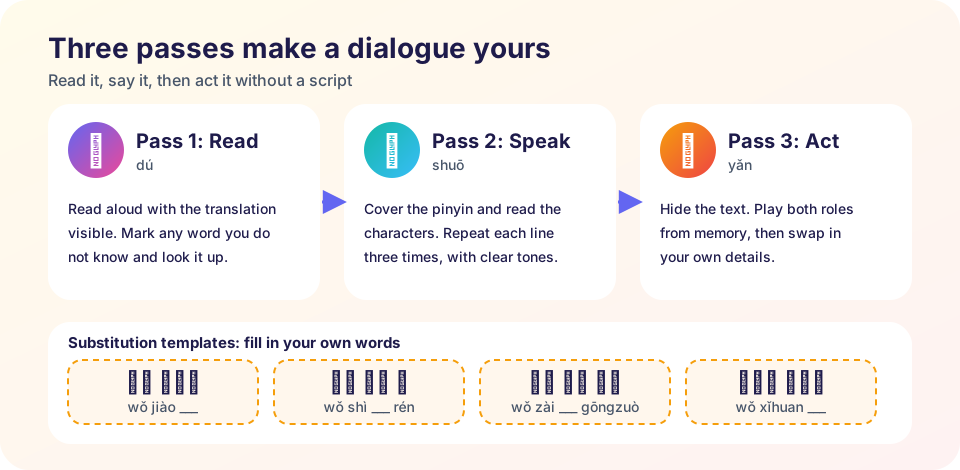
The three-pass method
- Pass 1, read (
读): read the dialogue aloud with the translation visible. Look up every word you do not know. Say each line twice. - Pass 2, speak (
说): cover the pinyin and read the characters. If you stumble, uncover only that line. Repeat each line three times, paying attention to tones. - Pass 3, act (
演): hide the text and play both roles from memory. When it flows, change details (names, prices, places, times) using the substitution templates in the picture.
Record yourself on your phone, then listen back. You will hear tone mistakes that you could not hear while speaking. If you can, practice with a friend or tutor, since real conversations include surprises that a script never has.
Dialogue A: At a café
This one uses numbers, money and the polite words from chapter 5.
| Speaker | Chinese | Pinyin | English |
|---|---|---|---|
| 服务员 | 你好,欢迎光临!你想喝点儿什么? | Nǐ hǎo, huānyíng guānglín! Nǐ xiǎng hē diǎnr shénme? | Hello, welcome! What would you like to drink? |
| 顾客 | 我要一杯咖啡,一杯茶。 | Wǒ yào yì bēi kāfēi, yì bēi chá. | I would like a coffee and a tea. |
| 服务员 | 咖啡二十八块,茶十八块,一共四十六块。 | Kāfēi èrshíbā kuài, chá shíbā kuài, yígòng sìshíliù kuài. | The coffee is 28 yuan, the tea 18 yuan, 46 yuan altogether. |
| 顾客 | 可以扫码吗? | Kěyǐ sǎo mǎ ma? | Can I pay by scanning a code? |
| 服务员 | 可以。请扫这里。 | Kěyǐ. Qǐng sǎo zhèlǐ. | Yes. Please scan here. |
| 顾客 | 好了。谢谢! | Hǎo le. Xièxie! | Done. Thank you! |
| 服务员 | 不客气,请稍等。 | Bú kèqi, qǐng shāo děng. | You're welcome, please wait a moment. |
Check yourself: What does the customer order? How much is the coffee? What does 请稍等 mean? (Answers: a coffee and a tea; 28 yuan; "please wait a moment".)
Variations: change the drinks (一杯水, 两杯咖啡), the prices and the payment method (我用现金).
Dialogue B: Making plans
This one uses time words, the aspect marker 过 and place words from chapters 6 and 8.
| Speaker | Chinese | Pinyin | English |
|---|---|---|---|
| 小王 | 周六你有空吗? | Zhōuliù nǐ yǒu kòng ma? | Are you free on Saturday? |
| 小李 | 有。有什么事? | Yǒu. Yǒu shénme shì? | Yes. What's up? |
| 小王 | 我们一起去看电影吧。下午三点怎么样? | Wǒmen yìqǐ qù kàn diànyǐng ba. Xiàwǔ sān diǎn zěnmeyàng? | Let's go to a movie together. How about three in the afternoon? |
| 小李 | 好啊。我没看过这部电影。 | Hǎo a. Wǒ méi kàn guo zhè bù diànyǐng. | Sure. I haven't seen this movie. |
| 小王 | 那我们在电影院门口见。 | Nà wǒmen zài diànyǐngyuàn ménkǒu jiàn. | Then let's meet at the cinema entrance. |
| 小李 | 好,不见不散! | Hǎo, bú jiàn bú sàn! | OK, see you there, no matter what (literally: if we don't meet, we don't leave)! |
Check yourself: What day do they plan to meet? At what time? Where? (Saturday, 3 p.m., at the cinema entrance.)
Notice 没看过 (haven't seen, experience), 下午三点 (time word before the verb phrase) and 在电影院门口见 (place before the verb). 不见不散 is a friendly idiom meaning "if we do not meet, we will not leave".
Dialogue C: Finding the museum
This one uses directions and transport from chapter 8.
| Speaker | Chinese | Pinyin | English |
|---|---|---|---|
| 游客 | 请问,去博物馆怎么走? | Qǐngwèn, qù bówùguǎn zěnme zǒu? | Excuse me, how do I get to the museum? |
| 路人 | 你可以坐地铁。坐二号线,三站就到。 | Nǐ kěyǐ zuò dìtiě. Zuò èr hào xiàn, sān zhàn jiù dào. | You can take the subway. Take line 2; it is three stops. |
| 游客 | 地铁站在哪儿? | Dìtiězhàn zài nǎr? | Where is the subway station? |
| 路人 | 就在前面,银行的对面。 | Jiù zài qiánmian, yínháng de duìmiàn. | It's just ahead, opposite the bank. |
| 游客 | 谢谢您! | Xièxie nín! | Thank you! |
| 路人 | 不客气,一路平安! | Bú kèqi, yílù píng'ān! | You're welcome, have a safe trip! |
Check yourself: Which line should the tourist take? How many stops? Where is the station? (Line 2, three stops, ahead and opposite the bank.)
Your turn: write your own
Pick one dialogue and rewrite it with your own details. A good five-line plan:
- A greeting and a question (
你好,请问…). - A reply with a detail (a number, a time or a place).
- A follow-up question (
…怎么样?,…在哪儿?). - A reply that uses
了or过or a complement. - A polite closing (
谢谢,再见,不客气).
Write your version in characters with pinyin, then say it aloud twice. Show it to a teacher, tutor or native speaker if you can.
When practice goes wrong
Every learner hits the same few snags. If you cannot remember a line, do not stare at it: read it aloud three times, then close your eyes and say it once. If a line keeps tripping you up, look at its tones and break it into short chunks, practicing each chunk alone. If you can say everything alone but freeze with another person, ask your partner to improvise a little, so that you practice reacting, not reciting. If you understand the written version but not the audio, replay the audio at a slower speed and read along, then listen again without reading. And if you are tired, stop: two focused ten-minute sessions beat one long, sleepy hour. Keep a short list of "lines I still miss" and rehearse only those for a few days.
Common misconceptions
"Memorizing the dialogue is enough." Memorizing helps, but understanding the patterns and swapping details is what lets you speak freely.
"If I understand it written, I will understand it spoken." Listening is a separate skill. Practice with audio and with real people, not only with text.
"Every line must be perfect." Native speakers understand you from context. Aim for clear tones and keep going.
Try it
Press Run (or Ctrl + Enter) to see the result here.
Program input · what you'd type while the program runs
Type the answers before you press Run, one per line. Each time the program reads a line (with input()), it gets the next line from this box.
Check your understanding
Quick check · 5 questions
of 5 answered You scored / 5 · perfect!
-
1. In Dialogue A, how much is the coffee?
咖啡二十八块 means the coffee is 28 yuan; the total is 46. -
2. What does 我没看过这部电影 mean?
没…过 expresses 'have not ever': I haven't seen this movie. -
3. Where will the friends meet in Dialogue B?
在电影院门口见: they will meet at the cinema entrance. -
4. In Dialogue C, which line takes the tourist to the museum?
坐二号线 means take line 2. -
5. What does 一路平安 wish the other person?
一路平安 means 'have a safe trip'.
Summary
- Practice dialogues in three passes: read, speak, act.
- Dialogue A: café, prices and payment. Dialogue B: plans, time words and 过. Dialogue C: directions and subway.
- Adapt a script by swapping in your own names, numbers, times and places.
- Speaking aloud, recording yourself and practicing with real people beat silent reading.
Track your progress
Create a free account to tick off lessons and pick up where you left off on any device.
of Mandarin Chinese for Beginners lessons completed