


















Lesson 27 of 44 · Time, Aspect and Complements
Aspect Markers: 了, 过, 着 and 在
Understand Mandarin aspect: 了 for completion and change, 过 for experience, 着 for continuing states and 在 for actions in progress, with negation.
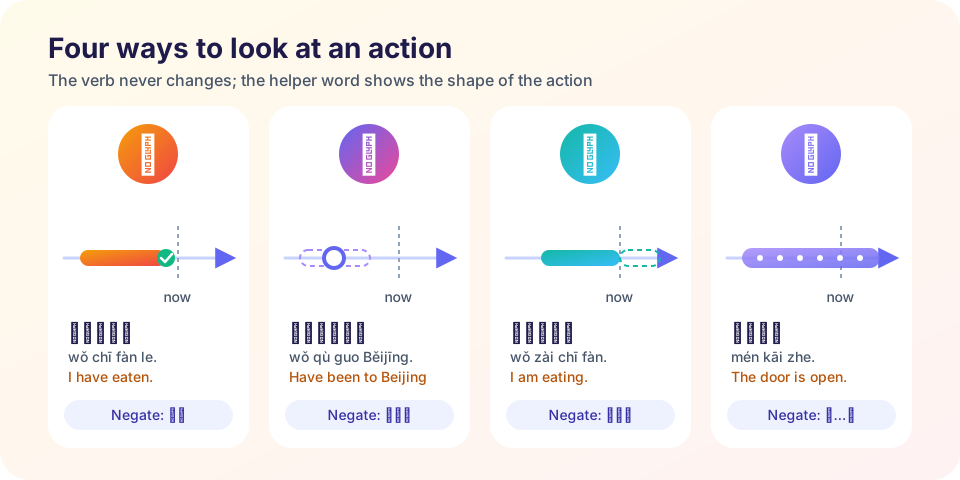
If English speakers could change only one thing about how they think about Mandarin grammar, it should be this: Chinese has no past tense, it has aspect. A tense says when an action happens (past, present, future). Aspect says what shape the action has: finished, experienced at least once, going on right now, or a state that lingers. The four words that carry this meaning are 了, 过, 在 and 着. They are small (了, 过 and 着 are light-tone syllables, le, guo and zhe; 在 keeps its full fourth tone), and they decide whether a sentence sounds natural. This lesson takes each in turn, with worked examples and clear rules for negation.
What you will learn
- The two jobs of 了: finished action and new situation.
- How 过 shows life experience and differs from 了.
- How 在 shows an action in progress and 着 a lasting state.
- How to negate each of them, and why 了 does not mean "past tense".
Key terms
体 (tǐ), aspect: the shape of an action in time: finished, experienced, ongoing, continuing.
了 (le): marks completion (after the verb) or a new situation (at the end of a sentence).
过 (guo): marks that something has been experienced at least once.
在 (zài) and 着 (zhe): progressive action and continuing state.
没 (méi): the negator for completed actions and experiences (never 不 with 了 or 过).
了: completion and change
The word 了 has two jobs, and recognizing which one you are using is half the battle.
Job 1: the action is complete (verb + 了). 了 right after a verb says the action reached its end. 我买了三本书。 (Wǒ mǎi le sān běn shū.) "I bought three books." This pattern wants a number, a quantity or a description after the verb, or another clause. A bare 我买了书。 tends to feel unfinished; speakers continue it: 我买了书就回家。 (Wǒ mǎi le shū jiù huí jiā.) "I'll go home after I buy the books."
Job 2: a new situation (sentence-final 了). 了 at the end of a sentence says that something has changed, begun or become true now:
| Sentence | Pinyin | Meaning |
|---|---|---|
| 下雨了。 | Xià yǔ le. | It is raining now (it has started). |
| 我饿了。 | Wǒ è le. | I am hungry (I was not before). |
| 现在八点了。 | Xiànzài bā diǎn le. | It is eight o'clock now. |
| 我会说中文了。 | Wǒ huì shuō Zhōngwén le. | I can speak Chinese now. |
| 我吃饭了。 | Wǒ chī fàn le. | I have eaten (I ate). |
The last one is the everyday way to say "I've eaten". The question form is 你吃饭了吗? (Nǐ chī fàn le ma?) "Have you eaten yet?" A famous Chinese greeting, 吃了吗? (Chī le ma?), literally asks the same.
了 is not "past tense"
Think of three sentences that never use 了 even though the action is in the past: 我小时候每天跑步。 (Wǒ xiǎoshíhou měitiān pǎobù.) "As a child I ran every day." - a habit. 昨天我很忙。 (Zuótiān wǒ hěn máng.) "I was busy yesterday." - a state. 去年我住在北京。 (Qùnián wǒ zhù zài Běijīng.) "Last year I lived in Beijing." Past time is shown by 小时候, 昨天, 去年, not by 了. And 了 can appear in the future: 明天下了课,我就去。 (Míngtiān xià le kè, wǒ jiù qù.) "Tomorrow, once class is over, I will go." Here 下了课 is a completed step in a future plan.
Negating 了
Use 没 (méi) or 没有, and drop the 了: 我没吃饭。 (Wǒ méi chī fàn.) "I did not eat." To say "not yet", add 还: 我还没吃饭。 (Wǒ hái méi chī fàn.) or 还没吃呢。 (Hái méi chī ne.) Do not use 不: 我不吃饭了 has a different meaning ("I'm not going to eat any more").
过: have ever done
过 goes after the verb and says that the action has happened at least once in your life, and that is not part of the present moment: 我去过北京。 (Wǒ qù guo Běijīng.) "I have been to Beijing." Questions: 你吃过饺子吗? (Nǐ chī guo jiǎozi ma?) "Have you ever eaten dumplings?" Answers: 吃过。 "Yes, I have." or 没吃过。 "No, I haven't." The negative uses 没 and keeps the 过. Add 从来 (cónglái, "all along") for "never": 我从来没吃过。 (Wǒ cónglái méi chī guo.)
Compare 了 and 过:
| Sentence | Meaning |
|---|---|
| 我去了北京。 | I went to Beijing (a specific trip; I might still be there, or just returned). |
| 我去过北京。 | I have been to Beijing (an experience, I am not there now). |
Note that 过 is a neutral-tone suffix here (guo). The verb 过 (guò) means "to pass" or "to spend (a holiday or time)": 过年 (guò nián, celebrate the New Year), 过生日 (guò shēngrì, celebrate a birthday).
在: an action in progress
在 (zài) before a verb says the action is going on right now: 我在学中文。 (Wǒ zài xué Zhōngwén.) "I am studying Chinese." You can strengthen it with 正 (zhèng, "just at this moment"): 他正在睡觉。 (Tā zhèngzài shuìjiào.) "He is sleeping right now." A final 呢 (ne) softens it and adds a conversational flavor: 他在睡觉呢。
The negative uses 没: 他没在睡觉。 (Tā méi zài shuìjiào.) "He isn't sleeping."
在 also works as the verb "to be at" or as a preposition "at, in": 我在学校。 (Wǒ zài xuéxiào.) "I am at school." 我在学校学习。 (Wǒ zài xuéxiào xuéxí.) "I study at school." Context decides: 我在学习 alone means "I'm studying", where 在 marks progress and has no place word.
着: a state that continues
着 (zhe) goes after a verb and describes a state that continues, often a result of an earlier action: 门开着。 (Mén kāi zhe.) "The door is open." 灯亮着。 (Dēng liàng zhe.) "The light is on." 他穿着红衣服。 (Tā chuān zhe hóng yīfu.) "He is wearing red clothes." 墙上挂着一幅画。 (Qiáng shang guà zhe yì fú huà.) "A painting hangs on the wall."
It also joins two verbs, the first being the manner in which the second happens: 他坐着看书。 (Tā zuò zhe kàn shū.) "He reads while sitting." And it softens commands: 等着! (Děng zhe!) "Wait!" 听着! (Tīng zhe!) "Listen!"
The negative is 没…着: 门没开着。 (Mén méi kāi zhe.) "The door isn't open." Use it for lasting states, not for brief actions.
Putting it together
| Marker | Where | Shows | Negation | Example |
|---|---|---|---|---|
| 了 | after the verb or at the end | completion, or a new situation | 没 (drop 了) | 我没吃饭。 |
| 过 | after the verb | experience | 没 + V + 过 | 我没去过。 |
| 在 | before the verb | action in progress | 没(有)在 | 他没在睡觉。 |
| 着 | after the verb | continuing state | 没 + V + 着 | 门没开着。 |
Common misconceptions
"了 is the past tense." It marks completion or change, and many past sentences have no 了: habits, states, ordinary descriptions of the past.
"Use 不 to negate 了 and 过." Use 没: 我没去过, not 我不去过.
"In every sentence about the past, add 了." Add 了 only when you want to say something was completed, or the situation changed. 我昨天很累 is correct without it.
"在 and 着 mean the same." 在 says an action is going on; 着 says a state continues. 他在穿衣服 means he is putting clothes on; 他穿着衣服 means he is wearing them.
Try it
Press Run (or Ctrl + Enter) to see the result here.
Program input · what you'd type while the program runs
Type the answers before you press Run, one per line. Each time the program reads a line (with input()), it gets the next line from this box.
Check your understanding
Quick check · 6 questions
of 6 answered You scored / 6 · perfect!
-
1. Which sentence means 'I have been to Beijing' (an experience)?
过 marks an experience; 了 reports a specific completed trip. -
2. How do you say 'I did not eat'?
Negate completed actions with 没 and drop 了. -
3. What does 下雨了 mean?
Sentence-final 了 signals a change of situation: it has started to rain. -
4. Which word shows an action in progress?
在 before a verb marks an ongoing action: 我在学中文. -
5. How do you say 'The light is on' (a lasting state)?
着 after the verb describes a continuing state: 亮着. -
6. Which of these is true about 了?
了 marks completion or change; habits and states in the past do not take it.
Summary
- Chinese verbs have no tense; aspect words show the shape of the action.
- 了 after the verb marks completion; at the end of a sentence it marks a new situation. Negate with 没 and drop 了.
- 过 marks experience; negate with 没 + verb + 过.
- 在 before the verb marks an action in progress (strengthened by 正 and 呢); 着 after the verb marks a continuing state.
- Past time is shown by time words, not by 了.
Track your progress
Create a free account to tick off lessons and pick up where you left off on any device.
of Mandarin Chinese for Beginners lessons completed