


















Lesson 43 of 44 · Projects and Practice
Mandarin Cheat Sheet: One Page of Essentials
A one-page Mandarin recap for beginners: tones, word order, questions, negation, aspect, complements, numbers and everyday phrases, with a pattern builder.
This page is the course on one sheet. Print it or keep it open while you study, and use it to refresh your memory before a conversation, a class or a trip. Every row points back to a lesson if you need more detail. The big picture below holds the four tones, the standard word order, the most useful sentence patterns, the numbers from zero to ten thousand and a handful of phrases that open doors.
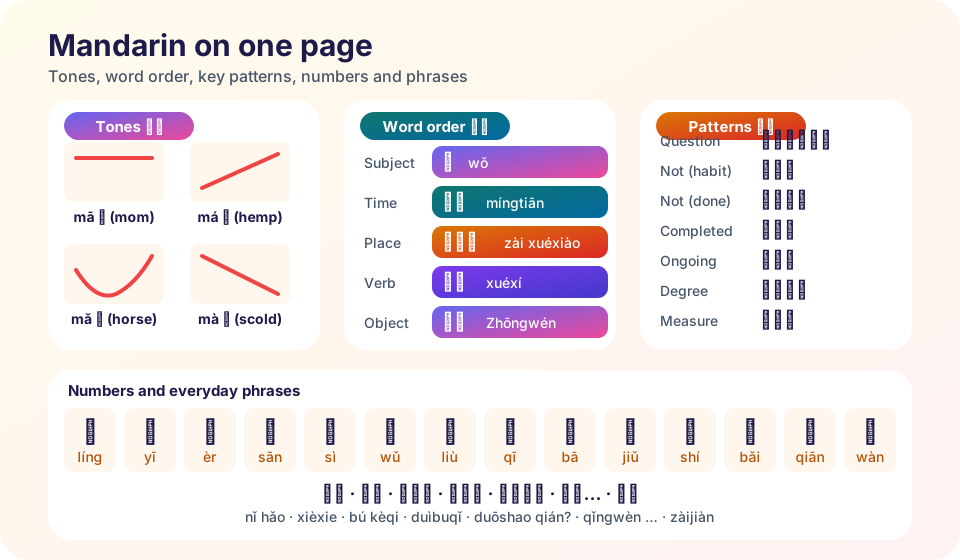
A cheat sheet works best as a tool, not a substitute for study. Use it in three ways. Before a conversation, skim the phrases table and say the five you are most likely to need. When you make a mistake, find the matching row and read its example aloud twice. At the end of each week, cover the right-hand column and try to produce each pattern from memory. If a row is hard to recall, it is the one to practice next.
What you will learn
- A one-page summary of the course's most important rules.
- How to build a correct sentence step by step.
- A short list of common mistakes to check yourself against.
Key terms
句型 (jùxíng): sentence pattern.
语序 (yǔxù): word order.
声调 (shēngdiào): tone.
常用语 (chángyòngyǔ): common expressions.
Tones
| Tone | Mark | Shape | Example |
|---|---|---|---|
| 1 | ā | high and flat | mā 妈 (mom) |
| 2 | á | rising | má 麻 (hemp) |
| 3 | ǎ | dipping (falls, then rises) | mǎ 马 (horse) |
| 4 | à | sharp falling | mà 骂 (to scold) |
| neutral | a | light and short | ma 吗 (question particle) |
Two sandhi rules: a third tone before another third tone becomes a rising tone (你好 is pronounced "ní hǎo"), and 一 and 不 change before a fourth tone (yí ge, bú shì).
Word order
Subject + Time + Place + Verb + Object: 我明天在学校学习中文。 (Wǒ míngtiān zài xuéxiào xuéxí Zhōngwén.) "Tomorrow I study Chinese at school." Time and place come before the verb. Duration and frequency come after it: 我学了两年中文。
Sentence patterns
| Idea | Pattern | Example |
|---|---|---|
| Yes/no question | statement + 吗 | 你是学生吗? |
| A-not-A question | verb + 不 + verb | 你去不去? |
| What / who / where | question word in place | 你叫什么名字? 图书馆在哪儿? |
| Not (habit, will, state) | 不 + verb | 我不吃肉。 |
| Not (done, have not) | 没(有) + verb | 我没吃饭。 我没去过。 |
| Completion | verb + 了 / sentence + 了 | 我吃了三个。 下雨了。 |
| Experience | verb + 过 | 我去过北京。 |
| In progress | 在 + verb | 我在学中文。 |
| Continuing state | verb + 着 | 门开着。 |
| Degree | verb + 得 + adjective | 他说得很好。 |
| Result | verb + result | 听懂, 吃完, 找到 |
| Can / cannot | verb + 得 / 不 + result | 看得懂, 听不懂 |
| Location | X 在 Y | 银行在超市旁边。 |
| Existence | place + 有 + X | 超市旁边有一家银行。 |
| Distance | A 离 B 近 / 远 | 学校离这儿很近。 |
Measure words connect numbers and nouns: 一个人, 两杯茶, 三本书, 四张票, 五家银行. Use 两 (not 二) before a measure word.
Numbers, money and time
| Idea | Chinese | Pinyin |
|---|---|---|
| 11, 20, 35 | 十一, 二十, 三十五 | shíyī, èrshí, sānshíwǔ |
| 101 | 一百零一 | yìbǎi líng yī |
| 100,000 | 十万 | shíwàn |
| ¥3.50 | 三块五 | sān kuài wǔ |
| 2:15 | 两点一刻 | liǎng diǎn yí kè |
| 2:30 | 两点半 | liǎng diǎn bàn |
| 14 Nov 2026 | 二零二六年十一月十四号 | èr líng èr liù nián shíyī yuè shísì hào |
| Saturday | 星期六 | xīngqī liù |
Everyday phrases
| Situation | Chinese | Pinyin |
|---|---|---|
| Greet | 你好 / 您好 | nǐ hǎo / nín hǎo |
| Thanks | 谢谢 / 不客气 | xièxie / bú kèqi |
| Sorry | 对不起 / 没关系 | duìbuqǐ / méi guānxi |
| Introduce | 我叫… 我是…人 | wǒ jiào … wǒ shì … rén |
| Price | 多少钱? 太贵了! | duōshao qián? tài guì le! |
| Ask the way | 请问,…在哪儿? | qǐngwèn, … zài nǎr? |
| Don't understand | 我听不懂。请再说一遍。 | wǒ tīng bu dǒng. qǐng zài shuō yí biàn. |
| Order food | 我要…。买单! | wǒ yào …. mǎidān! |
| Goodbye | 再见 | zàijiàn |
Common mistakes to check
Time after the verb. Say 我七点起床, not 我起床七点.
二 for 2 before a measure word. Say 两个人, 两点, not 二个人, 二点.
不 for the past. Say 我没去, not 我不去 ("I did not go").
了 as a past tense. 了 marks completion or change; many past sentences have no 了.
Missing 人 after the country. Say 我是美国人, not 我是美国.
Place after the verb. Say 我在家学习, not 我学习在家.
Try it
Press Run (or Ctrl + Enter) to see the result here.
Program input · what you'd type while the program runs
Type the answers before you press Run, one per line. Each time the program reads a line (with input()), it gets the next line from this box.
Check your understanding
Quick check · 5 questions
of 5 answered You scored / 5 · perfect!
-
1. What is the standard order for a sentence with time and place?
Time and place come before the verb: 我明天在学校学习中文. -
2. How do you say 'I did not eat'?
Use 没 for 'did not'. -
3. Which tone is dipping?
The third tone dips: mǎ. -
4. Which sentence is correct for 'two people'?
Use 两 before a measure word. -
5. What does 听不懂 mean?
V不C is the potential negative: cannot understand.
Summary
- Four tones plus neutral; tone sandhi for 3rd+3rd and for 一 and 不.
- Order: Subject + Time + Place + Verb + Object; duration after the verb.
- Core patterns: 吗, 不, 没, 了, 过, 在, 着, 得, result, can/cannot complements, 在 vs 有, 离.
- Numbers use digits plus 十, 百, 千, 万, 亿; 两 before measure words.
- A dozen phrases get you through greeting, thanking, shopping, asking the way and eating.
Track your progress
Create a free account to tick off lessons and pick up where you left off on any device.
of Mandarin Chinese for Beginners lessons completed