


















Lesson 4 of 44 · Getting Started
Chapter 1 review: getting started
Review chapter 1 of the Mandarin course: Mandarin and its names, scripts, the three pillars of the language, how to study, plus a 9-question quiz.
You have finished the first chapter. You now have the map of the territory: what Mandarin is, how it is written down, what makes it unusual and how to study it without burning out. This page collects the chapter on one picture and one table, lets you test yourself and points to what comes next.
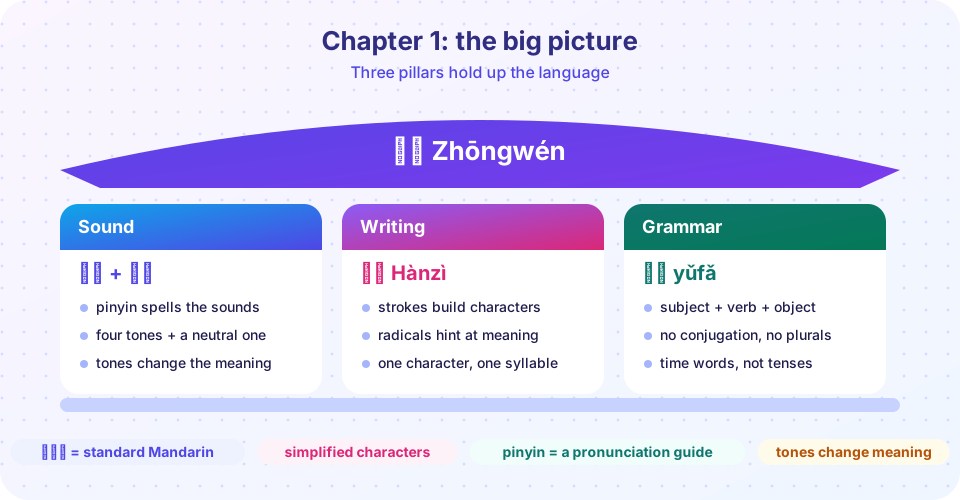
What you will learn
- a one-page recap of the chapter
- how well you remember the key facts, tested by a 9-question quiz
- what to do before moving on to pinyin
Recap table
| Topic | What to remember |
|---|---|
| Mandarin | The largest branch of the Chinese language family; its standard is 普通话 (mainland China), 国语 (Taiwan), 华语 (Singapore, Malaysia and overseas) |
| Other varieties | Wu (Shanghainese), Yue (Cantonese), Min (Hokkien), Hakka, Xiang, Gan: related but not mutually intelligible in speech |
| Writing | Characters (汉字), simplified in mainland China and Singapore, traditional in Taiwan, Hong Kong and Macau |
| Pinyin | A Latin-letter spelling of Mandarin sounds with tone marks, approved in 1958; a bridge to pronunciation, not a replacement for characters |
| Four features | Tones, characters, short regular grammar (no conjugation), measure words |
| Study loop | Listen, speak, read, write, review |
| Spaced review | Review at growing gaps: Day 1, 3, 7, 14, 30 as a starting point |
| Routine | 30 minutes a day beats an occasional marathon; review before new material |
The three pillars
Look at the picture again. The sound pillar is pinyin plus four tones and a neutral tone. The writing pillar is characters, built from strokes and recurring parts. The grammar pillar is a compact system: subject, verb, object, with time and place words before the verb, particles and measure words instead of endings. Chapter 2 takes the first pillar, chapter 3 the second and third, and chapter 4 adds the machinery for counting and asking.
Notice how little of this you can learn by reading alone. Sound needs your mouth, writing needs your hand and grammar needs sentences you actually build. That is why every lesson from here on has interactive work.
Key terms
普通话 Pǔtōnghuà: standard Mandarin of mainland China.
汉字 hànzì: Chinese characters.
拼音 pīnyīn: the Latin-letter spelling system for Mandarin.
声调 shēngdiào: tones.
复习 fùxí: review.
How to use this review
Read the recap table once, then close it and say the facts aloud from memory. Turn each row into a question for yourself: What are the three names of standard Mandarin? Which script does Taiwan use? What does the study loop contain? Anything you cannot answer in a few seconds goes on your review list, and you can add the answers to your flashcards today. A week later, come back and take the quiz again without looking. That second attempt, spaced a few days after the first, is the part that fixes the facts in memory.
Common misconceptions
"Pinyin is Chinese." Pinyin is a tool for sounds. Real Chinese writing uses characters. If you rely on pinyin alone, you cannot read signs, menus or messages in China.
"Simplified and traditional are different languages." They are two writing standards for the same language. The spoken language is the same.
"Study more hours to learn faster." Short, regular sessions with spaced review usually work better than long irregular ones.
Try it
Test yourself on the words and ideas from this chapter. Each card shows a question; think of the answer, then reveal it and mark yourself honestly. The deck repeats the cards you miss, which is a miniature of spaced repetition.
Check your understanding
Quick check · 9 questions
of 9 answered You scored / 9 · perfect!
-
1. Which name is used for standard Mandarin in Taiwan?
国语 (Guóyǔ, national language) is the usual name in Taiwan. 粤语 is Cantonese. -
2. Which is the main reason simplified characters were introduced?
Simplified characters have fewer strokes. They changed the written forms, not the spoken language. -
3. Which of these is NOT a branch of Chinese?
Pinyin is a spelling system, not a language branch. Hakka and Wu are both Chinese varieties. -
4. Which feature of Mandarin is true?
Every syllable has a tone or the neutral tone. Mandarin nouns and verbs do not take endings for number or person. -
5. What should you do before adding new material in a study session?
Review before new material keeps old words from slipping away. -
6. What does shadowing mean?
Shadowing trains your mouth and ear by imitating real speech. -
7. Which spelling shows a Chinese word with a tone mark in pinyin?
Standard pinyin writes tone marks over vowels: nǐ hǎo. Number spellings such as ni3 hao3 are common for typing. -
8. Why is it risky to learn only from pinyin?
Real Chinese uses characters. Pinyin is a scaffold that you should gradually remove. -
9. Which is the best description of a chunk?
Chunks carry tone, rhythm and grammar together, so they are quick to use in conversation.
Summary
- Mandarin is the largest branch of Chinese, with several regional names for its standard.
- Characters (simplified or traditional) carry the writing; pinyin carries the sounds.
- The language rests on three pillars: sound, writing and grammar.
- A short, daily routine with spaced review is the surest path.
Track your progress
Create a free account to tick off lessons and pick up where you left off on any device.
of Mandarin Chinese for Beginners lessons completed