


















Lesson 41 of 44 · Projects and Practice
Project: A Flashcard and Study Planner
Build a spaced-repetition routine for Mandarin: how to make good flashcards, a five-box Leitner system you can run in your browser, a simulation and a weekly plan.
Vocabulary is the fuel of conversation, and forgetting is the biggest obstacle: you learn a word on Monday and have lost it by Friday. The fix is not more hours but smarter timing. Spaced repetition means reviewing a card just before you would forget it, then waiting longer each time you succeed. This project explains the idea, shows you how to make good Chinese flashcards, runs a working five-box system in your browser, simulates it in Python, and ends with a weekly study plan you can follow.
What you will learn
- Why spaced repetition works and what active recall means.
- How to design flashcards for Chinese words, characters and sentences.
- How the five-box Leitner method works.
- How to estimate a daily workload and plan a week of study.
Key terms
间隔重复 (jiàngé chóngfù): spaced repetition.
主动回忆 (zhǔdòng huíyì): active recall, trying to remember before looking at the answer.
遗忘曲线 (yíwàng qūxiàn): forgetting curve; the idea, studied by Hermann Ebbinghaus in the 1880s, that memory fades quickly at first and then more slowly.
闪卡 (shǎnkǎ): flashcard.
Why spaced repetition works
Two ideas from memory research drive this method. First, retrieval strengthens memory: trying to recall an answer builds a stronger memory than rereading it. Second, spacing beats cramming: spreading out your reviews over days and weeks produces longer-lasting memory than the same time spent in one block. Ebbinghaus's forgetting curve captured the first observation that memory decays fast right after learning. Modern research on the "spacing effect" supports the second. The exact timings vary from person to person and from material to material, so treat any schedule as a starting point.
Making good flashcards for Chinese
A card is only as good as its design. Some rules that work well for Mandarin:
- One idea per card. A card with one word is easier to review than one with ten.
- Prefer words to isolated characters.
电话(diànhuà, telephone) is more useful than电and话separately, because words are what you meet in speech. - Include pinyin with tone marks on the answer side, and say it aloud before you check.
- Add a short example sentence to show how the word is used:
我的电话号码是…. - Make cards in both directions after the first week: Chinese to English (recognition) and English to Chinese (production).
- Add listening cards if your app supports audio: hear the word, recall the meaning.
- Keep cards short. If the answer needs a paragraph, split the card.
Example card (front and back):
| Front | Back |
|---|---|
| 电话 | diànhuà: telephone. 我的电话号码是… (My phone number is…) |
| telephone | 电话 diànhuà |
Many free apps already do the scheduling for you: Anki is a well-known spaced-repetition app, and dictionary apps such as Pleco include flashcards. The point of this lesson is to understand how the system works, so you can use any tool well.
A starter deck from this course
You do not need to build a deck from nothing. Take the words you have already met and sort them into themes: numbers and money (块, 毛, 斤, 折, 买单), time (点, 刻, 半, 差, 昨天), grammar words (了, 过, 在, 着, 得), directions (一直走, 左转, 右转, 旁边), family (爷爷, 外婆, 哥哥, 妹妹) and manners (您, 辛苦了, 干杯). Start with ten cards from one theme, add ten more each day, and mix the themes together after the first week so that you practice recalling a word without knowing which topic it belongs to. Cards for words you actually need this week are always the most motivating.
The Leitner box system
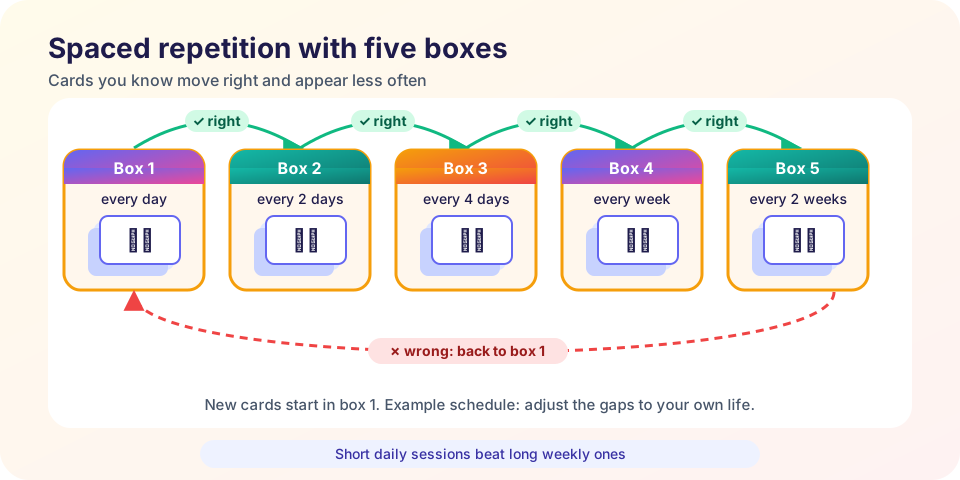
The Leitner method, devised by the German science journalist Sebastian Leitner in the 1970s, uses boxes to schedule reviews. In the version used here:
- There are five boxes with example review gaps: 1 day, 2 days, 4 days, 7 days, 14 days.
- Every new card starts in box 1.
- When you review a card and answer correctly, it moves one box right (reviewed less often).
- When you answer wrongly, it goes back to box 1.
- Only review the cards that are due on a given day.
Because correct cards are reviewed less and less often, your daily workload stays manageable even as your deck grows.
A daily workload estimate
If every answer is right, a card introduced today is reviewed after 1, 3, 7, 14 and 28 days, and then every 14 days. Because new cards arrive every day, each day's review pile is the sum of all those scheduled reviews. With perfect recall, the number of reviews per day is the number of new cards per day times the number of scheduled reviews that fit in the time since you started: 5 per card during the first month, then one more every 14 days. The planner below calculates this for you. Real numbers are higher because wrong answers send cards back to box 1, which is exactly the point: the system spends your time on the words you find hard.
A fixed top gap of 14 days makes the pile keep growing. Real spaced-repetition apps keep stretching the gap (to a month, then several months) for cards you know well, or let you retire cards. If your daily review pile starts to feel heavy, cut the number of new cards for a week or two.
A weekly study plan
A short, steady routine beats occasional marathons. Here is a plan for about 30 to 45 minutes a day:
| Day | Focus | Activities |
|---|---|---|
| Monday | New words | 10 new flashcards; say each aloud |
| Tuesday | Dialogue | One dialogue, three passes |
| Wednesday | Characters | Write 5 characters by hand; review radicals |
| Thursday | Listening | Short audio or video; note five new words |
| Friday | Speaking | Practice with a partner, tutor or by recording yourself |
| Saturday | Reading | Signs, menus, apps, graded readers |
| Sunday | Review | Flashcard backlog, a quiz, rest |
Every day also includes your flashcard review, about 5 to 10 minutes. Adjust the plan to your schedule, and do not skip a day entirely: even five minutes keeps the habit alive.
Common misconceptions
"More new cards a day means faster progress." Adding too many new cards creates a review pile you cannot keep up with. Ten new cards per day is a sustainable pace for most learners.
"If I recognize the card, I know it." Recognition is easier than recall. Say the answer aloud before turning the card.
"Flashcards are enough." They build vocabulary, but you still need listening, speaking, reading and writing practice in context.
"I should fix my schedule exactly." The best schedule is the one you will actually follow.
Try it
Press Run (or Ctrl + Enter) to see the result here.
Program input · what you'd type while the program runs
Type the answers before you press Run, one per line. Each time the program reads a line (with input()), it gets the next line from this box.
Press Run (or Ctrl + Enter) to see the console output here.
No output.
Check your understanding
Quick check · 5 questions
of 5 answered You scored / 5 · perfect!
-
1. What is spaced repetition?
Spaced repetition schedules reviews at longer and longer gaps as you remember. -
2. In the Leitner system, what happens when you answer wrongly?
A wrong answer sends the card back to box 1 for frequent review. -
3. Which makes a better flashcard for Chinese?
One idea per card, with pinyin and an example, works best. -
4. What is active recall?
Retrieving the answer yourself strengthens memory more than rereading. -
5. Why not add 50 new cards a day?
Too many new cards produce too many reviews. A steady, small number is more sustainable.
Summary
- Spaced repetition and active recall are the most efficient ways to hold vocabulary.
- Make one-idea cards with pinyin and a short example; use both directions.
- In the Leitner system, correct answers move a card right and wrong answers send it to box 1.
- Ten new cards a day plus short daily reviews is a sustainable routine; add listening, speaking and reading across the week.
Next: Glossary
Track your progress
Create a free account to tick off lessons and pick up where you left off on any device.
of Mandarin Chinese for Beginners lessons completed