


















Lesson 23 of 44 · Daily Life and Numbers
Money, Shopping and Ordering Food
Say prices with 块 and 毛, ask 多少钱, bargain politely, pay by phone, and order in a Chinese restaurant with ready-made phrases and dialogues.
With numbers in your pocket you can do real things: buy a bottle of water, haggle over fruit, split a bill and order dinner. In this lesson you will learn the money words, the phrases for shopping and paying (including the mobile payments that dominate Chinese cities), and a complete script for a restaurant meal. Every sentence is short and reusable. Learn them as chunks, then swap in your own words.
What you will learn
- The units of Chinese money and how to say any price.
- The core shopping phrases: asking prices, quantities, sizes and discounts.
- How payment works today: cash, QR codes and giving change.
- How to order food, state a preference and ask for the bill.
Key terms
块 (kuài) / 元 (yuán): yuan; 块 is spoken, 元 is written and formal.
毛 (máo) / 角 (jiǎo): a tenth of a yuan; 毛 is spoken, 角 is written.
打折 (dǎzhé): to give a discount; 八折 means you pay 80 percent.
买单 (mǎidān): "the bill, please", spoken in a restaurant.
斤 (jīn): the market weight unit, 500 grams.
Money words
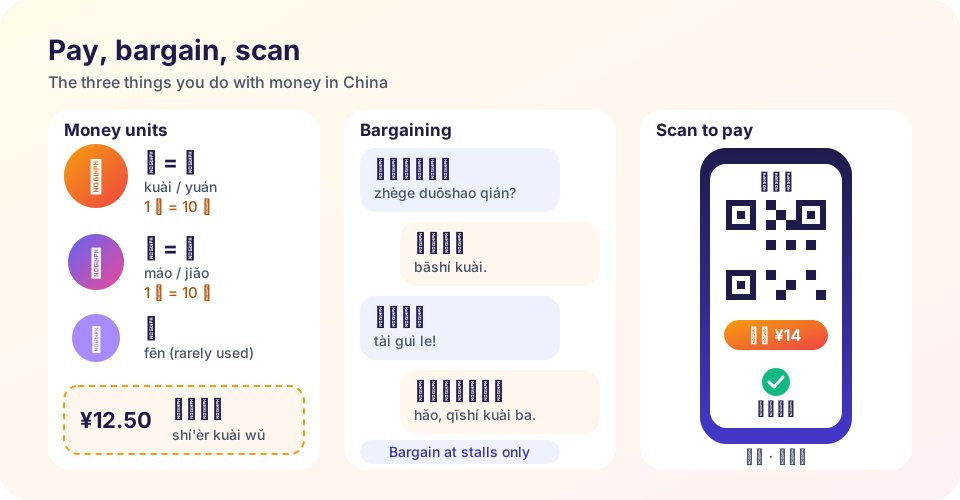
The currency is the renminbi (人民币, rénmínbì, "the people's money"), and its basic unit is the yuan. Prices are written with ¥ or 元, but in speech you say 块. The smaller units are 毛 (a tenth, so 10 máo make one kuài) and 分 (a hundredth), though 分 coins have almost vanished from daily life.
| Written | Spoken | Pinyin | Meaning |
|---|---|---|---|
| ¥2 | 两块 | liǎng kuài | 2 yuan |
| ¥0.50 | 五毛 | wǔ máo | 50 fen |
| ¥3.50 | 三块五 | sān kuài wǔ | 3 yuan 5 máo, final 毛 dropped |
| ¥12.05 | 十二块零五分 | shí'èr kuài líng wǔ fēn | note the 零 for the empty 毛 place |
| ¥100 | 一百块 | yìbǎi kuài | |
| ¥1,299 | 一千两百九十九块 | yìqiān liǎngbǎi jiǔshíjiǔ kuài |
Two rules from the last lesson reappear here. Use 两 before a measure word, so ¥2 is 两块, but 二十块 is ¥20. And in everyday speech the last unit is often dropped, so 三块五 is understood without 毛. In real conversation people also drop 块 when the context makes it obvious: a vendor who says 八十 probably means ¥80.
Asking about price
The key question is 多少钱? (duōshao qián?), literally "how much money". Put the thing in front: 这个多少钱? "How much is this?" For small, cheap things people use 几块钱? (jǐ kuài qián?), which expects a small answer. To ask for the total, use 一共多少钱? (yígòng duōshao qián?). For food sold by weight, ask 怎么卖? (zěnme mài?), "how is it sold?", and the seller replies with a price per 斤 (jīn). One jin is 500 grams; a kilogram is 一公斤 (yì gōngjīn) or 两斤.
A trap for later: in older measure language, 两 (liǎng) is also a small unit of weight (50 grams, a tenth of a jin). In markets you will mostly hear 斤, and 两 as a weight word appears in food and traditional medicine.
Shopping phrases
| Chinese | Pinyin | Meaning |
|---|---|---|
| 我要这个。 | Wǒ yào zhège. | I want this one. |
| 我想买一件衬衫。 | Wǒ xiǎng mǎi yí jiàn chènshān. | I would like to buy a shirt. |
| 有大一点的吗? | Yǒu dà yìdiǎn de ma? | Do you have a bigger one? |
| 可以试试吗? | Kěyǐ shìshi ma? | May I try it on? |
| 有别的颜色吗? | Yǒu bié de yánsè ma? | Do you have another color? |
| 太贵了! | Tài guì le! | Too expensive! |
| 能便宜一点吗? | Néng piányi yìdiǎn ma? | Can you make it a little cheaper? |
| 打折吗? | Dǎzhé ma? | Is there a discount? |
| 我再看看。 | Wǒ zài kànkan. | I will look around some more. |
| 就这些,谢谢。 | Jiù zhèxiē, xièxie. | That is all, thanks. |
太…了 (tài ... le) wraps an adjective to mean "too" or "very": 太贵了 (too expensive), 太好了 (great!). 一点 (yìdiǎn) means "a little" and softens requests: 便宜一点 is "a bit cheaper". Notice how 大一点的 ends in 的: it turns "a bigger" into a noun phrase, "a bigger one".
Bargaining
Bargaining (讲价, jiǎngjià or 砍价, kǎnjià) is expected at open-air markets, small stalls and tourist spots, and almost never in supermarkets, chain stores, malls or restaurants with printed prices. A friendly bargain is quiet and smiling: say 太贵了 once, propose a price, and be ready to walk away politely with 我再看看. Never get angry; the seller often calls a customer back with a better price.
Discounts
Discounts use 折 (zhé) and work in the opposite direction from English: the number says how many tenths of the price you pay. A sign saying 八折 means you pay 80 percent, a 20 percent discount. 五折 is half price, 九折 is 10 percent off. The verb is 打 (dǎ): 打八折 "give an 80 percent price".
Paying
In large Chinese cities almost everybody pays by phone, scanning a QR code through 微信支付 (Wēixìn zhīfù, WeChat Pay) or 支付宝 (Zhīfùbǎo, Alipay). The seller shows a code and you scan it, or you show yours and they scan it. Useful phrases:
| Chinese | Pinyin | Meaning |
|---|---|---|
| 可以扫码吗? | Kěyǐ sǎo mǎ ma? | Can I pay by scanning a code? |
| 我用现金。 | Wǒ yòng xiànjīn. | I will use cash. |
| 能刷卡吗? | Néng shuā kǎ ma? | Can I pay by card? |
| 找您两块。 | Zhǎo nín liǎng kuài. | Here is your change, 2 yuan. |
| 有零钱吗? | Yǒu língqián ma? | Do you have small change? |
| 要发票吗? | Yào fāpiào ma? | Do you want a receipt (invoice)? |
Foreign bank cards are accepted in more places than they used to be, but small shops and street stalls still prefer phone payment or cash, so carry some cash when you travel. Never rely on one payment method, and do not enter your real payment details anywhere unless you trust the app.
Ordering food
A restaurant script has a handful of moves, each with a short phrase:
- Seating. The host asks
几位?(jǐ wèi?), "how many people?" You answer两位(liǎng wèi), "two". - Menu.
请给我菜单。(Qǐng gěi wǒ càidān.) "Please give me the menu." - Ordering.
我要一碗面条。(Wǒ yào yì wǎn miàntiáo.) "I would like a bowl of noodles." The casual alternative is来一个…(lái yí ge...), "bring one...". - Preferences.
不要辣。(Bú yào là.) no spice;少放盐。(shǎo fàng yán) less salt;不要香菜。(bú yào xiāngcài) no cilantro;我对花生过敏。(Wǒ duì huāshēng guòmǐn.) "I am allergic to peanuts." Say that last one clearly if it applies to you. - Asking for advice.
有什么推荐的吗?(Yǒu shénme tuījiàn de ma?) "What do you recommend?" - Paying.
买单!(Mǎidān!) or结账。(Jiézhàng.) And for leftovers:打包。(Dǎbāo.) "To go, please."
| Food | Pinyin | Measure phrase |
|---|---|---|
| 米饭 | mǐfàn | 一碗米饭 (a bowl of rice) |
| 面条 | miàntiáo | 一碗面条 (a bowl of noodles) |
| 饺子 | jiǎozi | 一盘饺子 (a plate of dumplings) |
| 包子 | bāozi | 两个包子 (two steamed buns) |
| 茶 | chá | 一杯茶 (a cup of tea) |
| 水 | shuǐ | 一瓶水 (a bottle of water) |
Two dialogues
At a clothes stall
| Speaker | Chinese | Pinyin | English |
|---|---|---|---|
| 顾客 | 这件衬衫多少钱? | Zhè jiàn chènshān duōshao qián? | How much is this shirt? |
| 老板 | 一百二十块。 | Yìbǎi èrshí kuài. | 120 yuan. |
| 顾客 | 太贵了,八十块行吗? | Tài guì le, bāshí kuài xíng ma? | Too expensive. Is 80 okay? |
| 老板 | 一百,不能再便宜了。 | Yìbǎi, bù néng zài piányi le. | 100, I cannot go lower. |
| 顾客 | 好吧,我要了。可以扫码吗? | Hǎo ba, wǒ yào le. Kěyǐ sǎo mǎ ma? | Okay, I will take it. Can I scan to pay? |
| 老板 | 可以。 | Kěyǐ. | Of course. |
In a restaurant
| Speaker | Chinese | Pinyin | English |
|---|---|---|---|
| 服务员 | 您好,几位? | Nín hǎo, jǐ wèi? | Hello, how many? |
| 客人 | 两位。请给我们菜单。 | Liǎng wèi. Qǐng gěi wǒmen càidān. | Two. Please give us the menu. |
| 服务员 | 想吃点什么? | Xiǎng chī diǎn shénme? | What would you like to eat? |
| 客人 | 一盘饺子,一碗面条,不要辣。 | Yì pán jiǎozi, yì wǎn miàntiáo, bú yào là. | A plate of dumplings, a bowl of noodles, not spicy. |
| 服务员 | 喝什么? | Hē shénme? | And to drink? |
| 客人 | 两杯茶。 | Liǎng bēi chá. | Two cups of tea. |
| 客人 | 服务员,买单! | Fúwùyuán, mǎidān! | Waiter, the bill please! |
Common misconceptions
"You must bargain everywhere." Bargain only where prices are not printed: markets, stalls, some small independent shops. In a supermarket it is out of place.
"八折 means 8 percent off." It means you pay 8 tenths, 80 percent, so the discount is 20 percent.
"Say 元 when speaking." 元 is correct and appears on signs and receipts, but in conversation people say 块. Using 元 aloud sounds bookish.
"一斤 is one pound." One jin is 500 grams, a little more than a pound (about 454 grams).
Try it
Press Run (or Ctrl + Enter) to see the console output here.
No output.
Press Run (or Ctrl + Enter) to see the result here.
Program input · what you'd type while the program runs
Type the answers before you press Run, one per line. Each time the program reads a line (with input()), it gets the next line from this box.
Check your understanding
Quick check · 5 questions
of 5 answered You scored / 5 · perfect!
-
1. How do you say ¥2 in spoken Chinese?
Before the unit 块 you use 两, so ¥2 is 两块 (liǎng kuài). 两毛 would be 20 fen. -
2. A sign says 八折. What do you pay?
折 gives the tenths you pay: 八折 is 80 percent, a 20 percent discount. -
3. What does 买单 mean at a restaurant?
买单 (mǎidān) or 结账 (jiézhàng) asks for the bill. -
4. Which is the best sentence to ask about the price of a shirt?
多少钱 is the standard price question. 几位 asks about the number of people. -
5. Where is bargaining normal?
Bargaining belongs at stalls and markets where prices are not printed.
Summary
- Say yuan as 块 (written 元), a tenth as 毛 (written 角); 3.50 is 三块五.
- 多少钱 asks the price, 一共 gives the total, 怎么卖 asks how food is sold; 一斤 is 500 grams.
- 太…了, 一点 and 能…吗 make requests natural: 太贵了, 便宜一点, 能便宜一点吗.
- 折 states the share you pay: 八折 means 80 percent.
- Phone payments (微信支付, 支付宝) are everywhere, but carry cash; change is 找.
- At a restaurant: 几位, 菜单, 我要…, 不要辣, 买单, 打包.
Next: Chapter 5 review
Track your progress
Create a free account to tick off lessons and pick up where you left off on any device.
of Mandarin Chinese for Beginners lessons completed