


















Lesson 33 of 44 · Reading Characters
Reading Signs, Menus and Apps
Recognize the Chinese characters you meet every day: street and shop signs, warnings, restaurant menus and app buttons, plus how to type with pinyin.
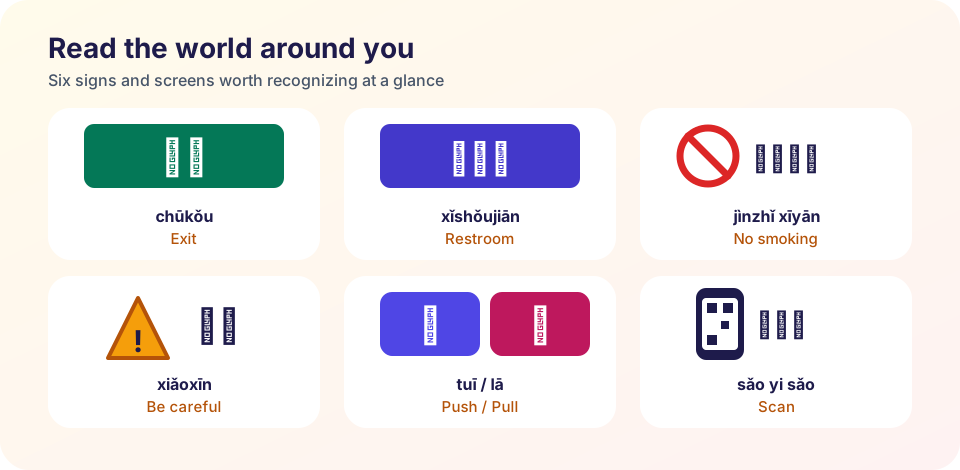
A beginner who can recognize about a hundred characters can already do a surprising amount in China: find the exit, choose the right toilet, understand a menu section and tap through a payment app. Real-life reading is also the best motivation for learning characters, because every sign you decode is a small victory. This lesson collects the vocabulary of the street, the restaurant and the phone, shows how to use the radicals you learned to guess meanings, and finishes with a quick guide to typing Chinese.
What you will learn
- Common public signs, warnings and shop words.
- Menu characters, including the radicals that mark cooking methods.
- Screen words on payment and chat apps.
- How to type Chinese with a pinyin keyboard.
- A simple strategy for reading characters you do not know.
Key terms
标志 (biāozhì): sign, mark.
菜单 (càidān): menu.
输入法 (shūrùfǎ): input method, the keyboard that turns pinyin into characters.
候选字 (hòuxuǎnzì): candidate characters shown while you type.
Public signs and places
| Chinese | Pinyin | Meaning |
|---|---|---|
| 出口 / 入口 | chūkǒu / rùkǒu | exit / entrance |
| 紧急出口 | jǐnjí chūkǒu | emergency exit |
| 厕所 / 洗手间 | cèsuǒ / xǐshǒujiān | toilet / restroom |
| 男 / 女 | nán / nǚ | men / women |
| 推 / 拉 | tuī / lā | push / pull (on doors) |
| 地铁 | dìtiě | subway |
| 火车站 | huǒchēzhàn | railway station |
| 机场 | jīchǎng | airport |
| 医院 | yīyuàn | hospital |
| 药店 | yàodiàn | pharmacy |
| 银行 | yínháng | bank |
| 超市 | chāoshì | supermarket |
| 邮局 | yóujú | post office |
| 饭店 / 餐厅 | fàndiàn / cāntīng | restaurant |
| 酒店 | jiǔdiàn | hotel (in mainland usage) |
Notice the radicals: 医 and 药 both relate to medicine, 银 has the metal radical 钅, and 饭 has the food radical 饣. Many place words share a final character: 店 (shop), 院 (a courtyard or institution), 站 (station), 场 (field, venue).
Directions and compass points
东 (dōng, east), 南 (nán, south), 西 (xī, west) and 北 (běi, north) appear on road signs and subway lines: 东路, 南大街, 北京 (Běijīng, "northern capital"), 南京 (Nánjīng, "southern capital"). Road signs usually show pinyin underneath the characters, which makes them a good place to practice matching sounds with characters.
Warnings and instructions
| Chinese | Pinyin | Meaning |
|---|---|---|
| 小心 | xiǎoxīn | be careful |
| 小心地滑 | xiǎoxīn dì huá | caution, slippery floor |
| 注意安全 | zhùyì ānquán | pay attention to safety |
| 禁止 | jìnzhǐ | prohibited |
| 禁止吸烟 | jìnzhǐ xīyān | no smoking |
| 请勿拍照 | qǐng wù pāizhào | please do not take photos |
| 请排队 | qǐng páiduì | please queue |
| 免费 | miǎnfèi | free of charge |
| 营业中 | yíngyè zhōng | open for business |
| 暂停营业 | zàntíng yíngyè | temporarily closed |
| 欢迎光临 | huānyíng guānglín | welcome (to a shop) |
The pattern 请勿 + verb ("please do not ...") is polite and appears on many notices. 禁止 + verb is firmer, a prohibition.
Reading a menu
Menus are arranged by type of food and cooking method. Learn a few cooking characters and you can read most items:
| Chinese | Pinyin | Meaning |
|---|---|---|
| 炒 | chǎo | stir-fried (炒饭 fried rice, 炒面 fried noodles) |
| 烤 | kǎo | roasted (烤鸭 roast duck) |
| 蒸 | zhēng | steamed |
| 红烧 | hóngshāo | red-braised (in soy sauce) |
| 汤 | tāng | soup |
| 面 / 饭 | miàn / fàn | noodles / rice or meal |
| 鸡 / 牛 / 猪 | jī / niú / zhū | chicken / beef / pork (add 肉 ròu for the meat) |
| 鱼 | yú | fish |
| 豆腐 | dòufu | tofu |
| 青菜 | qīngcài | green vegetables |
| 辣 / 甜 / 酸 / 咸 | là / tián / suān / xián | spicy / sweet / sour / salty |
A tip from the radicals: many cooking-method characters (炒, 烤, 烧) include the fire radical 火 or its four-dot form 灬, and 汤 has the water radical 氵. A menu line reads left to right as a short description: 红烧牛肉面 (hóngshāo niúròu miàn) is "red-braised beef noodles".
App screens
Phone apps are full of two-character commands. The most common ones:
| Chinese | Pinyin | Meaning |
|---|---|---|
| 扫一扫 | sǎo yi sǎo | scan |
| 登录 / 注册 | dēnglù / zhùcè | log in / sign up |
| 设置 | shèzhì | settings |
| 搜索 | sōusuǒ | search |
| 确认 / 取消 | quèrèn / qǔxiāo | confirm / cancel |
| 返回 | fǎnhuí | go back |
| 下一步 | xià yí bù | next step |
| 完成 | wánchéng | done |
| 分享 | fēnxiǎng | share |
| 保存 / 删除 | bǎocún / shānchú | save / delete |
| 支付 / 订单 | zhīfù / dìngdān | payment / order |
| 通讯录 | tōngxùnlù | contacts |
| 发现 | fāxiàn | discover |
| 我 | wǒ | me (your profile tab) |
When you pay by phone, look for 确认支付 (quèrèn zhīfù, "confirm payment") before you tap and be careful with the amount. Never enter payment details or passwords unless you are sure of the app you are using.
Typing Chinese: the pinyin keyboard
Almost everyone types Chinese with a pinyin input method. You type the sound in Latin letters without tone marks, and the keyboard shows candidate characters. For 你好, you type nihao, and the list offers 你好 first. Press the number or tap the one you want. If the sound has many matching characters (ma gives 吗, 妈, 马, 码, 骂 and more), the keyboard remembers which ones you pick most often and moves them forward. You can also type just the initials of a phrase on many keyboards, write with your finger on a handwriting pad, or dictate by voice.
Learning to type in pinyin is an excellent way to practice pronunciation, since you must know the sound to get the character. The only extra skill is recognizing the right character in the candidate list, which is exactly the reading skill you are building.
A strategy for unknown characters
When a character confronts you:
- Look for parts you know. Find the radical and the sound part.
请is讠(speech) plus青(qīng): "something spoken, sounds like qing". - Use context. A sign at a subway exit probably names a street or a number, not a poem.
- Check, then record. Point a camera translation or dictionary app at the character, then write down the pinyin and meaning. A short list of characters you meet in real life is more useful than any list from a book.
Practice: reading three real-world lines
Apply the strategy to three short examples that you could meet today.
A menu line: 红烧牛肉面 28元. Start from the end: 28元 is 28 yuan (the written word for the money unit). 面 is noodles. 牛肉 is beef, made of 牛 (ox, cow) and 肉 (meat). 红烧 is "red-braised", a cooking method you learned above. So: red-braised beef noodles, 28 yuan.
A notice: 请勿在此停车. 请勿 is "please do not" and 停车 (tíngchē) is "to park". The middle word 在此 (zài cǐ) means "here" in a formal, written style. Together: please do not park here. Even without knowing every character, the pattern 请勿 + verb gives the meaning away.
A shop door: 营业时间 9:00-21:00. 营业 (yíngyè) is "to do business", the same word as 营业中 ("open"), and 时间 (shíjiān) is "time". The numbers are the 24-hour clock: the shop is open from nine in the morning until nine in the evening. Say it aloud: 九点到晚上九点 (jiǔ diǎn dào wǎnshang jiǔ diǎn).
In each case you did not read every character, you combined a few known words, a pattern and the context. That is exactly how fluent readers also work: they do not decode each stroke, they recognize chunks.
Common misconceptions
"You need to know thousands of characters to function." For everyday signs and menus, a few hundred are enough, and the same ones repeat.
"Pinyin keyboards mean I never need to know characters." You still must recognize the right candidate and notice mistakes.
"A sign's translation word for word is the meaning." Many signs use set phrases (小心地滑); learn the phrase, not the parts.
"酒店 means a bar." Despite the 酒 (alcohol) in it, 酒店 usually means a hotel in mainland China. A bar is 酒吧 (jiǔbā).
Try it
Press Run (or Ctrl + Enter) to see the result here.
Program input · what you'd type while the program runs
Type the answers before you press Run, one per line. Each time the program reads a line (with input()), it gets the next line from this box.
Check your understanding
Quick check · 5 questions
of 5 answered You scored / 5 · perfect!
-
1. What does 出口 mean?
出 means out and 口 means mouth or opening: 出口 is an exit; 入口 is an entrance. -
2. Which of these means 'please do not take photos'?
请勿 + verb means 'please do not'; 拍照 is to take photos. -
3. On a payment screen, what does 确认 mean?
确认 (quèrèn) is confirm; 取消 is cancel and 设置 is settings. -
4. What do you type to get 你好 on a pinyin keyboard?
You type the pinyin without tone marks and choose from the candidates. -
5. The cooking character 炒 means:
炒 is stir-fried (炒饭 fried rice); steamed is 蒸 and roasted is 烤.
Summary
- A few hundred characters cover everyday signs, menus and app screens.
- Place and sign vocabulary: 出口, 入口, 厕所, 推, 拉, 地铁, 医院, 小心, 禁止, 请勿.
- Menu characters: 炒, 烤, 蒸, 汤, 面, 饭, 辣; cooking-method characters often contain the fire radical.
- App words: 扫一扫, 登录, 设置, 搜索, 确认, 取消, 支付.
- Type with pinyin without tones and pick the right candidate; unknown characters can be decoded with radicals, sound parts and context.
Next: Chapter 7 review
Track your progress
Create a free account to tick off lessons and pick up where you left off on any device.
of Mandarin Chinese for Beginners lessons completed