


















Lesson 42 of 44 · Projects and Practice
Glossary of Key Terms
A searchable glossary of key Mandarin words, grammar terms, characters and cultural terms from the course, with pinyin and English, plus a self-quiz.
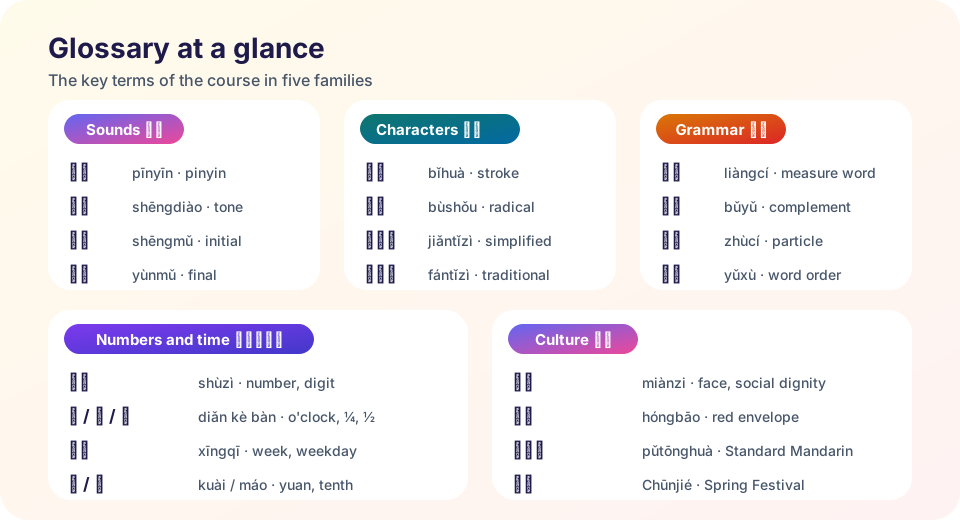
This glossary collects the terms and words you have met in the course, grouped by theme. Each entry gives the Chinese, the pinyin with tone marks and a short English meaning. Use the tables for quick review, the search tool to look something up, and the quiz to test yourself. Entries come from the chapters on numbers and money, time and aspect, characters and conversation and culture, plus the core language and grammar terms of the course. Words from earlier chapters, such as greetings and pronouns, are covered in the first half of the course.
What you will learn
- A compact reference of the course vocabulary with pinyin and meanings.
- How the terms group into families, which makes them easier to remember.
- How to search and quiz yourself on the terms.
Key terms
词汇 (cíhuì): vocabulary.
词典 (cídiǎn): dictionary.
生词 (shēngcí): a new word.
复习 (fùxí): to review.
Language and study terms
| Chinese | Pinyin | Meaning |
|---|---|---|
| 汉语 | Hànyǔ | the Chinese language |
| 普通话 | pǔtōnghuà | Standard Mandarin |
| 拼音 | pīnyīn | pinyin, the Romanization system |
| 声调 | shēngdiào | tone |
| 声母 | shēngmǔ | initial (consonant at the start of a syllable) |
| 韵母 | yùnmǔ | final (vowel part of a syllable) |
| 汉字 | Hànzì | Chinese characters |
| 简体字 | jiǎntǐzì | simplified characters |
| 繁体字 | fántǐzì | traditional characters |
| 词 | cí | word |
| 句子 | jùzi | sentence |
| 语法 | yǔfǎ | grammar |
| 语序 | yǔxù | word order |
| 量词 | liàngcí | measure word |
| 助词 | zhùcí | particle |
| 补语 | bǔyǔ | complement |
| 体 | tǐ | aspect (the shape of an action) |
Numbers, money and food
| Chinese | Pinyin | Meaning |
|---|---|---|
| 零 | líng | zero |
| 十 / 百 / 千 | shí / bǎi / qiān | ten / hundred / thousand |
| 万 / 亿 | wàn / yì | ten thousand / one hundred million |
| 两 | liǎng | two (before measure words and units) |
| 幺 | yāo | one (read aloud in phone numbers) |
| 第 | dì | prefix for ordinal numbers |
| 块 / 元 | kuài / yuán | yuan (spoken / written) |
| 毛 / 角 | máo / jiǎo | a tenth of a yuan (spoken / written) |
| 斤 | jīn | a unit of weight, 500 grams |
| 多少钱 | duōshao qián | how much is it? |
| 一共 | yígòng | in total |
| 贵 / 便宜 | guì / piányi | expensive / cheap |
| 折 | zhé | discount (the tenths you pay) |
| 菜单 | càidān | menu |
| 服务员 | fúwùyuán | waiter, attendant |
| 买单 | mǎidān | the bill, please |
| 打包 | dǎbāo | to take away (leftovers) |
Time, aspect and complements
| Chinese | Pinyin | Meaning |
|---|---|---|
| 年 / 月 / 日 | nián / yuè / rì | year / month / day |
| 号 | hào | day of the month (spoken) |
| 星期 | xīngqī | week, weekday |
| 点 | diǎn | o'clock |
| 分 | fēn | minute; also a hundredth of a yuan |
| 刻 | kè | quarter of an hour |
| 半 | bàn | half |
| 差 | chà | short of |
| 今天 / 明天 / 昨天 | jīntiān / míngtiān / zuótiān | today / tomorrow / yesterday |
| 了 | le | completion, or a new situation |
| 过 | guo | have ever done (experience) |
| 在 | zài | in the middle of doing; at |
| 着 | zhe | continuing state |
| 没 | méi | not (for completed actions and 过) |
| 得 | de | links a verb to a degree complement |
| 完 | wán | finish (result complement) |
| 懂 | dǒng | understand (result complement) |
| 来 / 去 | lái / qù | toward the speaker / away from the speaker |
Characters and reading
| Chinese | Pinyin | Meaning |
|---|---|---|
| 笔画 | bǐhuà | stroke |
| 笔顺 | bǐshùn | stroke order |
| 部首 | bùshǒu | radical |
| 偏旁 | piānpáng | side component of a character |
| 形声字 | xíngshēngzì | phonetic-semantic compound |
| 声旁 / 形旁 | shēngpáng / xíngpáng | sound part / meaning part |
| 同音字 | tóngyīnzì | homophone character |
| 出口 / 入口 | chūkǒu / rùkǒu | exit / entrance |
| 输入法 | shūrùfǎ | input method (keyboard) |
Conversation and travel
| Chinese | Pinyin | Meaning |
|---|---|---|
| 自我介绍 | zìwǒ jièshào | self-introduction |
| 姓 / 名字 | xìng / míngzi | family name / name |
| 家 | jiā | home, family |
| 爷爷 / 奶奶 | yéye / nǎinai | father's father / father's mother |
| 外公 / 外婆 | wàigōng / wàipó | mother's father / mother's mother |
| 哥哥 / 姐姐 | gēge / jiějie | older brother / older sister |
| 弟弟 / 妹妹 | dìdi / mèimei | younger brother / younger sister |
| 属 | shǔ | to belong to a zodiac sign |
| 怎么走 | zěnme zǒu | how do I get there? |
| 一直走 | yìzhí zǒu | go straight |
| 左转 / 右转 | zuǒ zhuǎn / yòu zhuǎn | turn left / turn right |
| 旁边 / 对面 | pángbiān / duìmiàn | beside / opposite |
| 坐 / 骑 / 开 | zuò / qí / kāi | ride (as a passenger) / ride (astride) / drive |
| 打车 | dǎchē | take a taxi |
| 地铁 | dìtiě | subway |
Culture
| Chinese | Pinyin | Meaning |
|---|---|---|
| 您 | nín | polite "you" |
| 师傅 | shīfu | master; polite address for drivers and skilled workers |
| 面子 | miànzi | face, social dignity |
| 红包 | hóngbāo | red envelope with money |
| 春节 | Chūnjié | Spring Festival, Chinese New Year |
| 中秋节 | Zhōngqiū Jié | Mid-Autumn Festival |
| 端午节 | Duānwǔ Jié | Dragon Boat Festival |
| 干杯 | gānbēi | cheers (dry glass) |
Confusing pairs
Some of the hardest glossary entries come in pairs that look or sound alike. Make a contrast card for each pair, with one example sentence on each side.
| Pair | The difference | Example |
|---|---|---|
| 块 / 元 | same value; 块 is spoken, 元 is written | 三块 (speech), ¥3 / 3元 (writing) |
| 二 / 两 | 二 for counting, tens and digits; 两 before measure words | 二十, 两个人 |
| 不 / 没 | 不 for habits, wishes, future, states; 没 for "did not" and "have not" | 我不去, 我没去 |
| 了 / 过 | 了 for completion or change; 过 for experience | 我去了, 我去过 |
| 在 (at) / 有 (there is) | 在 says where something is; 有 says what exists in a place | 银行在这儿, 这儿有银行 |
| 你 / 您 | 您 is the polite form | 您好, 你好 |
| 坐 / 骑 / 开 | passenger / ride astride / drive | 坐地铁, 骑车, 开车 |
| 哪儿 / 那儿 | where? (3rd tone) / there (4th tone) | 你在哪儿? 在那儿。 |
| 他 / 她 / 它 | he / she / it, all pronounced tā | 他, 她, 它 |
How to learn the glossary
A glossary is not something you read once. The best way to learn it is to use the terms in sentences you write or say yourself. Choose five entries a day, say each aloud with its pinyin, and make up one short sentence for each. Review the confusing pairs weekly, because they are the ones you will mix up under pressure. When you meet a new word in real life, add it to your own glossary with a source note, such as where you saw it, and you will remember both the word and the moment.
Try it
Press Run (or Ctrl + Enter) to see the result here.
Program input · what you'd type while the program runs
Type the answers before you press Run, one per line. Each time the program reads a line (with input()), it gets the next line from this box.
Check your understanding
Quick check · 5 questions
of 5 answered You scored / 5 · perfect!
-
1. What is 量词?
量词 (liàngcí) is the measure word, such as 个 or 杯. -
2. What does 买单 ask for?
买单 (mǎidān) means 'the bill, please'. -
3. What does 了 mark?
了 marks a completed action or a change of situation; 过 marks experience. -
4. Which is the polite form of 'you'?
您 (nín) is the respectful 'you'. -
5. What is 红包?
红包 is a red envelope given at festivals, weddings and birthdays.
Summary
- Terms fall into families: language and grammar, numbers and money, time and aspect, characters, conversation and culture.
- Learn words in families and in phrases, not as isolated list items.
- Review the glossary with the search tool and the self-quiz every week.
Next: Cheat sheet
Track your progress
Create a free account to tick off lessons and pick up where you left off on any device.
of Mandarin Chinese for Beginners lessons completed