


















Lesson 3 of 44 · Getting Started
How to study Chinese effectively
A practical study plan for Mandarin beginners: listen, speak, read, write and review, spaced repetition, a weekly schedule and common mistakes to avoid.
Most people who stop learning Chinese do not stop because it is too hard. They stop because their routine breaks. A study plan that fits into ordinary life beats a heroic plan that lasts two weeks. This lesson gives you a small, sustainable system, and it explains why each part works, so you can adapt it to your own life.
What you will learn
- the five habits of a balanced beginner routine
- why spaced review works, and how to schedule it
- a realistic weekly plan for 20 to 40 minutes a day
- the most common beginner mistakes and how to avoid them
Key terms
Spaced repetition means reviewing material at growing intervals, just before you would forget it.
Retrieval practice means trying to recall something from memory instead of just rereading it.
Shadowing means repeating a speaker's words right after hearing them, copying rhythm and tones.
Chunk means a whole phrase learned as one unit, such as 你好吗 (nǐ hǎo ma), rather than three separate words.
The five habits
A balanced beginner routine touches five skills. They support each other, so do not drop one for long.
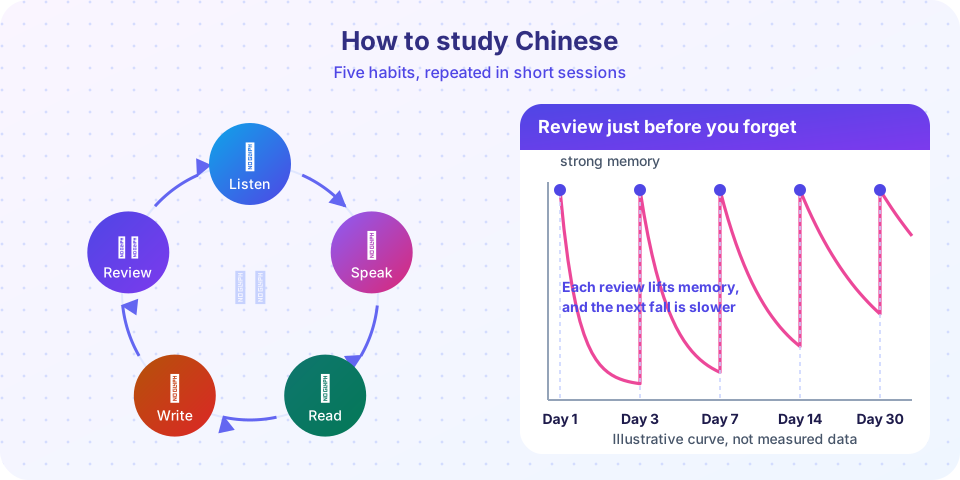
- Listen (听, tīng). Hear real Chinese every day: short dialogues, slow podcasts for learners, songs and children's videos. At first you will understand little. That is fine. Your ear is learning the tones and the rhythm, which no text can teach.
- Speak (说, shuō). Say every new word and sentence aloud, ideally to a person. Even speaking to yourself helps. A language exchange partner or a tutor, even once a week, is the best investment you can make.
- Read (读, dú). Read the dialogues in this course in characters, then in pinyin only to check. Later chapters teach you to read short texts.
- Write (写, xiě). Write a few characters by hand each day. You do not need to be able to write 3,000 characters by hand, because most people type them. But handwriting a few hundred early on builds recognition, and the strokes make the structure of characters visible.
- Review (复习, fùxí). Come back to old material in a planned way. This is the habit that decides whether things stay.
Why spaced review works
In 1885 the German psychologist Hermann Ebbinghaus published experiments on memorizing nonsense syllables and showed that forgetting is fastest soon after learning and then slows. Later research on memory confirms two practical points. First, retrieving something from memory strengthens it much more than reading it again. Second, spreading your reviews over time beats cramming them into one session. Put together, these give the classic recipe: test yourself on a new item, then again after a day or so, then after a few days, a week, a few weeks. Every successful recall pushes the next review further out.
The exact intervals vary between systems, and the best intervals depend on how hard an item is for you. A reasonable beginner schedule is Day 1, Day 3, Day 7, Day 14 and Day 30 after first learning, which is what the picture above shows. If you fail to recall an item, move it back to a short interval. Flashcard apps such as Anki automate this, but paper cards in a shoebox work too. The classic paper version, the Leitner system, uses several boxes: a correct card moves up one box, which is reviewed less often, and a wrong card goes back to box 1.
The tool below prints a review calendar for any day you learn something new.
Press Run (or Ctrl + Enter) to see the result here.
Program input · what you'd type while the program runs
Type the answers before you press Run, one per line. Each time the program reads a line (with input()), it gets the next line from this box.
A realistic weekly plan
Here is a plan for 30 minutes a day, five or six days a week. Change the times to match your day, but keep the shape.
| Part | Minutes | What you do |
|---|---|---|
| Review | 10 | Flashcards or the quizzes from earlier lessons, said aloud |
| New material | 10 | One lesson section or a few new words and a dialogue |
| Listening | 5 | A short dialogue or a learner podcast, twice |
| Speaking or writing | 5 | Shadow a dialogue, or write five characters by hand |
Once a week, add a longer session: re-read a chapter review, talk with a partner or tutor, and write a short message about your day in simple Chinese, however clumsy. At the end of each chapter, take the review quiz again a few days later without looking.
A simple rule keeps you honest: review before new material. When the review pile is large, learn less new content that day. A big pile is a sign that you are going too fast, not that you should skip it.
Plan your pace
Words per day is a planning number, not a promise. The widget below lets you set your own assumptions and see where they lead. It does not predict how fast you will learn: your memory, your free time and the difficulty of the words all matter.
Mistakes to avoid
Learning only from pinyin. Pinyin is a scaffold, not the language. Learners who never read characters stall when real texts, signs and menus appear. Use pinyin beside characters from the start, then gradually cover it.
Skipping tones "for now". Words learned with the wrong tone must later be unlearned, which is harder than learning them right. Learn every new word with its tone, aloud, from day one.
Memorizing single words only. Real Chinese is made of phrases. Learn 你好吗, 不客气 and 我是学生 as chunks and you get grammar, rhythm and tones in one go.
Waiting until you are "ready" to speak. You will never feel ready. Start with five minutes of simple conversation a week and let mistakes teach you.
Collecting resources instead of using them. Choose one main course (this one), one listening source and one flashcard tool. Finish things.
Common misconceptions
"Adults cannot learn tones." Adults can learn tones, but it takes focused listening. Research on adult learners shows improvement with targeted practice, though individual differences exist. Be patient and record yourself.
"More hours in one weekend equals the same as daily practice." Memory consolidates with sleep and spacing, so short daily sessions usually beat one long session.
"If I cannot write characters by hand I cannot read them." Reading and writing are separate skills. Most people type. Handwriting helps recognition early on but is not required to read.
Check your understanding
Quick check · 4 questions
of 4 answered You scored / 4 · perfect!
-
1. What does spaced repetition mean?
Reviews are spread out and the gaps grow as the memory strengthens. -
2. Which activity is retrieval practice?
Retrieval practice means pulling an answer from memory, which strengthens it more than passive rereading. -
3. Why is it better to learn 你好吗 as a chunk than as three separate words?
Whole phrases give you ready-to-use language and a feel for natural rhythm. -
4. What is a good rule when your review pile gets big?
A big pile means you are adding too fast. Reviewing first keeps what you know from slipping away.
Summary
- A balanced routine includes listening, speaking, reading, writing and review.
- Spaced retrieval practice (Day 1, 3, 7, 14, 30 as a starting point) keeps words in memory.
- Thirty focused minutes a day, with review before new material, beat occasional long sessions.
- Avoid pinyin-only learning, skipped tones, isolated words and endless resource collecting.
Next: Chapter 1 review
Track your progress
Create a free account to tick off lessons and pick up where you left off on any device.
of Mandarin Chinese for Beginners lessons completed