


















Lesson 29 of 44 · Time, Aspect and Complements
Chapter 6 Review: Time, Aspect and Complements
Review chapter 6: dates and clock words, aspect markers 了 过 在 着, and result, degree, direction and potential complements, with a word-order game and quiz.
This chapter handled the three ideas that make Chinese verbs work without tenses: when (time words), what shape (aspect words) and what result (complements). The picture below shows how they stack in one sentence. Use the table to check your memory, then play with the word-order game and finish with the quiz.
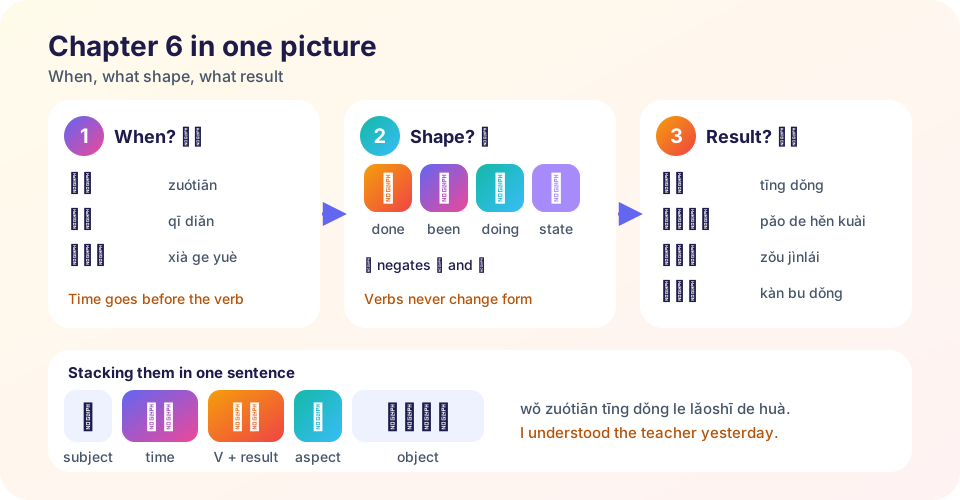
Recap table
| Topic | What to remember | Example | Lesson |
|---|---|---|---|
| Dates | Year → month → day; 号 spoken, 日 written | 十一月十四号 shíyī yuè shísì hào | Dates and clock |
| Weekdays | 星期 + 一…六; Sunday 日 or 天 | 星期六 xīngqī liù | Dates and clock |
| Clock | 点 hour, 刻 quarter, 半 half, 差 short of; 两点 for 2:00 | 两点一刻 liǎng diǎn yí kè | Dates and clock |
| Word order | Time before the verb, big to small | 我明天下午三点去学校。 | Dates and clock |
| 了 | Completion (after verb) or new situation (end) | 下雨了。 我吃饭了。 | Aspect markers |
| 过 | Experience; negate with 没…过 | 我去过北京。 | Aspect markers |
| 在 / 着 | Action in progress / lasting state | 我在学中文。 门开着。 | Aspect markers |
| Result complement | Verb + result; negate with 没 | 听懂, 吃完, 找到 | Complements |
| Degree complement | V + 得 + description | 他跑得很快。 | Complements |
| Direction | 上 下 进 出 回 过 + 来 / 去 | 请进来。 | Complements |
| Potential | V得C can, V不C cannot | 听不懂, 买不起 | Complements |
| Duration | After the verb | 学了两年中文 | Complements |
Mistakes to watch for
Learners most often slip in four places. They put the time after the verb. They think 了 is a past tense and add it everywhere, or they use 不 where 没 is needed. They say 二点 instead of 两点. They forget 很 in a degree complement. If you catch yourself on any of these, go back to the matching section and read the examples out loud.
When you build a sentence, work in the same order the sentence runs: subject, time, (place), verb, result, aspect, object. Then check the negation: 没 for past and completed, 不 for habits, wishes and the future.
Worked example: from English to Chinese in four steps
Take an English sentence and build its Chinese version piece by piece: "Yesterday afternoon I finished my homework, and then I studied Chinese for an hour."
- Time first. "Yesterday afternoon" is
昨天下午(zuótiān xiàwǔ). Big unit first, and before the verb. - Subject.
我(wǒ), placed after the time word (or before it, since both are fine). - Verb with result and aspect. "Finished" is the result complement
完, and the action is complete, so:做完了作业(zuò wán le zuòyè). The verb is做, the result is完, the aspect is了. - Second clause with a duration. "Studied Chinese for an hour" puts the length after the verb:
学了一个小时中文(xué le yí ge xiǎoshí Zhōngwén). The word然后(ránhòu, "then") connects the two clauses.
The result: 昨天下午我做完了作业,然后我学了一个小时中文。 (Zuótiān xiàwǔ wǒ zuò wán le zuòyè, ránhòu wǒ xué le yí ge xiǎoshí Zhōngwén.) Now negate and question it: 我还没做完作业。 (Wǒ hái méi zuò wán zuòyè.) "I haven't finished my homework yet." 你做完作业了吗? (Nǐ zuò wán zuòyè le ma?) "Have you finished your homework?" Notice that every move you made came from this chapter, and that the verb 做 never changed its form.
Self-check
You have the chapter if you can:
- Read a date and a clock time aloud, in both the formal and the everyday way.
- Put a time word in its correct place without thinking.
- Choose among
了,过,在and着for a short English sentence and say why. - Negate with
没and不correctly. - Say
我听不懂and他跑得很快and explain what不and得do.
Try it
Press Run (or Ctrl + Enter) to see the console output here.
No output.
Check your understanding
Quick check · 10 questions
of 10 answered You scored / 10 · perfect!
-
1. What does 我吃饭了 most naturally mean?
Sentence-final 了 marks a completed or new situation: I have eaten. -
2. How do you say 'I haven't eaten yet'?
Use 还没 + verb for 'not yet', and do not add 了. -
3. Which sentence has the correct word order?
Time words come before the verb. -
4. How do you say 4:45 colloquially (one form)?
三刻 is three quarters of an hour, 45 minutes. -
5. Which word marks 'have ever done'?
过 marks experience: 去过, 吃过. -
6. What does 听不懂 mean?
V不C is the potential negative: cannot achieve the result. -
7. Which sentence means 'He runs very fast'?
Degree complements use 得 after the verb: 跑得很快. -
8. 'Come in' said from inside the room is:
来 marks movement toward the speaker. -
9. Where does duration go in 'I studied Chinese for two years'?
Duration follows the verb: 学了两年中文. -
10. What does 门开着 describe?
着 describes a continuing state: the door is open.
Summary
- Time words say when and go before the verb; verbs never change form.
- 了 marks completion or change, 过 experience, 在 progress, 着 a lasting state; negate completed actions and experiences with 没, not 不.
- Complements follow the verb: result (听懂), degree (跑得很快), direction (进来), potential (听不懂), duration (学了两年).
- Next chapter: reading Chinese characters, from strokes and radicals to real signs.
Track your progress
Create a free account to tick off lessons and pick up where you left off on any device.
of Mandarin Chinese for Beginners lessons completed