


















Lesson 15 of 44 · Measure Words and Questions
Chapter 4 overview: counting and asking
A big-picture preview of Mandarin measure words, yes/no questions, question words, 这/那 and the particle 的, plus the numbers 1 to 10 you need first.
By now you can name yourself, say who someone is, describe things and negate a sentence. Chapter 4 adds the two systems that make Mandarin sound like Mandarin: measure words, the little counting words that sit between a number and a noun, and questions, which need no word-order change at all. Along the way you will meet "this" and "that", and the little word 的 that shows who owns what. This overview shows how the pieces fit before the details.
What you will learn
- what a measure word is and why Chinese uses them
- the numbers 1 to 10, which you need for counting
- the four tools for asking questions
- how 这, 那 and 的 fit the picture
- what each lesson in this chapter covers
Key terms
Measure word (量词, liàngcí) is a counting word that goes between a number (or 这, 那) and a noun: 三个人.
Question particle (疑问助词, yíwèn zhùcí) is a word such as 吗 that turns a statement into a question.
Question word (疑问词, yíwèncí) is a word such as 谁 or 什么 that stands for the unknown information.
Demonstrative (指示词, zhǐshìcí) points: 这 (this), 那 (that).
Numbers 1 to 10
You need these ten words for almost everything in this chapter.
| Number | 一 | 二 | 三 | 四 | 五 | 六 | 七 | 八 | 九 | 十 |
|---|---|---|---|---|---|---|---|---|---|---|
| Pinyin | yī | èr | sān | sì | wǔ | liù | qī | bā | jiǔ | shí |
| Value | 1 | 2 | 3 | 4 | 5 | 6 | 7 | 8 | 9 | 10 |
Watch the two special cases. 二 and 两. For a plain number, 二 (èr) is "two": 二, 十二, 二十. But before a measure word, "two" is almost always 两 (liǎng): 两个人 (liǎng gè rén, two people). 一 changes tone (yí, yì, yī) depending on the next syllable, as you saw in chapter 2. Both points come up again in the next lessons.
The counting pattern
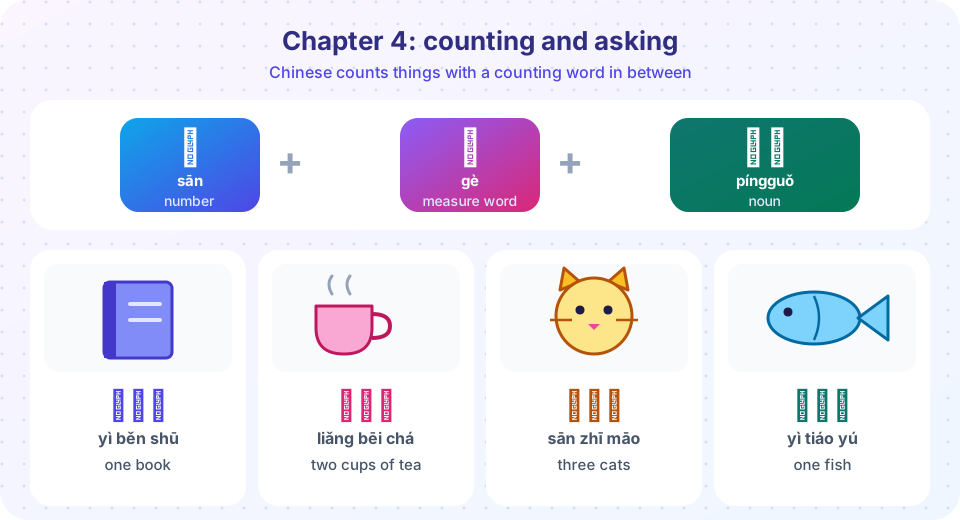
In English you can say "three apples" or "two people". In Mandarin, a number cannot touch a noun directly. A measure word must stand between them:
Number + measure word + noun
| Chinese | Pinyin | Literal | English |
|---|---|---|---|
| 三个苹果 | sān gè píngguǒ | three item apple | three apples |
| 一本书 | yì běn shū | one volume book | one book |
| 两杯茶 | liǎng bēi chá | two cup tea | two cups of tea |
| 一只猫 | yì zhī māo | one (animal) cat | one cat |
English has a small version of this idea: "a cup of tea", "a pair of shoes", "three head of cattle". Mandarin simply does it for all counting. The most general measure word, 个 (gè), works for people and many ordinary things. Other measure words are tied to a shape or kind: 本 (běn) for bound things like books, 张 (zhāng) for flat things, 只 (zhī) for small animals, 条 (tiáo) for long, thin things. The next lesson teaches the main ones.
Counting things
三个苹果 sān gè píngguǒ
Yes/no questions
Question words
The question word sits where the answer goes.
This, that, of
Asking questions
Mandarin questions do not move words around. You keep the statement's order and use one of a few tools.
- Add 吗 (ma) to a statement for a yes/no question: 你是学生吗?
- Repeat the verb with 不 (the "verb-not-verb" pattern): 你是不是学生?
- Use a question word that stands where the answer would be: 你叫什么名字? (what is your name?)
- Offer a choice with 还是 (háishi): 你喝茶还是咖啡? (tea or coffee?)
You do not need to learn a new sentence structure for each question. You learn the question words (谁, 什么, 哪, 哪儿, 几, 怎么, 为什么, 多少) and drop them into place.
This, that and 的
The demonstratives 这 (zhè, this) and 那 (nà, that) combine with measure words: 这本书 (zhè běn shū, this book), 那个人 (nà gè rén, that person). The particle 的 (de) links an owner or a description to a noun: 我的书 (wǒ de shū, my book). The last content lesson of the chapter covers both.
What this chapter covers
- This overview.
- Measure words. Nine measure words to start with, the rule for 个, 两 and 二, and how to choose.
- Yes/no questions. 吗, V不V, 吧, 呢 and 还是.
- Question words. Who, what, which, where, how many, how, why, with sample dialogues.
- 这, 那 and 的. Pointing, possession and describing.
- Chapter 4 review. A cheat sheet and a ten-question quiz.
Common misconceptions
"Measure words are optional." They are not: "三苹果" is wrong; 三个苹果 is right. The only common exceptions are some units (年 nián year, 天 tiān day) and fixed forms you learn as vocabulary.
"There is one right measure word for each noun." Often there is a default, but some nouns accept several, and 个 is a safe fallback in everyday speech when you are unsure.
"Questions need a rising voice." The words and particles mark the question. You may raise your voice slightly, but the tones of the words stay.
Try it
First, a counting builder. Choose a noun and a number, and see the phrase with the right measure word, the right form of "two" and the right tone of 一.
Second, a Python numbers table that also builds the numbers up to 99 (a preview of chapter 5) and shows 个 with each number.
Press Run (or Ctrl + Enter) to see the result here.
Program input · what you'd type while the program runs
Type the answers before you press Run, one per line. Each time the program reads a line (with input()), it gets the next line from this box.
Check your understanding
Quick check · 5 questions
of 5 answered You scored / 5 · perfect!
-
1. Which pattern is correct for counting things in Mandarin?
A measure word must stand between the number and the noun: 三个苹果. -
2. How do you say 'two people'?
Before a measure word, 'two' is 两 (liǎng): 两个人. -
3. Which tool makes a statement into a yes/no question?
吗 (ma) at the end of a statement makes it a yes/no question. -
4. Where does a question word such as 什么 go in the sentence?
Mandarin keeps the statement order: 你叫什么名字? ~ 我叫王明。 -
5. What does 这本书 mean?
这 (this) + 本 (measure word for books) + 书 (book).
Summary
- Counting uses number + measure word + noun; 个 is the general measure word.
- Numbers 1 to 10: yī, èr, sān, sì, wǔ, liù, qī, bā, jiǔ, shí; use 两 for "two" before measure words.
- Questions keep statement order: add 吗, repeat the verb with 不, use a question word, or offer a choice with 还是.
- 这 and 那 point; 的 links owner and thing.
Next: Measure words
Track your progress
Create a free account to tick off lessons and pick up where you left off on any device.
of Mandarin Chinese for Beginners lessons completed