


















Lesson 14 of 44 · Characters and Basic Grammar
Chapter 3 review: characters and basic grammar
Review chapter 3 of the Mandarin course: strokes, stroke order, radicals, pronouns, 是, word order, 不, 没 and 很, with a cheat sheet and a 10-question quiz.
Chapter 3 gave you two things at once: a way to look at characters and the skeleton of a Mandarin sentence. This review puts both on one page, lets you practice spotting common mistakes and then tests the whole chapter in ten questions. When you can explain each rule in your own words, with an example, you are ready for chapter 4.
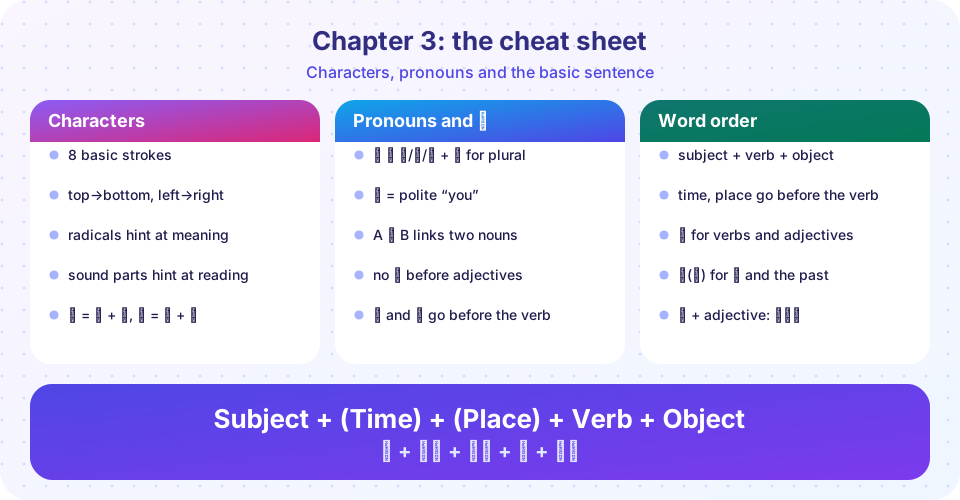
What you will learn
- a one-page recap of strokes, radicals, pronouns, 是 and basic word order
- how to spot and fix the most common beginner mistakes
- which parts to revisit before chapter 4
Recap table
| Topic | What to remember | Example |
|---|---|---|
| Strokes | eight basic strokes; compound strokes | 横 héng, 竖 shù, 撇 piě, 捺 nà |
| Stroke order | top→bottom, left→right, horizontal→vertical, 撇 before 捺, outside→inside, close the box last | 十, 人, 国 |
| Radicals | recurring parts that hint at meaning | 氵 water: 河; 讠 speech: 说; 亻 person: 你 |
| Character types | pictographs, meaning pairs, meaning + sound (the largest group) | 日, 明, 妈 |
| Pronouns | 我 你 他/她/它 + 们 for plurals; 您 polite | 我们, 你们, 他们 |
| 是 | A 是 B; negative 不是 (bú shì); never before an adjective | 我是学生。 |
| 也, 都 | after the subject, before the verb; 也 before 都 | 我们也都是学生。 |
| Word order | S + (time) + (place) + V + O | 我明天在家学中文。 |
| 不 and 没 | 不 for verbs and adjectives; 没(有) for 有 and the past | 我不去; 我没有书 |
| Adjectives | act like verbs: 很 + adjective; no 是; drop 很 when negating | 她很忙; 她不忙 |
Key terms
Radical: a recurring component that hints at meaning.
Stroke order: the standard sequence for writing the strokes.
不 / 没: the two common negatives.
很: a light "very" that links a subject to an adjective.
Why these pieces fit together
Notice a theme. Chinese expresses relationships with position and small words, not with endings. The subject comes first, the verb after it, and time and place slot in between. Characters also work by position: radicals sit in predictable places, and strokes follow a fixed order from top to bottom and left to right. Once you see that Chinese likes left-to-right and top-to-bottom order everywhere, from the way you write a character to the way you build a sentence, the language feels more logical.
Another theme is economy. A single verb form serves all persons and tenses; a single negative word handles most verbs; a single linking adverb makes adjectives sentence-ready. The price is that you must watch the little words, and you must hear and say tones. That is why the next chapter adds measure words and questions, the two systems that give Mandarin most of its everyday flavor.
How to use this review
Cover the right-hand column of the recap table and try to produce each example from the left-hand rule. Then write five or six sentences of your own about yourself, using the skeleton: who you are with 是, what you do with a verb, where and when with 在 and time words, and what you do not do with 不 or 没. Read your sentences aloud, checking tones. Finally, write ten characters from the chapter by hand, with the correct stroke order, and name the radical of each. These three small exercises make the grammar and the characters feel like skills rather than facts.
Common misconceptions
"Chinese has no rules." It has fewer inflection rules but strong word-order rules. Put time and place before the verb and the sentence works.
"A radical tells you the full meaning." It points to a category only.
"I can use 不 for every negative." Use 没 with 有.
"Plural 们 works everywhere." Use it for pronouns and optionally for people nouns, never with numbers.
Try it
The error-spotter shows a sentence with one common mistake. Choose the correct version. Read the corrected sentence aloud each time.
Check your understanding
Quick check · 10 questions
of 10 answered You scored / 10 · perfect!
-
1. In which order do you write the strokes of 人?
撇 (left-falling) comes before 捺 (right-falling). -
2. Which radical hints at speech, as in 说, 请, 谢?
讠 is the speech radical. -
3. Which is the largest category of Chinese characters?
Most characters combine a meaning part and a sound part. -
4. How do you say 'We are all teachers'?
都 goes after the subject and before the verb: 我们都是老师. -
5. Which sentence is correct for 'I will go to Beijing tomorrow'?
Time words go before the verb: 我明天去北京. -
6. How do you say 'I don't have a car' (车 chē, car)?
没有 negates 有. -
7. What is wrong with '她是很高'?
Adjectives do not need 是. -
8. When 不 is followed by 是, how is it said?
不 becomes bú before a fourth tone: bú shì. -
9. Which is the polite form of 'you' for one person?
您 (nín) is the polite singular 'you'. -
10. What does 她不忙 mean?
不 + adjective, without 很: she is not busy.
Summary
- Characters follow stroke-order rules and are built from radicals and sound parts.
- Pronouns plus 们 form plurals; 是 links nouns; adjectives need 很, not 是.
- The sentence skeleton is S + (time) + (place) + V + O; 不 negates verbs and adjectives, 没 negates 有.
- Chapter 4 adds measure words and questions.
Track your progress
Create a free account to tick off lessons and pick up where you left off on any device.
of Mandarin Chinese for Beginners lessons completed