


















Lesson 21 of 44 · Daily Life and Numbers
Chapter 5 Overview: Daily Life and Numbers
A map of chapter 5: Chinese numbers, money, shopping and ordering food, with a sample market dialogue, a deck of slides and a preview of each lesson.
So far you have learned how to greet people, how tones work and how a basic Mandarin sentence is built. This chapter takes you out of the classroom and into the street. You will count, ask what things cost, pay with cash or a phone, and order a meal. Numbers come first, because almost every real-life exchange in China involves one: a price, a time, a phone number, a floor, a bus line.
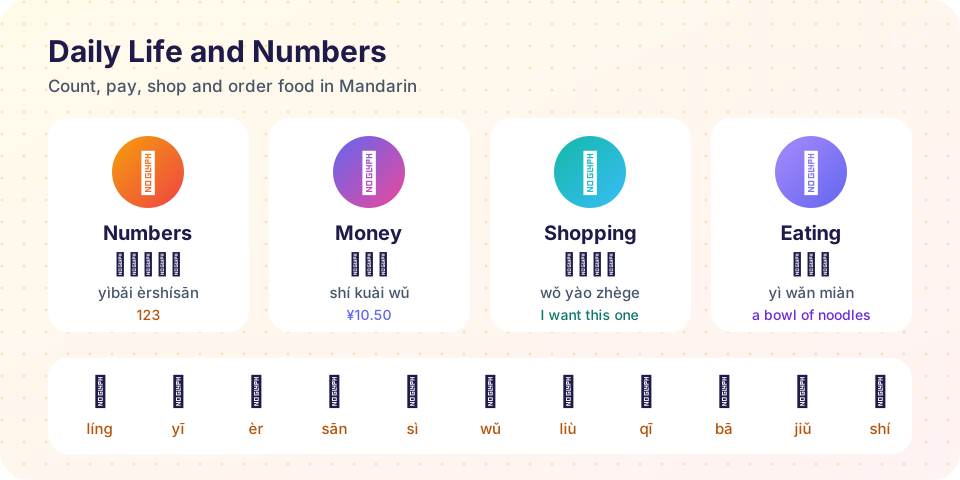
What you will learn
- How the Chinese number system is built, and why it is easier than English once you see the pattern.
- How to read and say prices, from small change to thousands of yuan.
- Which quantity words go with food, drinks and goods.
- How to shop, bargain politely and pay in a modern Chinese city.
- How to order in a restaurant without pointing at the menu in panic.
Key terms
数字 (shùzì): number, digit.
块 (kuài) and 元 (yuán): the spoken and written word for the main unit of money, the yuan.
多少钱 (duōshao qián): "how much does it cost?"
买单 (mǎidān): "the bill, please".
The chapter in slides
Numbers are the foundation
If you can say 1 to 10, you can say 1 to 99.
Money talk
Shopping
At the table
A first taste: the market
Read this dialogue slowly. You do not need to know every word yet; notice how many of the words are numbers or money words.
| Speaker | Chinese | Pinyin | English |
|---|---|---|---|
| 顾客 (customer) | 老板,这个苹果多少钱? | Lǎobǎn, zhège píngguǒ duōshao qián? | Boss, how much are these apples? |
| 老板 (seller) | 八块一斤。 | Bā kuài yì jīn. | Eight yuan per jin (half a kilogram). |
| 顾客 | 太贵了!六块行吗? | Tài guì le! Liù kuài xíng ma? | Too expensive! Is six okay? |
| 老板 | 七块吧,今天的很甜。 | Qī kuài ba, jīntiān de hěn tián. | Seven, then; today's are very sweet. |
| 顾客 | 好,我要两斤。 | Hǎo, wǒ yào liǎng jīn. | Fine, I will take two jin. |
| 老板 | 一共十四块。 | Yígòng shísì kuài. | Fourteen yuan altogether. |
Notice three things. First, the seller says 八块 and not 八元: spoken Chinese uses 块 for the yuan. Second, "two jin" is 两斤, not 二斤; you will learn this 二 versus 两 rule in the next lesson. Third, the customer bargains: that is normal at a fruit stall, but you would never do it in a supermarket.
What each lesson covers
- Numbers from zero to a hundred million: the full number system, reading phone numbers and years, and the 一 and 二 puzzles.
- Money, shopping and ordering food: prices, bargaining, mobile payment and a complete restaurant script.
- Chapter 5 review: a one-page summary and a ten-question quiz.
How to study this chapter
Say every number aloud, even when you are alone. Numbers are the one area where a small drill session pays off immediately, because you will meet them every day. Try to read the prices and numbers you see in the real world: bus numbers, shop prices in photos or videos, your own phone number. A course cannot replace speaking with people, so use every real chance you get, even a quick order at a local Chinese restaurant, to practice for real.
Do not translate numbers back into English in your head. Learn to hear sān shí wǔ and picture 35 directly. The earlier you drop the translation step, the faster you will follow real speech.
Check your understanding
Quick check · 3 questions
of 3 answered You scored / 3 · perfect!
-
1. In spoken Chinese, what is the usual word for the yuan?
块 is the everyday spoken word; 元 (yuán) is the written and formal word. -
2. Which phrase asks the price of something?
多少钱 (duōshao qián) literally means 'how much money'. -
3. What does 一共十四块 mean?
一共 (yígòng) means 'in total', so the sentence gives the total price.
Summary
- This chapter covers numbers, money, shopping and food, the vocabulary of daily errands.
- Numbers are built from ten digits and a few big units, so you can say any number once you know the pattern.
- 块 is the spoken yuan; 多少钱 asks the price; 买单 asks for the bill.
- Bargaining is normal at markets, not in shops with fixed prices.
Track your progress
Create a free account to tick off lessons and pick up where you left off on any device.
of Mandarin Chinese for Beginners lessons completed