


















Lesson 38 of 44 · Conversation and Culture
Culture, Etiquette and Festivals
Learn Chinese etiquette in plain terms: forms of address, polite phrases, table manners, gifts, red envelopes, lucky numbers, festivals and regional language differences.
Grammar gets you understood; etiquette gets you welcomed. Chinese culture has its own habits for greeting people, sharing a meal, giving a gift and celebrating festivals, and a small amount of knowledge will help you avoid awkward moments and make good impressions. This lesson is a friendly guide, not a rulebook. Customs differ between regions, generations and families, and many people, especially younger people in big cities, are relaxed about tradition. Treat what follows as common patterns you are likely to meet, and watch what the people around you do.
What you will learn
- How to address people by name and title, and when to use 您.
- The everyday polite phrases and how to answer compliments.
- Table manners at a Chinese meal.
- Gift-giving customs, red envelopes and lucky and unlucky numbers.
- The main festivals and their greetings.
- How Mandarin varies between regions.
Key terms
面子 (miànzi): "face", social dignity and reputation.
红包 (hóngbāo): red envelope, a gift of money.
您 (nín): the polite form of "you".
普通话 (pǔtōnghuà): Standard Mandarin, the common spoken language.
Forms of address
Chinese people usually address each other by surname + title, not by first name. A teacher called Wang is 王老师 (Wáng lǎoshī), a manager called Li is 李经理 (Lǐ jīnglǐ), a doctor called Zhang is 张医生 (Zhāng yīshēng). The word 老师 is a respectful way to address teachers and also experts and many professionals. A driver or skilled worker is often 师傅 (shīfu). For a man or woman without a known title, 先生 (xiānsheng) "Mr." and 女士 (nǚshì) "Ms." are polite.
Among colleagues and friends of similar age, people add 小 (xiǎo, "young") or 老 (lǎo, "old") before the surname: 小王, 老王. Use 小 for someone younger than you and 老 for someone older, but do not use 老 with someone who is much older if you are not close; use the title instead. Children traditionally call adults they do not know 叔叔 (shūshu, "uncle") and 阿姨 (āyí, "auntie").
The polite pronoun 您 (nín) is used to show respect to elders, teachers, customers and strangers in formal situations: 您好, 您贵姓, 请您坐. Between friends and with children, 你 is fine. If you are unsure, 您 never offends.
Polite phrases
| Situation | Chinese | Pinyin | Meaning |
|---|---|---|---|
| thanks | 谢谢 / 不客气 | xièxie / bú kèqi | thank you / you're welcome |
| apology | 对不起 / 没关系 | duìbuqǐ / méi guānxi | sorry / it's okay |
| excuse me | 不好意思 | bù hǎoyìsi | sorry to bother you; embarrassed |
| asking a favor | 麻烦你… | máfan nǐ … | sorry to trouble you, could you… |
| thanking effort | 辛苦了 | xīnkǔ le | thank you for your hard work |
| leaving a host | 打扰了 / 慢走 | dǎrǎo le / màn zǒu | sorry to have bothered you / take care (host says) |
| compliment | 哪里哪里 | nǎlǐ nǎlǐ | not at all (modest reply) |
Answering compliments
If someone says 你的中文说得真好! (Nǐ de Zhōngwén shuō de zhēn hǎo!) "Your Chinese is really good!", the traditional modest reply is 哪里哪里,我还要多练习。 (Nǎlǐ nǎlǐ, wǒ hái yào duō liànxí.) "Not at all, I still need much more practice." Simply saying 谢谢 is perfectly fine for foreigners and is widely understood; modest answers show you know the custom. Between very close friends and family, repeated 谢谢 can feel a little formal, and people may reply with a smile and a shared joke instead.
Everyday greetings
Besides 你好, a classic greeting among neighbors and acquaintances is 吃了吗? (Chī le ma?), "Have you eaten?" It is not an invitation; it is the equivalent of "How are you?", and the answer is 吃了,你呢? (Chī le, nǐ ne?). Another friendly greeting is 去哪儿? (Qù nǎr?), "Where are you going?", which is also not nosy. A light, vague answer such as 出去一下 (chūqù yíxià, "going out for a bit") is fine.
Face and indirectness
面子 (miànzi) means "face": a person's dignity and standing in front of others. Chinese people often avoid criticizing or refusing someone directly in public, because it would make that person lose face. A refusal may sound like 我考虑一下 (wǒ kǎolǜ yíxià, "I will think about it") or 不太方便 (bú tài fāngbiàn, "not very convenient"). Learn to listen for these soft refusals, and give feedback privately and gently. It is good manners, not dishonesty.
At the table
Meals are social events, often with shared dishes placed in the center of a round table, sometimes on a turntable. Some customs:
- The host usually orders many dishes and insists you eat more:
多吃点儿!(Duō chī diǎnr!) You can politely say够了,谢谢(gòu le, xièxie), "that is enough". - Wait for the eldest person or the host to start. In a formal seating plan the seat of honor is traditionally the one facing the door, so let the host guide you to your seat.
- Use serving chopsticks or spoons (
公筷, gōngkuài) if they are provided. - Never stick chopsticks upright in a bowl of rice: it resembles incense burned for the dead. Do not point with chopsticks or tap them on the bowl.
- Toasting:
干杯!(Gānbēi!) literally "dry the glass".随意(suíyì, "as you like") lets a guest drink at their own pace. Tradition says to lower your glass rim slightly below an elder's when clinking. - Tea: pour for others before yourself. In Cantonese-speaking regions, people thank the pourer by tapping two fingers on the table.
- Paying: friends often argue cheerfully over the bill,
我来!(Wǒ lái!), "I'll get it!" The person who invited usually pays. Splitting is各付各的(gè fù gè de) orAA制(AA zhì), more common among younger friends.
Gifts
When you visit someone's home, bring a small gift such as fruit, tea or sweets. Offer and receive gifts with both hands. Many people do not open a gift in front of the giver. Traditionally, certain gifts are avoided because their names sound like something unlucky: a clock (钟 zhōng, close to 送终, sòngzhōng, "attend someone's death"), an umbrella (伞 sǎn, like 散 sàn, "break apart"), or sharing a pear (梨 lí, like 离 lí, "separate"). Red and gold wrapping is festive; white and black are associated with funerals.
Lucky and unlucky numbers
Numbers matter because of how they sound. 八 (bā) sounds like 发 (fā, "to get rich"), so 8 is considered very lucky, and phone numbers and license plates with many eights are prized. 六 (liù) is associated with smoothness, 九 (jiǔ) sounds like 久 (long-lasting), and 四 (sì) sounds like 死 (sǐ, "death"), so some buildings skip floors or room numbers with a 4. These are cultural beliefs held to different degrees, not universal rules.
Red envelopes
A red envelope, 红包 (hóngbāo), is a gift of money in a red packet, given at Spring Festival, weddings and birthdays, usually by older people to younger ones. The amount should be tasteful, and amounts that include 8 are popular while 4 is avoided. Today people also send digital red envelopes on chat apps: 发红包 (fā hóngbāo, "send a red envelope").
Festivals and greetings
| Occasion | Greeting | Pinyin |
|---|---|---|
| Spring Festival | 春节快乐! / 新年快乐! | Chūnjié kuàilè! / Xīnnián kuàilè! |
| New Year wish | 恭喜发财! | Gōngxǐ fācái! (congratulations and prosperity) |
| Mid-Autumn | 中秋节快乐! | Zhōngqiū Jié kuàilè! |
| Dragon Boat | 端午节快乐! | Duānwǔ Jié kuàilè! |
| Birthday | 生日快乐! | Shēngrì kuàilè! |
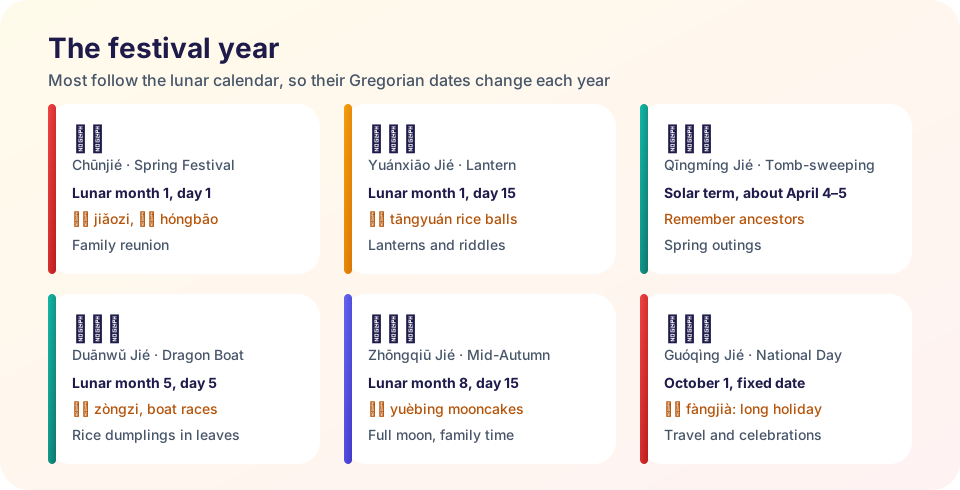
The Spring Festival (春节) is the biggest holiday, when hundreds of millions of people travel home, and families gather for a reunion dinner. The lunar date of each festival moves from year to year relative to the Gregorian calendar, except National Day (October 1).
One language, many accents
Standard Mandarin is called 普通话 (pǔtōnghuà) in mainland China, 国语 (Guóyǔ) in Taiwan and 华语 (Huáyǔ) in Singapore and Malaysia. They are largely the same, with differences in some words and in pronunciation. Mandarin is also not the only Chinese language: Cantonese (粤语 Yuèyǔ), Shanghainese (上海话 Shànghǎihuà) and Hokkien (闽南语 Mǐnnányǔ) are different spoken languages, though they share the same writing system. Many Chinese people grew up speaking both a local language and Mandarin, and their Mandarin often carries an accent.
Some of the regional differences you may notice:
- In the north, speakers add an r-sound to words (
儿化érhuà):哪儿,一点儿,玩儿(wánr, "to play"). - In many southern accents,
zh,chandshsound likez,cands. - Word choice varies: a taxi is
出租车(chūzūchē) in the mainland and计程车(jìchéngchē) in Taiwan; software is软件(ruǎnjiàn) in the mainland and軟體(ruǎntǐ) in Taiwan.
Do not worry about accents. Clear tones and everyday phrases will take you far, and most speakers are used to hearing many accents.
A dinner invitation
| Speaker | Chinese | Pinyin | English |
|---|---|---|---|
| 王阿姨 | 欢迎欢迎!请进,请坐。 | Huānyíng huānyíng! Qǐng jìn, qǐng zuò. | Welcome! Please come in and sit down. |
| 大卫 | 谢谢您!这是给您的一点水果。 | Xièxie nín! Zhè shì gěi nín de yìdiǎn shuǐguǒ. | Thank you! This is some fruit for you. |
| 王阿姨 | 哎呀,太客气了!快喝茶。 | Āiyā, tài kèqi le! Kuài hē chá. | Oh, you are too kind! Have some tea. |
| 大卫 | 您做的菜真香! | Nín zuò de cài zhēn xiāng! | The food you cooked smells wonderful! |
| 王阿姨 | 多吃点儿,别客气! | Duō chī diǎnr, bié kèqi! | Eat more, don't be shy! |
| 大卫 | 谢谢,我吃饱了。打扰了。 | Xièxie, wǒ chī bǎo le. Dǎrǎo le. | Thank you, I'm full. Sorry to have troubled you. |
Common misconceptions
"All Chinese people follow every traditional custom." Practices vary by region, age and family. Use these as common patterns, not as laws.
"Mandarin is the same as Chinese." Chinese is a family of related languages. Mandarin is the standard and most widely spoken one.
"A refusal is always a clear no." A soft refusal may sound like agreement. Listen for the indirect phrases.
"Foreigners must follow all etiquette perfectly." Most hosts forgive mistakes and appreciate your effort.
Try it
Press Run (or Ctrl + Enter) to see the console output here.
No output.
Press Run (or Ctrl + Enter) to see the result here.
Program input · what you'd type while the program runs
Type the answers before you press Run, one per line. Each time the program reads a line (with input()), it gets the next line from this box.
Check your understanding
Quick check · 5 questions
of 5 answered You scored / 5 · perfect!
-
1. Which form of address is respectful for a teacher named Wang?
Surname + 老师 is the respectful form. -
2. What do you never do with chopsticks at the table?
Upright chopsticks in rice resemble incense at funerals. -
3. Which number is considered lucky because of its sound?
八 (bā) sounds like 发 (fā), 'to get rich'. -
4. What is 普通话?
普通话 is Standard Mandarin; Cantonese is 粤语. -
5. How do you give and receive a gift politely?
Using both hands shows respect.
Summary
- Address people by surname + title (王老师, 李经理) and use 您 for respect.
- Learn the polite set: 谢谢/不客气, 对不起/没关系, 麻烦你, 辛苦了, 哪里哪里.
- At the table: the host orders for everyone, no upright chopsticks, toast with 干杯, argue happily over the bill.
- Gifts go with both hands; red envelopes carry money; 8 is lucky, 4 is avoided.
- Festivals follow the lunar calendar (春节, 元宵节, 端午节, 中秋节) except National Day on October 1.
- Mandarin has regional accents and vocabulary; Chinese is a family of related languages.
Next: Chapter 8 review
Track your progress
Create a free account to tick off lessons and pick up where you left off on any device.
of Mandarin Chinese for Beginners lessons completed