


















Lesson 22 of 44 · Daily Life and Numbers
Numbers from Zero to a Hundred Million
Learn Mandarin numbers from 0 to 100 million: the building pattern, the zero rule, 万 and 亿, 二 versus 两, tone changes of 一, phone numbers and years.
Chinese numbers are the friendliest part of the language. English has odd words like "eleven", "twelve" and "thirteen" that you simply have to memorize. Mandarin has no such surprises: once you know the ten digits you can say every number up to 99 by combining them, in exactly the way you read them. Eleven is "ten-one", twenty is "two-ten", thirty-five is "three-ten-five". This lesson shows the whole system, from small change to a hundred million, and the few traps that remain.
What you will learn
- The ten digits and the word for zero.
- How to build 11 to 99 and 100 to 9,999 with the zero rule.
- How 万 and 亿 work, and why Chinese groups digits by four.
- When to say 二 and when to say 两, and how 一 changes its tone.
- How to read phone numbers, years, fractions and percentages.
Key terms
数字 (shùzì): a number or digit.
零 (líng): zero, also the "gap" word inside numbers like 105.
两 (liǎng): the form of "two" used before measure words and before 百, 千, 万 and 亿.
第 (dì): the prefix that makes an ordinal, such as 第一 "first".
The ten digits
Memorize these first. Tones matter: sì (four) and shí (ten) differ only in the vowel and tone, and a wrong tone here can cost you money at the market.
| Number | Character | Pinyin | Sounds like (rough guide) |
|---|---|---|---|
| 0 | 零 | líng | "ling", rising tone |
| 1 | 一 | yī | "ee", high flat tone |
| 2 | 二 | èr | "ar", falling tone |
| 3 | 三 | sān | "sahn", high flat |
| 4 | 四 | sì | "sir" with a falling tone |
| 5 | 五 | wǔ | "woo", dipping tone |
| 6 | 六 | liù | "lyoh", falling |
| 7 | 七 | qī | "chee", high flat |
| 8 | 八 | bā | "bah", high flat |
| 9 | 九 | jiǔ | "jyoh", dipping |
| 10 | 十 | shí | "shr", rising |
In much of China people also show numbers with one hand: 1 to 5 look like the English finger counts, but 6 is a thumb and little finger, 7 is the fingertips pinched together, 8 is thumb and index finger, 9 is a hooked index finger and 10 is a fist or crossed index fingers. Handy when a market is noisy.
From 11 to 99
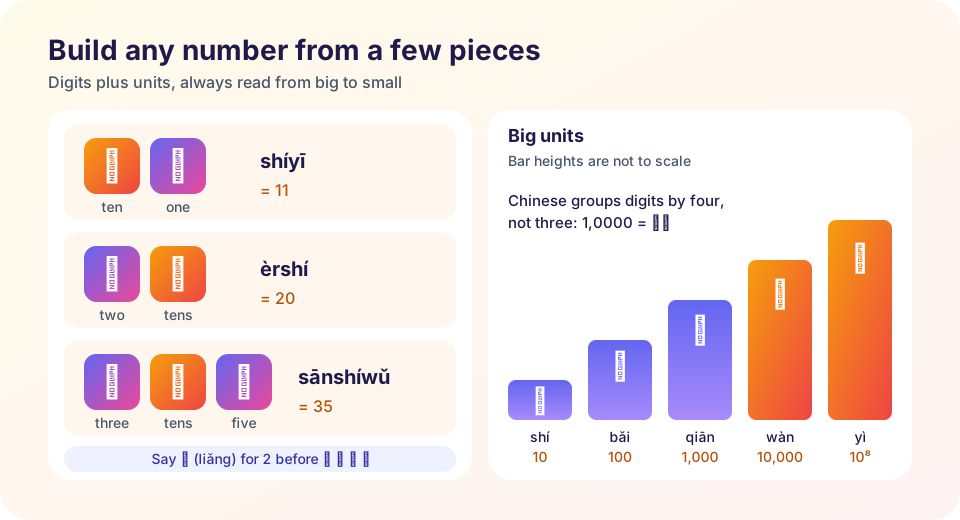
The rule is: tens digit + 十 + units digit. For 11 to 19 you skip the leading 一.
| Number | Built as | Chinese | Pinyin |
|---|---|---|---|
| 11 | ten + one | 十一 | shíyī |
| 16 | ten + six | 十六 | shíliù |
| 20 | two + ten | 二十 | èrshí |
| 21 | two + ten + one | 二十一 | èrshíyī |
| 47 | four + ten + seven | 四十七 | sìshíqī |
| 99 | nine + ten + nine | 九十九 | jiǔshíjiǔ |
There is nothing to memorize beyond the digits. If you can count to ten, you can count to 99. Try not to learn "twenty-one" as a vocabulary item; say it as the little equation it is.
Hundreds, thousands and the zero rule
Add the units 百 (bǎi, hundred), 千 (qiān, thousand) after the digit: 三百 is 300, 五千 is 5,000. The new part is 零. Whenever a place in the middle of the number is empty, you say 零 once to mark the gap. You do not say it at the end.
| Number | Chinese | Pinyin | Note |
|---|---|---|---|
| 100 | 一百 | yìbǎi | "one hundred" needs the 一 |
| 101 | 一百零一 | yìbǎi líng yī | the tens place is empty |
| 110 | 一百一十 | yìbǎi yìshí | people often say 一百一 |
| 120 | 一百二十 | yìbǎi èrshí | |
| 305 | 三百零五 | sānbǎi líng wǔ | one 零 |
| 1,000 | 一千 | yìqiān | |
| 1,005 | 一千零五 | yìqiān líng wǔ | the hundreds and tens are empty: still only one 零 |
| 1,050 | 一千零五十 | yìqiān líng wǔshí | |
| 1,500 | 一千五(百) | yìqiān wǔ(bǎi) | the last unit can be dropped in speech |
Two details help your speech sound natural. In a number between 100 and 199 you keep the leading 一 (一百), while 10 to 19 alone drop it. And after a hundred, a number ending in a round digit is often shortened by dropping the last unit: 250 is 二百五 in casual talk. (That one has a joke meaning in slang, "fool", so use 二百五十 when you want to be safe.)
万 and 亿: counting in fours
English groups digits in threes (thousand, million, billion). Chinese has a unit for every four zeros:
- 万 (wàn) = 10,000
- 亿 (yì) = 100,000,000
So 100,000 is 十万 ("ten ten-thousands"), 1,000,000 is 一百万 ("a hundred ten-thousands") and 10,000,000 is 一千万. A population of 1.4 billion is 十四亿 ("fourteen hundred-millions"). Newcomers find this the one real mental shift. A good trick: write the number with commas every four digits (1,0000 or 12,3456) and read each block as if it were a number from 1 to 9,999 followed by its unit.
| Number | Grouped by four | Chinese | Pinyin |
|---|---|---|---|
| 12,345 | 1,2345 | 一万二千三百四十五 | yíwàn èrqiān sānbǎi sìshíwǔ |
| 20,000 | 2,0000 | 两万 | liǎng wàn |
| 100,000 | 10,0000 | 十万 | shíwàn |
| 1,000,000 | 100,0000 | 一百万 | yìbǎiwàn |
| 100,000,000 | 1,0000,0000 | 一亿 | yí yì |
Prices on Chinese shopping apps use 万 as soon as a number is large, for example 1.2万 for 12,000.
二 or 两?
Both words mean "two", but they are not interchangeable.
- Use
二when counting, in ordinals, in the tens, and in dates and numbers read digit by digit:一、二、三,第二,二十,二月(February),十二. - Use
两before a measure word and before the units 百, 千, 万 and 亿:两个人(two people),两点(two o'clock),两百,两千,两万.
The two uses can meet in one number: 22 is 二十二, while 2,200 is 两千二百. For 200 you will hear both 两百 and 二百; beginners should default to 两百.
Tone changes of 一 and 不
The digit 一 is pronounced yī on its own, in dates, phone numbers and the end of numbers (十一, 第一). Inside a phrase it changes:
- Before a fourth-tone syllable it becomes
yí:一个(yí ge),一万(yí wàn). - Before a first, second or third-tone syllable it becomes
yì:一天(yì tiān),一年(yì nián),一百(yì bǎi).
The negative word 不 (bù) behaves like the first of those rules: it becomes bú before a fourth tone (不是, bú shì). Pinyin textbooks write these changed tones, so you will see them in this course.
Reading digits one by one
Phone numbers, room numbers, bus lines, ID numbers and years are read digit by digit, never as one big number. 2026 as a year is 二零二六年 (èr líng èr liù nián). In these digit-by-digit readings people often say 幺 (yāo) instead of 一, because yī and qī (seven) sound alike on a bad phone line: 110, the police number, is yāo yāo líng. Hotel room 1708 is yāo qī líng bā.
Ordinals, fractions and percentages
| Idea | Pattern | Example | Pinyin |
|---|---|---|---|
| first, second… | 第 + number | 第三 | dì-sān |
| half | 一半 | 一半 | yíbàn |
| a third | denominator + 分之 + numerator | 三分之一 | sān fēn zhī yī |
| percent | 百分之 + number | 百分之五十 | bǎi fēn zhī wǔshí |
| decimal point | 点 (diǎn) | 3.14 | sān diǎn yī sì |
Fractions are read backwards from English: "of three parts, one", so the denominator comes first.
Common misconceptions
"20 is just two and zero." No. 20 is 二十, two tens. You never say 二零 for a quantity (you do for years and phone numbers, which are read digit by digit).
"Chinese is hard because it has millions of numbers." The big numbers are a regular pattern. The only unusual step is that 万 means 10,000, so 100,000 is 十万, not 一百千.
"二 and 两 are the same." Before a measure word or a unit use 两. Saying 二个人 is a very common learner mistake.
Try it
Press Run (or Ctrl + Enter) to see the result here.
Program input · what you'd type while the program runs
Type the answers before you press Run, one per line. Each time the program reads a line (with input()), it gets the next line from this box.
Press Run (or Ctrl + Enter) to see the console output here.
No output.
Check your understanding
Quick check · 5 questions
of 5 answered You scored / 5 · perfect!
-
1. How do you say 35?
Tens digit + 十 + units digit: 三 十 五 (sānshíwǔ). 五十三 is 53. -
2. Which is the correct way to say 'two people'?
Before a measure word such as 个 you use 两 (liǎng), not 二. -
3. How do you say 101?
The tens place is empty, so you say 零 once: 一百零一 (yìbǎi líng yī). -
4. What does 十万 equal?
万 is 10,000, so 十万 is ten ten-thousands, which is 100,000. -
5. How is 一 pronounced in 一个?
一 becomes yí before a fourth-tone syllable. 个 (gè) has a fourth tone, so it is yí ge.
Summary
- Digits 零 to 十 plus a regular pattern give every number: 11 is 十一, 20 is 二十, 35 is 三十五.
- Say 零 once for an empty place in the middle of a number (一百零一), never at the end.
- 万 is 10,000 and 亿 is 100,000,000, so Chinese groups digits in fours: 100,000 is 十万.
- Use 两 before measure words and before 百, 千, 万, 亿; use 二 for counting, tens and ordinals.
- 一 and 不 change tone before a fourth tone (yí, bú); phone numbers often use 幺 (yāo) for 1.
- Years, phone numbers and rooms are read digit by digit; ordinals add 第.
Track your progress
Create a free account to tick off lessons and pick up where you left off on any device.
of Mandarin Chinese for Beginners lessons completed