


















Lesson 19 of 44 · Measure Words and Questions
这, 那 and 的: pointing and possession
Learn how to say this and that in Mandarin with 这, 那 and measure words, how to say here and there, and how to use 的 for possession and description.
Two of the most common little pieces of Mandarin finish off this chapter. The first is a pair of pointing words, 这 (zhè, this) and 那 (nà, that), which team up with the measure words you have just learned. The second is the particle 的 (de), a tiny word that links an owner to a thing, or a description to a noun. Between them they let you say "this book", "that person over there", "my phone", "the teacher's bag" and "a beautiful dress".
What you will learn
- how to say this, that, these and those, with measure words
- how to say here and there
- how to form possessives with 的 and when to leave it out
- how to describe a noun with an adjective and 的
- how to say "mine", "yours" and "the teacher's" without repeating the noun
Key terms
Demonstrative (指示词, zhǐshìcí) is a pointing word: 这 (this), 那 (that).
的 (de) is the particle of belonging and description; it is always neutral tone.
Possessive (所有格) shows who owns something: 我的书.
Modifier (修饰语) is a word or phrase that describes a noun.
This and that
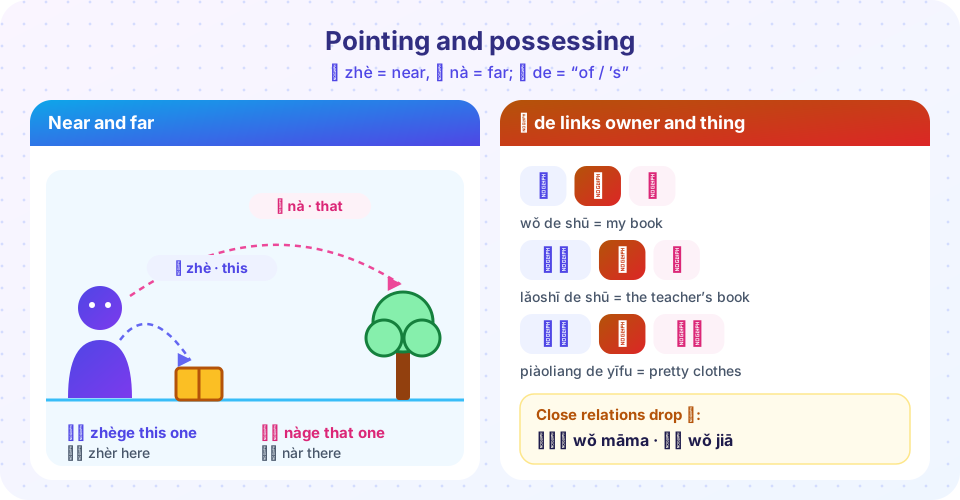
这 (zhè) points to something near. 那 (nà) points to something far. They are used in three ways.
1. By themselves as the subject of 是: 这是书。 (Zhè shì shū. This is a book.) 那是我的手机。 (Nà shì wǒ de shǒujī. That is my phone.) 这不是茶。 (Zhè bú shì chá. This is not tea.)
2. With a measure word and a noun: 这本书 (zhè běn shū, this book), 那只猫 (nà zhī māo, that cat), 这个人 (zhège rén, this person). The pattern is 这/那 + measure word + noun. With a number between, it becomes 这三本书 (zhè sān běn shū, these three books).
3. As "this one" / "that one": 这个 (zhège) and 那个 (nàge) when you point without naming the noun: 我要这个。 (Wǒ yào zhège. I want this one.) The question version is 哪个 (nǎge, which one). In speech you often hear zhèige / nèige / něige instead; the written forms are the same.
| Pointing word | Pinyin | Meaning |
|---|---|---|
| 这 | zhè | this |
| 那 | nà | that |
| 哪 | nǎ | which |
| 这个 / 那个 / 哪个 | zhège / nàge / nǎge | this one / that one / which one |
| 这些 / 那些 / 哪些 | zhèxiē / nàxiē / nǎxiē | these / those / which ones |
| 这儿 (这里) | zhèr (zhèlǐ) | here |
| 那儿 (那里) | nàr (nàlǐ) | there |
| 哪儿 (哪里) | nǎr (nǎlǐ) | where |
Practical differences: 这 and 那 cannot be used alone as the object of a verb or after a preposition. You cannot say "我喜欢这" for "I like this"; say 我喜欢这个 (wǒ xǐhuan zhège). For "here", use 这儿 / 这里: 我在这儿 (wǒ zài zhèr, I am here), 你在那儿 (nǐ zài nàr, you are there).
Plurals. Mandarin says "these" and "those" with 些 (xiē, some): 这些书 (zhèxiē shū, these books), 那些人 (nàxiē rén, those people). Note that 些 is already a measure word, so no other measure word follows it.
的: ownership and description
的 (de, always neutral tone) links a modifier to the noun that follows. It plays the part of English "'s" and "of".
Possession: owner + 的 + thing.
| Chinese | Pinyin | English |
|---|---|---|
| 我的书 | wǒ de shū | my book |
| 老师的书 | lǎoshī de shū | the teacher's book |
| 中国的首都 | Zhōngguó de shǒudū | China's capital |
| 他们的学校 | tāmen de xuéxiào | their school |
Close relationships can drop 的. For family, friends and groups you belong to, 的 is often omitted: 我妈妈 (wǒ māma, my mom), 我朋友 (wǒ péngyou, my friend), 我家 (wǒ jiā, my home), 我们学校 (wǒmen xuéxiào, our school). Adding 的 is not wrong, but the shorter forms sound more natural. For objects and less close relations, keep it: 我的手机, 老师的书.
Description: adjective + 的 + noun. A multi-syllable adjective needs 的 before the noun: 漂亮的衣服 (piàoliang de yīfu, pretty clothes), 好吃的菜 (hǎochī de cài, tasty dishes). A single-syllable adjective often joins the noun directly: 好书 (hǎo shū, a good book), 大房子 (dà fángzi, a big house), 新手机 (xīn shǒujī, a new phone). A 很 + adjective phrase uses 的: 很大的房子 (hěn dà de fángzi). In this course, if you are unsure, add 的.
Leaving out the noun. When the noun is clear from the context, drop it and keep 的: 这本书是我的。 (Zhè běn shū shì wǒ de. This book is mine.) 那是谁的? (Nà shì shéi de? Whose is that?) 我的 = mine, 你的 = yours, 老师的 = the teacher's.
Order with measure words. If both appear, the possessive comes first: 我的三本书 (wǒ de sān běn shū, my three books), and with a demonstrative, the possessive precedes it too: 我的这本书 (wǒ de zhè běn shū, this book of mine).
Spotting 的 in the wild
The particle 的 is one of the most frequent characters in Chinese texts, so you will see it everywhere. A useful reading habit is to look for the noun that comes right after 的 and treat everything before 的 as the description or the owner of that noun. In 我昨天买的书 (the book I bought yesterday), the whole phrase before 的 describes 书. In 老师的书, the owner is 老师. Long phrases before 的 are common in written Chinese, so reading them from the end backwards, finding the noun first, saves you many confusions.
You will meet more patterns with 的 in later chapters, including the emphatic 是……的 pattern, but you already have the core idea: 的 links a modifier on its left to a noun on its right. Everything the learner needs at this stage comes from that single idea, together with the habit of dropping 的 for close relationships.
Two short dialogues
Dialogue 1: in the classroom
| Speaker | Chinese | Pinyin | English |
|---|---|---|---|
| A | 这是什么? | Zhè shì shénme? | What is this? |
| B | 这是一本书。 | Zhè shì yì běn shū. | This is a book. |
| A | 这是你的书吗? | Zhè shì nǐ de shū ma? | Is this your book? |
| B | 不是,这是老师的书。我的书在那儿。 | Bú shì, zhè shì lǎoshī de shū. Wǒ de shū zài nàr. | No, it's the teacher's. My book is over there. |
Dialogue 2: who is that?
| Speaker | Chinese | Pinyin | English |
|---|---|---|---|
| A | 那个人是谁? | Nàge rén shì shéi? | Who is that person? |
| B | 他是我们的老师。你认识他吗? | Tā shì wǒmen de lǎoshī. Nǐ rènshi tā ma? | He is our teacher. Do you know him? |
| A | 认识,他叫王老师。 | Rènshi, tā jiào Wáng lǎoshī. | Yes, he's called Teacher Wang. |
New words: 认识 (rènshi, to know someone, to recognize) and the title 老师 (lǎoshī) after a family name: 王老师 means "Teacher Wang", a polite way to address a teacher.
Try it
First, a pointing demo. Choose an object, then choose near or far and an owner. The tool writes the phrase and the sentence, and the picture changes size for near and far.
Second, a Python helper that decides whether 的 is needed for a possessive phrase, using the "close relationship" rule. It prints the usual form and notes when 的 is optional.
Press Run (or Ctrl + Enter) to see the result here.
Program input · what you'd type while the program runs
Type the answers before you press Run, one per line. Each time the program reads a line (with input()), it gets the next line from this box.
Common misconceptions
"的 is always needed." Not with family, friends and groups you belong to: 我妈妈, 我朋友, 我们学校.
"这 and 那 can stand alone anywhere." As a bare word, they work mainly as the subject of 是. Otherwise use 这个, 那个 or 这儿, 那儿.
"那 (nà) and 哪 (nǎ) are the same." They differ in tone and meaning: 那 is "that", 哪 is "which". The mouth radical 口 in 哪 is a memory hook for a question.
"These = 这们." Plural is 这些, not 们.
"A measure word follows 些." 些 is already a measure word: 这些书, not "这些本书".
Check your understanding
Quick check · 6 questions
of 6 answered You scored / 6 · perfect!
-
1. How do you say 'this book'?
这 + measure word + noun: 这本书. -
2. Which sentence means 'That is my phone'?
那 + 是 + possessive + noun: 那是我的手机. -
3. Which form usually drops 的?
With close relationships, 的 is omitted: 我妈妈, 我朋友, 我家. -
4. How do you say 'this one is mine'?
You can drop the noun after 的: 这个是我的 (zhège shì wǒ de). -
5. What is the plural of 这, 'these'?
Use 些: 这些书 (zhèxiē shū), these books. -
6. Which word means 'there'?
那儿 (nàr) means there; 这儿 is here and 哪儿 is where.
Summary
- 这 = this, 那 = that, 哪 = which; with measure words: 这本书, 那个人; plural 这些, 那些; places 这儿, 那儿, 哪儿.
- 的 links owner and thing (我的书), and description and noun (漂亮的衣服); drop it with close relations (我妈妈) and sometimes with short adjectives (好书).
- Drop the noun after 的 to say "mine", "yours", "the teacher's".
- Possessive comes before the demonstrative: 我的这本书.
Next: Chapter 4 review
Track your progress
Create a free account to tick off lessons and pick up where you left off on any device.
of Mandarin Chinese for Beginners lessons completed