


















Lesson 7 of 44 · Pinyin, Tones and Greetings
Tones and tone changes
Learn the four Mandarin tones and the neutral tone with pitch charts, practice pairs, and the rules for third-tone, 不 and 一 tone changes.
If you remember one thing from this chapter, make it this: a tone is part of the word. When a Mandarin speaker says mǎi (买, buy) and mài (卖, sell), the two words differ only in tone. Get it wrong, and you can ask a shopkeeper to sell you something instead of buy it. This lesson teaches the four tones, the light neutral tone and the handful of rules about how tones shift in real speech.
What you will learn
- how to say and mark the four tones and the neutral tone
- how pitch levels (1 to 5) describe each tone
- the three main tone-change rules: third tone before third tone, 不 and 一
- how to practice tones so they stick
Key terms
Pitch contour is the shape of rising and falling pitch during a syllable.
Neutral tone (轻声, qīngshēng) is a light, short syllable with no fixed pitch of its own.
Tone sandhi is a regular change in the tone of a syllable caused by the tone next to it.
Chao numbers are the pitch-level numbers (1 to 5) used to write contours such as 55, 35, 214, 51.
The four tones
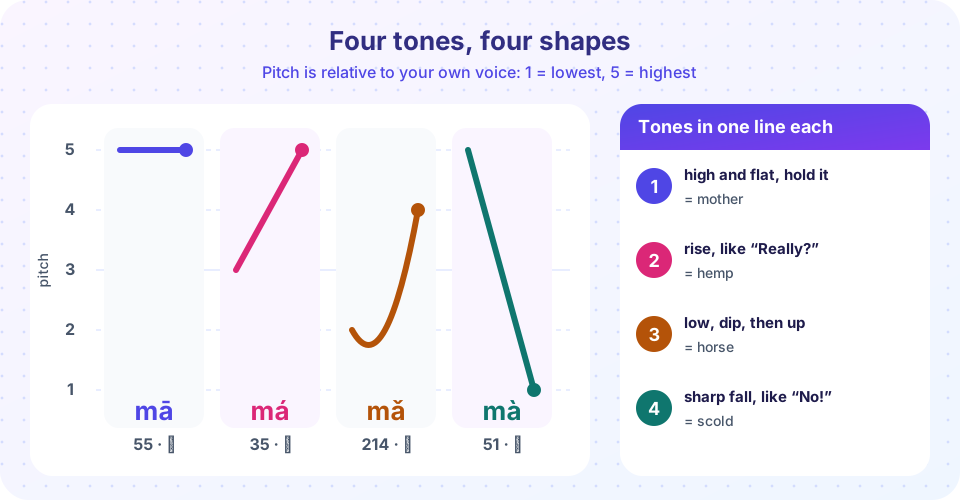
Mandarin tones are about pitch movement, not loudness. The chart above uses a five-level scale invented by the linguist Yuen Ren Chao: 1 is the bottom of your comfortable range and 5 is the top. Pitch is relative. A child and an adult have different notes, but each uses their own range.
| Tone | Mark | Shape | Chao numbers | Example |
|---|---|---|---|---|
| 1 | ˉ | high and level | 55 | mā 妈 mother |
| 2 | ˊ | rising, from middle to high | 35 | má 麻 hemp |
| 3 | ˇ | low, dipping, then rising | 214 | mǎ 马 horse |
| 4 | ˋ | sharp fall from high to low | 51 | mà 骂 to scold |
Tone 1 is a held, steady, high note, like singing one note "mmmā" at the top of your range. Keep it level; learners often let it sag.
Tone 2 rises, the way English speakers raise pitch on "Really?" or "What?" Start in the middle of your range and go up to the top.
Tone 3 is the one that scares learners, but only in isolation does it do the full dip-and-rise. Spoken alone, it starts fairly low, drops to the bottom and rises a little. In ordinary speech, when another syllable follows, speakers usually say only the low part (a "half third tone", about 21) and then move on. So when a tone 3 comes before tones 1, 2, 4 or a neutral syllable, just go low and stay low. Think of "uh-oh".
Tone 4 falls fast from high to low, like a firm "No!" or a command. Keep it short and sharp.
The tone mark is placed on the vowel by the rule you met in the last lesson: on a or e if there is one, on the o in ou, otherwise on the last vowel. Text messages often write tones as numbers after the syllable (ma1, ma2, ma3, ma4), which is also what you type in many input tools.
The neutral tone
Some syllables are pronounced light and short with no tone mark of their own. This is the neutral tone. It appears in the second syllable of many everyday words and on grammar particles:
- 妈妈 māma (mom), 爸爸 bàba (dad), 谢谢 xièxie (thanks)
- 吗 ma (question particle), 的 de (possessive particle), 了 le (aspect particle)
- 什么 shénme (what), 朋友 péngyou (friend), 桌子 zhuōzi (table)
A neutral syllable takes its pitch from the syllable before it: roughly a little lower after tone 1, a middle pitch after tone 2, higher after tone 3 and lowest after tone 4. Do not stress it; just let it fall away. In pinyin, neutral syllables have no tone mark.
Tone pairs: practice the 16 combinations
Real words combine tones. The table gives one common word for each pair of first-syllable and second-syllable tones. Read across the rows aloud, keeping the shapes. Notice 你好 nǐ hǎo: that is 3 + 3, and it changes, as the next section explains.
| 1st \ 2nd | Tone 1 | Tone 2 | Tone 3 | Tone 4 |
|---|---|---|---|---|
| Tone 1 | 今天 jīntiān (today) | 中国 Zhōngguó (China) | 钢笔 gāngbǐ (pen) | 生日 shēngrì (birthday) |
| Tone 2 | 明天 míngtiān (tomorrow) | 学习 xuéxí (to study) | 啤酒 píjiǔ (beer) | 学校 xuéxiào (school) |
| Tone 3 | 老师 lǎoshī (teacher) | 美国 Měiguó (USA) | 你好 nǐ hǎo (hello) | 好看 hǎokàn (good-looking) |
| Tone 4 | 大家 dàjiā (everybody) | 面条 miàntiáo (noodles) | 汉语 Hànyǔ (Chinese) | 再见 zàijiàn (goodbye) |
Tone changes (sandhi)
Three rules change tones in everyday speech. Spelling in pinyin usually keeps the original tone (except for 不 and 一, which are written with the changed tone in standard texts), but your mouth should follow the changes.
Rule 1. Third tone + third tone: the first becomes second. Two low tones in a row are hard to say, so the first one rises. 你好 is written nǐ hǎo but said ní hǎo. 很好 hěn hǎo is said hén hǎo, and 老虎 lǎohǔ (tiger) is said láohǔ. With longer runs, the grouping depends on the phrase's meaning, so listen to speakers for the pattern.
Rule 2. 不 (bù) becomes bú before a fourth tone. 不 normally has the fourth tone: 不好 bù hǎo, 不来 bù lái. Before another fourth-tone syllable it becomes second tone: 不是 bú shì, 不去 bú qù, 不对 bú duì. This is written with the changed tone.
Rule 3. 一 (yī, "one") changes with the next tone.
- Alone, or counting, or as a final digit: yī (tone 1): 一, 一月 yīyuè (January), 第一 dì yī (first).
- Before a fourth tone: yí (tone 2): 一个 yí gè, 一样 yíyàng (the same).
- Before tones 1, 2 or 3: yì (tone 4): 一天 yì tiān, 一年 yì nián, 一本 yì běn.
Write these changed tones in pinyin. Native speakers know them by ear, and beginners can learn them with the first few measure words.
Run the sandhi helper below. It takes syllables with tone numbers (use "bu" and "yi" without numbers for 不 and 一) and prints how they are said. It implements the simple versions of the rules, so longer third-tone runs may differ from real speech.
Press Run (or Ctrl + Enter) to see the result here.
Program input · what you'd type while the program runs
Type the answers before you press Run, one per line. Each time the program reads a line (with input()), it gets the next line from this box.
Notice that 你好 is written with two third tones in textbooks, but the helper shows the spoken first syllable as ní. That is the sandhi rule.
Hear the shape: pitch demo
The tool below draws each tone as a pitch line and can play it as a simple beep that glides the same way. Real speech is richer than a sine wave, so this is only a model of the pitch movement. The sound needs a click to start and may be unavailable in some browsers.
How to practice tones
- Use your hand. Draw each tone in the air as you say it. The movement helps your voice.
- Practice pairs, not single syllables. Tones in isolation sound different from tones in words. Use the 16-pair table.
- Record yourself and compare with a reliable audio source or a native speaker.
- Exaggerate first. Make tone 1 very high and tone 4 very sharp, then relax to natural size.
- Learn tones with every new word. Never memorize a word without its tone.
- Do not be discouraged by the context. Real speech has sentence intonation on top of tones, but the word tones still survive, and listeners use context to forgive small slips.
Common misconceptions
"A question rises like in English." Questions in Mandarin are formed with the particle 吗 (ma) or other words, not with pitch. You can raise the whole sentence a little for a question, but the tones of each word stay.
"Tone 3 is always a dip and a rise." The full contour (214) appears in isolation or at the end of a phrase. Before other tones, speakers say only the low part.
"Tones are only for beginners to worry about." Native speakers hear a wrong tone as the wrong word, so tones remain important at every level.
Check your understanding
Quick check · 6 questions
of 6 answered You scored / 6 · perfect!
-
1. Which tone is high and level?
Tone 1 stays high and flat (55): mā. -
2. How is 你好 (nǐ hǎo) normally said?
Third-tone sandhi: the first of two third tones is said as a second tone. -
3. What does 不 become in 不是?
不 is bù, but before a fourth tone (shì) it is said bú: bú shì. -
4. How is 一 pronounced in 一天 (one day)?
一 is yì before tones 1, 2 and 3: yì tiān. It is yí before tone 4 and yī alone. -
5. What is true about the neutral tone?
Neutral-tone syllables, such as the second ma in 妈妈 māma, are light and have no fixed contour. -
6. Which pair of words differs only in tone?
买 and 卖 have the same letters but different tones and opposite meanings.
Summary
- Mandarin has four tones (high level, rising, dip-and-rise, falling) plus a light neutral tone.
- Tones are pitch contours relative to your own range; the tone is part of the word.
- Third tone before third tone becomes second; 不 becomes bú before a fourth tone; 一 becomes yí before tone 4 and yì before tones 1, 2, 3.
- Practice tones in pairs, with your hand, and record yourself.
Next: Greetings and politeness
Track your progress
Create a free account to tick off lessons and pick up where you left off on any device.
of Mandarin Chinese for Beginners lessons completed