


















Lesson 16 of 44 · Measure Words and Questions
Measure words: counting things in Mandarin
Learn how Mandarin measure words work, the nine most useful ones and how to choose among them, with 两 vs 二, the tone of 一 and a café dialogue.
English speakers sometimes say "a cup of tea" or "a pair of shoes", where "cup" and "pair" are measure words. Mandarin takes this idea and applies it to everything you count. You cannot say "three book" or "two cat" directly. You say "three volume book" and "two animal cat": 三本书, 两只猫. The little word in the middle is a measure word, also called a classifier. It looks like extra work, but it is predictable once you know the main ones, and it sometimes tells you about the shape or kind of thing you are counting.
What you will learn
- the pattern number + measure word + noun
- nine core measure words and the nouns they go with
- how 两, 二 and the tone of 一 behave
- how to add 这, 那 and 几 to the pattern
- what to do when you are not sure which measure word to use
Key terms
Measure word / classifier (量词, liàngcí) is the counting word between a number and a noun.
个 (gè) is the general-purpose measure word.
两 (liǎng) is "two" before a measure word; 二 (èr) is "two" in plain counting.
Container measure is a word for a vessel used as a unit: 杯 (cup), 瓶 (bottle), 碗 (bowl).
How measure words work
The basic pattern is number + measure word + noun: 三个人 (sān gè rén, three people). The same pattern works with 这 (this), 那 (that) and the question word 几 (jǐ, how many): 这本书 (zhè běn shū, this book), 那张纸 (nà zhāng zhǐ, that sheet of paper), 几个人 (jǐ gè rén, how many people).
Some things to notice:
- The measure word stays the same for singular and plural: 一本书 (one book) and 五本书 (five books) both use 本.
- The noun itself does not change. 书 is both "book" and "books".
- Adjectives usually go between the measure word and the noun: 一个大苹果 (yí gè dà píngguǒ, a big apple), 两杯热茶 (liǎng bēi rè chá, two cups of hot tea).
- With 一 right after a verb, speakers often drop the 一 in casual speech: 我买本书 (wǒ mǎi běn shū, I'll buy a book).
Nine measure words to start with
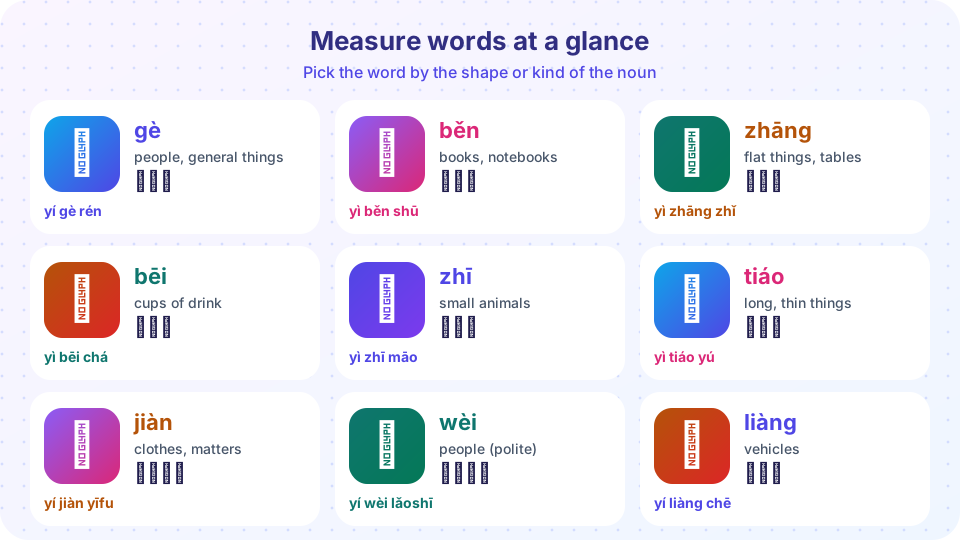
| Measure word | Pinyin | Used for | Example |
|---|---|---|---|
| 个 | gè | people and many general things | 一个人 yí gè rén (a person), 三个苹果 sān gè píngguǒ |
| 本 | běn | books, notebooks, magazines | 一本书 yì běn shū |
| 张 | zhāng | flat things: paper, tables, beds, tickets, photos | 一张纸 yì zhāng zhǐ, 一张桌子 yì zhāng zhuōzi |
| 杯 | bēi | cups and glasses of a drink | 一杯茶 yì bēi chá |
| 只 | zhī | small animals; one of a pair | 一只猫 yì zhī māo, 一只手 yì zhī shǒu |
| 条 | tiáo | long, thin things: fish, roads, rivers, trousers | 一条鱼 yì tiáo yú, 一条裤子 yì tiáo kùzi |
| 件 | jiàn | clothes (tops and coats), matters, luggage | 一件衣服 yí jiàn yīfu, 一件事 yí jiàn shì |
| 位 | wèi | people, politely | 一位老师 yí wèi lǎoshī, 三位客人 sān wèi kèrén |
| 辆 | liàng | vehicles | 一辆车 yí liàng chē |
More measure words, grouped by idea:
- Containers: 瓶 (píng, bottle): 一瓶水; 碗 (wǎn, bowl): 一碗饭; 盘 (pán, plate)
- Pairs and sets: 双 (shuāng, pair of things that go together): 一双鞋 (a pair of shoes), 一双筷子 (a pair of chopsticks); 对 (duì): 一对夫妻 (a married couple)
- Handles and grips: 把 (bǎ): 一把椅子 (a chair), 一把伞 (an umbrella)
- Places and businesses: 家 (jiā): 一家商店 (a shop), 一家饭馆 (a restaurant), 一家公司 (a company)
- Family size: 口 (kǒu): 我家有四口人 (wǒ jiā yǒu sì kǒu rén, there are four people in my family)
- Events (verb measure words): 次 (cì, time, occasion): 我去过一次 (I have gone once; the 过 form comes in chapter 6)
- Some, a bit: 些 (xiē): 一些 (yìxiē, some), 这些 (zhèxiē, these), 那些 (nàxiē, those)
You do not need to memorize a list at once. Learn each measure word together with its first noun, as in the examples, and add more as you meet new nouns. If you do not know the measure word, use 个. Native speakers will understand, and 个 is also the usual measure word in many everyday situations.
两, 二 and 一
两 vs 二. For the number two, Mandarin has two words. Use 二 (èr) when you simply count or say a number: 一, 二, 三, 二十 (èrshí, twenty), 第二 (dì èr, second). Use 两 (liǎng) before a measure word: 两个人, 两杯茶, 两张票. In compound numbers 二 is used before 十 (二十), and either appears in other places: 两百 or 二百 for 200 (chapter 5).
一 changes tone. You learned the rule in chapter 2: 一 is yí before a fourth tone and yì before the others.
| Measure word | Tone | 一 + MW |
|---|---|---|
| 个 gè, 件 jiàn, 位 wèi, 辆 liàng | 4th | yí gè, yí jiàn, yí wèi, yí liàng |
| 本 běn | 3rd | yì běn |
| 杯 bēi, 只 zhī, 张 zhāng | 1st | yì bēi, yì zhī, yì zhāng |
| 条 tiáo | 2nd | yì tiáo |
How to choose a measure word
Often the measure word matches the shape or kind of the noun. 张 goes with flat, spread-out things (paper, table, ticket); 条 with long, thin things (fish, river, road, trousers); 本 with bound things (books); 辆 with wheeled vehicles; 位 is used with people to show respect. Some choices are purely conventional, though, and it is best to learn them with the noun. One noun can have different measure words for different meanings, such as a plain 个 versus a more descriptive one. When in doubt, say 个 and listen for a correction.
Run the helper below, which groups nouns by measure word and writes out phrases with the correct 两 and 一.
Press Run (or Ctrl + Enter) to see the result here.
Program input · what you'd type while the program runs
Type the answers before you press Run, one per line. Each time the program reads a line (with input()), it gets the next line from this box.
A café dialogue
| Speaker | Chinese | Pinyin | English |
|---|---|---|---|
| 服务员 | 你好!请问你要什么? | Nǐ hǎo! Qǐngwèn nǐ yào shénme? | Hello! What would you like? |
| 我 | 我要一杯茶和两个包子。 | Wǒ yào yì bēi chá hé liǎng gè bāozi. | I'd like a cup of tea and two steamed buns. |
| 服务员 | 好的。还要什么? | Hǎo de. Hái yào shénme? | OK. Anything else? |
| 我 | 不要了,谢谢。 | Bú yào le, xièxie. | No, that's all, thanks. |
New words: 服务员 (fúwùyuán, waiter), 要 (yào, to want), 和 (hé, and), 包子 (bāozi, steamed bun). The phrase 不要了 here simply means "that's all, no more".
Pick the measure word
Try the drill. Choose the measure word that fits each noun. The game gives a reason after each answer.
Common misconceptions
"I can skip measure words." Without one, a counted noun is wrong: 三书 is not Chinese. Measure words are required (with a few unit nouns like 年 and 天).
"个 is always acceptable." It is understood almost everywhere, but a native speaker will say 一本书, not 一个书. Learn the specific one with each noun when you can.
"The measure word shows plural." It does not. The same measure word is used for one and many.
"二 and 两 are interchangeable." 二 is for numbers; 两 is for amounts of things before a measure word.
Check your understanding
Quick check · 6 questions
of 6 answered You scored / 6 · perfect!
-
1. Which measure word goes with 书 (book)?
本 (běn) is for bound things such as books and notebooks. -
2. How do you say 'two cups of tea'?
两 before a measure word: 两杯茶 (liǎng bēi chá). -
3. How is 一 pronounced in 一个?
个 (gè) is a fourth-tone syllable, so 一 becomes yí. -
4. Which measure word is polite for people, as in 一___老师?
位 (wèi) is the respectful measure word for people. -
5. Which is the safest choice when you do not know the measure word?
个 is the general measure word and is understood in most situations. -
6. What does 几个人 ask?
几 (jǐ) means how many, followed by measure word and noun.
Summary
- Counting needs number + measure word + noun; the measure word does not mark plural.
- Core nine: 个, 本, 张, 杯, 只, 条, 件, 位, 辆; plus 瓶, 碗, 双, 把, 家, 口, 次.
- Use 两 (not 二) for "two" before a measure word, and watch the tone of 一.
- When unsure, use 个; learn each noun with its measure word.
Next: Yes/no questions
Track your progress
Create a free account to tick off lessons and pick up where you left off on any device.
of Mandarin Chinese for Beginners lessons completed