


















Lesson 37 of 44 · Conversation and Culture
Directions and Transport
Ask for and give directions in Mandarin, use location words, take the subway, bus, taxi and train, and talk about distance and travel time, with dialogues.
Getting around is one of the most practical things you can do in Mandarin. In a big Chinese city you will ask where a building is, hear a stranger point and say 一直走,然后右转, and step onto a subway where every announcement is in Chinese. This lesson gives you the whole toolkit: location words, the patterns for "X is next to Y", direction commands, distance and time words, and the vocabulary of public transport. Practice with a map in front of you and say each route aloud.
What you will learn
- How to ask where something is and how to get there.
- Location words and the two patterns 在 (is at) and 有 (there is).
- Direction commands and landmarks.
- How to talk about distance and travel time.
- How to use the subway, bus, taxi and train.
Key terms
在哪儿 (zài nǎr): where is it?
怎么走 (zěnme zǒu): how do I get there?
离 (lí): distance from, as in "A is far from B".
坐 (zuò): to sit; also "to travel by" a vehicle.
Asking where something is
Three ways to ask, from simplest to most polite:
| Chinese | Pinyin | Meaning |
|---|---|---|
| 洗手间在哪儿? | Xǐshǒujiān zài nǎr? | Where is the restroom? |
| 请问,银行在哪里? | Qǐngwèn, yínháng zài nǎlǐ? | Excuse me, where is the bank? |
| 请问,去火车站怎么走? | Qǐngwèn, qù huǒchēzhàn zěnme zǒu? | Excuse me, how do I get to the train station? |
哪儿 (nǎr) is common in the north, with the r-sound; 哪里 (nǎlǐ) is used everywhere. Start with 请问 (qǐngwèn, "may I ask") to get a friendly answer. People will often point and say 那边 (nàbian, "over there") first, then explain.
Location words
| Chinese | Pinyin | Meaning |
|---|---|---|
| 前面 / 后面 | qiánmian / hòumian | in front / behind |
| 左边 / 右边 | zuǒbian / yòubian | left / right |
| 上面 / 下面 | shàngmian / xiàmian | above / below |
| 里面 / 外面 | lǐmiàn / wàimiàn | inside / outside |
| 旁边 | pángbiān | beside, next to |
| 对面 | duìmiàn | opposite, across from |
| 中间 | zhōngjiān | in the middle |
| 附近 | fùjìn | nearby |
Two patterns: 在 and 有
To say where something is, put it first and use 在 ("be at"):
银行在超市旁边。 (Yínháng zài chāoshì pángbiān.) "The bank is next to the supermarket."
To say what is in a place, put the place first and use 有 ("there is"):
超市旁边有一家银行。 (Chāoshì pángbiān yǒu yì jiā yínháng.) "Next to the supermarket there is a bank."
The thing that is located is definite in a 在 sentence (you already know about it) and new in a 有 sentence. Businesses use the measure word 家 (jiā): 一家银行, 两家饭店.
Giving directions
| Chinese | Pinyin | Meaning |
|---|---|---|
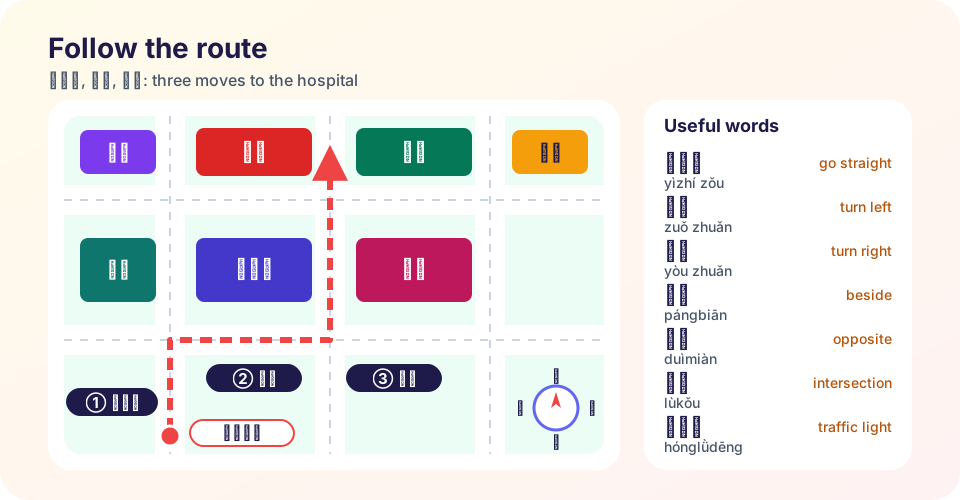
| 一直走 | yìzhí zǒu | go straight on |
| 往前走 | wǎng qián zǒu | walk forward |
| 左转 / 右转 | zuǒ zhuǎn / yòu zhuǎn | turn left / right |
| 往左拐 / 往右拐 | wǎng zuǒ guǎi / wǎng yòu guǎi | turn left / right (colloquial) |
| 到路口 | dào lùkǒu | at the intersection |
| 红绿灯 | hónglǜdēng | traffic light |
| 过马路 | guò mǎlù | cross the road |
| 第二个路口 | dì-èr ge lùkǒu | the second intersection |
| 就在… | jiù zài … | it is right at … |
| 到了 | dào le | you have arrived |
A typical set of directions: 一直走,到第二个路口右转,走五分钟就到了。 (Yìzhí zǒu, dào dì-èr ge lùkǒu yòu zhuǎn, zǒu wǔ fēnzhōng jiù dào le.) "Go straight, turn right at the second intersection, and in five minutes you are there." Notice that the time 五分钟 follows the verb 走, as you learned with duration complements. The little word 就 (jiù) adds "right away, just".
Distance and travel time
离 (lí) compares two places: 学校离这儿很近。 (Xuéxiào lí zhèr hěn jìn.) "The school is very near here." 近 (jìn) is near and 远 (yuǎn) is far. The question is 远不远? or 远吗? and the answer 不远,走路十分钟。 (Bù yuǎn, zǒulù shí fēnzhōng.) "Not far, ten minutes on foot."
For the route between two places, use 从…到… (cóng ... dào ...): 从这儿到火车站要二十分钟。 (Cóng zhèr dào huǒchēzhàn yào èrshí fēnzhōng.) "From here to the train station takes twenty minutes." 要 (yào) here means "it takes (time)". Ask how long with 要多久? (yào duōjiǔ?) and answer with 大概… (dàgài, "about").
Ways to travel
Chinese uses different verbs for different vehicles.
| Chinese | Pinyin | Meaning | Verb pattern |
|---|---|---|---|
| 坐地铁 | zuò dìtiě | take the subway | 坐 (sit, ride as a passenger) |
| 坐公交车 | zuò gōngjiāochē | take the bus | 坐 |
| 坐火车 | zuò huǒchē | take the train | 坐 |
| 坐飞机 | zuò fēijī | take a plane | 坐 |
| 打车 | dǎchē | take a taxi (hail or call) | 打 |
| 骑自行车 | qí zìxíngchē | ride a bicycle | 骑 |
| 开车 | kāichē | drive a car | 开 |
| 走路 | zǒulù | walk | 走 |
Use 坐 for being a passenger, 骑 for riding a bike or scooter, and 开 for driving. High-speed trains are 高铁 (gāotiě).
On the subway
Chinese subway systems are efficient and well signed, with announcements in Chinese and English. The words to know:
| Chinese | Pinyin | Meaning |
|---|---|---|
| 几号线 | jǐ hào xiàn | which line? |
| 一号线 | yī hào xiàn | line 1 |
| 站 | zhàn | station, stop |
| 下一站 | xià yí zhàn | next stop |
| 换乘 / 换车 | huànchéng / huànchē | transfer |
| 出口 | chūkǒu | exit (labeled A, B, C...) |
| 方向 | fāngxiàng | direction |
| 买票 | mǎi piào | buy a ticket |
| 扫码 | sǎo mǎ | scan a code to enter |
Useful sentences: 去人民广场坐几号线? (Qù Rénmín Guǎngchǎng zuò jǐ hào xiàn?) "Which line do I take to People's Square?" and 在哪儿换乘? (Zài nǎr huànchéng?) "Where do I transfer?"
Taxis and trains
In a taxi, address the driver as 师傅 (shīfu), a polite and very common term for a skilled worker. Say 师傅,请去火车站。 (Shīfu, qǐng qù huǒchēzhàn.) "Driver, please go to the train station." 到那儿多少钱? (Dào nàr duōshao qián?) asks the price; 在这儿停。 (Zài zhèr tíng.) means "stop here". Ride-hailing apps are very common, and you can show the driver your destination on the screen. At the railway station, 买一张去上海的票。 (Mǎi yì zhāng qù Shànghǎi de piào.) means "I want a ticket to Shanghai" (张 zhāng is the measure word for tickets). Station words: 检票 (jiǎnpiào, ticket check), 站台 (zhàntái, platform), 候车室 (hòuchēshì, waiting room).
Two dialogues
Asking the way
| Speaker | Chinese | Pinyin | English |
|---|---|---|---|
| 游客 | 请问,医院在哪儿? | Qǐngwèn, yīyuàn zài nǎr? | Excuse me, where is the hospital? |
| 路人 | 一直走,到红绿灯左转。 | Yìzhí zǒu, dào hónglǜdēng zuǒ zhuǎn. | Go straight, turn left at the traffic light. |
| 游客 | 远吗? | Yuǎn ma? | Is it far? |
| 路人 | 不远,走路十分钟。医院就在右边。 | Bù yuǎn, zǒulù shí fēnzhōng. Yīyuàn jiù zài yòubian. | Not far, ten minutes on foot. The hospital is right on your right. |
| 游客 | 谢谢您! | Xièxie nín! | Thank you! |
At a subway station
| Speaker | Chinese | Pinyin | English |
|---|---|---|---|
| 乘客 | 请问,去机场坐几号线? | Qǐngwèn, qù jīchǎng zuò jǐ hào xiàn? | Excuse me, which line goes to the airport? |
| 工作人员 | 坐二号线,在人民广场换乘十号线。 | Zuò èr hào xiàn, zài Rénmín Guǎngchǎng huànchéng shí hào xiàn. | Take line 2 and transfer to line 10 at People's Square. |
| 乘客 | 要多久? | Yào duōjiǔ? | How long does it take? |
| 工作人员 | 大概一个小时。 | Dàgài yí ge xiǎoshí. | About an hour. |
Common misconceptions
"转 and 拐 mean different things." Both mean "to turn". 拐 (guǎi) is more colloquial and common in northern speech: 往左拐 and 左转 give the same direction.
"Use 坐 for everything." Use 骑 for bikes and 开 for driving.
"The place goes after the verb as in English ('study at school')." In Chinese 在 + place comes before the verb: 我在学校学习.
"远 and 离 are the same." 远 is the adjective "far". 离 is the preposition "from": 学校离这儿很远.
Try it
Press Run (or Ctrl + Enter) to see the result here.
Program input · what you'd type while the program runs
Type the answers before you press Run, one per line. Each time the program reads a line (with input()), it gets the next line from this box.
Check your understanding
Quick check · 5 questions
of 5 answered You scored / 5 · perfect!
-
1. How do you say 'The bank is next to the supermarket'?
Use 在 for the location of something already known: X 在 Y 旁边. -
2. Which verb goes with 'bicycle' (骑自行车)?
Use 骑 for riding a bicycle or scooter, 开 for driving a car, and 坐 for riding as a passenger. -
3. What does 左转 mean?
左 is left and 转 is to turn. -
4. How do you say 'The school is far from here'?
离 expresses distance from: A 离 B 很远. -
5. Where does the time go in 'Walk for five minutes'?
Duration follows the verb: 走五分钟.
Summary
- Ask with …在哪儿? or 请问,去…怎么走?; reply with 一直走, 左转, 右转, 红绿灯, 路口.
- Location: X 在 Y 旁边 (X is next to Y) versus Y 旁边有 X (next to Y there is X).
- Distance: A 离 B 近 / 远; route: 从…到…, time with 要.
- Transport verbs: 坐 (passenger), 骑 (ride), 开 (drive), 打车 (take a taxi), 走路 (walk).
- On the subway: 几号线, 换乘, 下一站, 出口; in a taxi: 师傅, 在这儿停.
Next: Culture and etiquette
Track your progress
Create a free account to tick off lessons and pick up where you left off on any device.
of Mandarin Chinese for Beginners lessons completed