


















Lesson 30 of 44 · Reading Characters
Chapter 7 Overview: Reading Characters
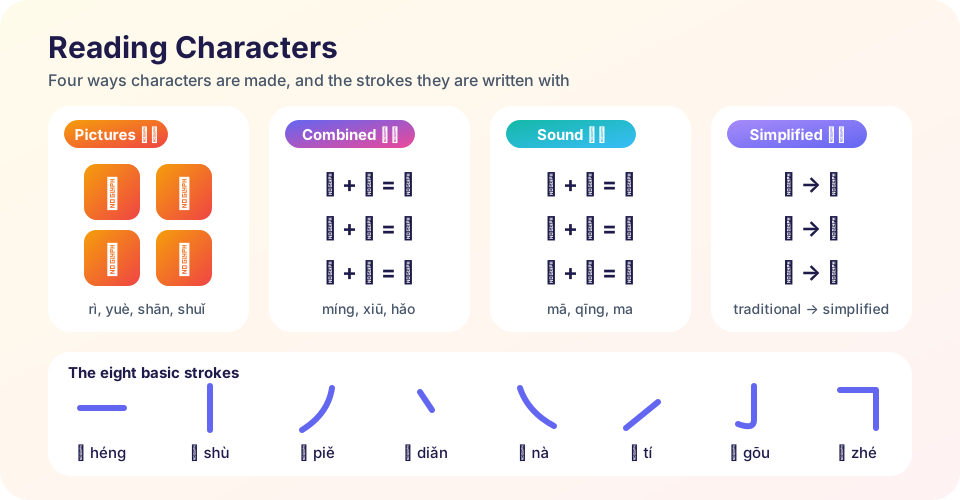
A map of chapter 7: how Chinese characters are built from strokes and components, radicals, sound clues, simplified and traditional forms, and real-life reading.
Many beginners fear Chinese characters more than anything else in the language. The fear is understandable: there are thousands of them, and they look nothing like an alphabet. But characters are not random pictures. They are built from a small set of strokes and a few hundred recurring components, and once you see the building blocks, the writing system starts to look like a logical puzzle instead of a wall. This chapter shows you how the puzzle works and gives you tools to read signs, menus and simple texts.
What you will learn
- What a Chinese character is, and how it differs from a word and a letter.
- The eight basic strokes and the rules for stroke order.
- How radicals and components give clues about meaning and sound.
- How the difference between simplified and traditional characters works.
- How to read real-life signs, menus and app screens.
Key terms
汉字 (Hànzì): Chinese characters.
笔画 (bǐhuà): stroke, the basic line of a character.
部首 (bùshǒu): radical, the component used to organize dictionaries and often a clue to meaning.
简体字 (jiǎntǐzì) / 繁体字 (fántǐzì): simplified and traditional characters.
The chapter in slides
A character is a syllable
Characters are not letters.
Strokes come first
Radicals and sound clues
Two scripts
Read the real world
A first look: characters you already know
You have already met many characters in the first four chapters. Look at these and notice how simple they are:
| Character | Pinyin | Meaning | Strokes |
|---|---|---|---|
| 人 | rén | person | 2 |
| 大 | dà | big | 3 |
| 小 | xiǎo | small | 3 |
| 日 | rì | sun, day | 4 |
| 月 | yuè | moon, month | 4 |
| 山 | shān | mountain | 3 |
| 口 | kǒu | mouth | 3 |
| 学 | xué | to study | 8 |
Notice that most of them have only a few strokes. Even the more complex 学 is built from smaller pieces you will soon recognize: a roof-like top and a 子 (child) below.
A note on the sizes involved
How many characters do you need? Large dictionaries list tens of thousands, but ordinary reading uses far fewer: a couple of thousand common characters cover the vast majority of what you see in newspapers and books, and the characters you need for signs, menus and simple messages are a few hundred. Most modern words are two characters long (电话, diànhuà, "telephone"), so you often meet the same characters again in new combinations. That repetition makes learning more efficient than the raw numbers suggest.
What each lesson covers
- Radicals and strokes: the eight strokes, the stroke-order rules and the most useful radicals.
- Phonetic-semantic compounds: how a sound clue and a meaning clue combine to form most characters.
- Signs, menus and apps: a vocabulary for everyday reading, and how to type Chinese with pinyin.
- Chapter 7 review: a summary poster and a ten-question quiz.
How to study this chapter
Handwriting a few characters, even badly, trains your eye to notice strokes and components. You do not need to become a calligrapher. But writing each new character three to five times, saying its pinyin and meaning aloud, builds the visual memory that reading needs. Use the stroke-order rules, not your own invented order, because writing apps and teachers use the standard order and it helps you read cursive handwriting later.
When you meet a new character, ask three questions: What is its radical? Does it contain a part you already know? Does the character sound like a known character? You will be surprised how often the answer helps.
Check your understanding
Quick check · 3 questions
of 3 answered You scored / 3 · perfect!
-
1. What is a Chinese character most like?
Each character represents one syllable and usually a unit of meaning, though many words use two characters. -
2. Which region mainly uses traditional characters?
Taiwan, Hong Kong and Macau use traditional characters; mainland China and Singapore use simplified. -
3. What is a radical?
A radical (部首) is a component such as 氵 or 亻 that often hints at meaning.
Summary
- A character stands for one syllable and usually a unit of meaning; words are often two characters.
- All characters are written with eight basic strokes in a standard order.
- Radicals and components give clues to meaning; many characters also contain a sound clue.
- Mainland China and Singapore use simplified characters; Taiwan, Hong Kong and Macau use traditional.
Next: Radicals and strokes
Track your progress
Create a free account to tick off lessons and pick up where you left off on any device.
of Mandarin Chinese for Beginners lessons completed