


















Lesson 1 of 44 · Getting Started
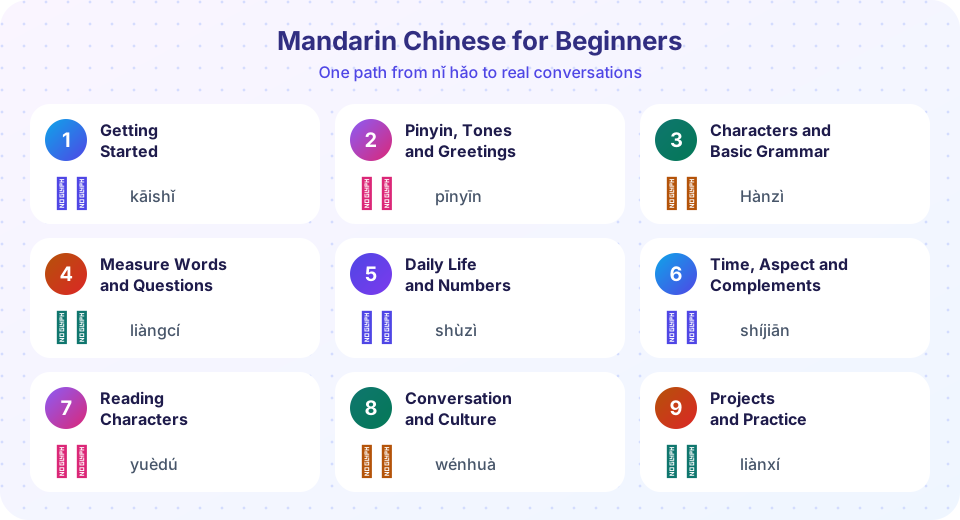
Course map: how this Mandarin course works
Start here: who this Mandarin course is for, how its nine chapters fit together, how pinyin and characters are shown, and how to study.
Welcome. In this course you will learn the beginnings of Mandarin Chinese, the language that more people speak as a first language than any other. You do not need to know anything about Chinese yet. If you can read English and you are curious, you are ready. By the end you will be able to greet people, introduce yourself, ask simple questions, talk about numbers, time and daily life, read a few hundred characters and follow short conversations.
What you will learn
- who the course is for and what you need before you start
- how the nine chapters build on one another
- how Chinese is written in this course: characters, pinyin and English
- a realistic weekly study plan
Key terms
Mandarin is the standard spoken Chinese used across mainland China, Taiwan and Singapore, and by many people worldwide.
Hànzì (汉字) are Chinese characters, the written symbols of the language.
Pinyin (拼音) is the system that spells Chinese sounds with the Latin alphabet.
Tone (声调, shēngdiào) is the pitch pattern of a syllable. It is part of the word.
Who this course is for
This course is written for learners aged about 11 and up, and for adults who want a gentle but serious start. Perhaps you are preparing for travel, for study, for work with Chinese colleagues, or you want to talk with family. Perhaps you simply love languages. The explanations are in plain English, every new term is defined when it first appears, and every example is shown three ways: Chinese characters, pinyin with tone marks, and an English translation.
You do not need a Chinese keyboard, a special font or any earlier language study. A modern browser shows all the characters you will meet. If a character shows as an empty box, your device is missing a Chinese font, and installing one is a quick fix in your system settings.
An honest word about speaking
A course on a web page cannot replace speaking with people. Reading about tones is like reading about swimming: it helps, but you only learn by getting in the water. There are no recorded sounds in this course. Instead, every sound is explained in three ways: where your mouth and tongue go, an English respelling ("nǐ hǎo ≈ nee how"), and, where it helps, the International Phonetic Alphabet (IPA) written in square brackets, such as [tɕʰ].
Some demonstrations offer a speak button that uses your browser's built-in voice. It may be missing on your device, and its Chinese voice may sound slightly off, so treat it as a bonus and never as the teacher. For real pronunciation practice, find a tutor, a language exchange partner or a Mandarin-speaking friend, and say everything you learn out loud. Be brave early. Beginners who speak badly in week one speak well in month six.
How the nine chapters fit together
Chinese has three layers that you learn side by side: how it sounds, how it is written and how sentences are built. The chapters weave them together.
Sounds first
You will say real phrases by the end of chapter 2.
Characters and grammar
Chinese grammar is short and regular.
Everyday life
Reading
Using it
This part of the course (chapters 1 to 4) takes you from zero to simple sentences with counting and questions. The second part (chapters 5 to 9) builds daily-life vocabulary, time and aspect, reading and real conversations.
How every lesson is built
Each lesson follows the same shape so you always know where you are. It starts with a short list of what you will learn, then key terms, then the explanation with worked examples and a picture. A "common misconceptions" box warns about typical mistakes. Then comes a "Try it" section with small interactive tools: flashcards, drills and tiny programs. A short quiz checks your understanding, and a summary ends the lesson. Chapter overviews give the big picture, and chapter reviews collect everything on one page and quiz you on the whole chapter.
How Chinese is shown in this course
Every example looks like this:
| Characters | Pinyin | English |
|---|---|---|
| 你好 | nǐ hǎo | hello |
| 谢谢 | xièxie | thank you |
This course uses simplified characters, the standard in mainland China and Singapore. Taiwan, Hong Kong and Macau use traditional characters. Most simplified characters are simply tidier versions of the traditional ones, and the spoken language is the same. The next lesson says more.
Pinyin always carries tone marks, and names such as Běijīng are capitalized. In running English text, a Chinese word may be followed by its pinyin and meaning in parentheses: 老师 (lǎoshī, teacher).
Common misconceptions
"Chinese is impossibly hard." Chinese is different, not impossible. The grammar is simpler than that of many European languages: no verb conjugation, no genders, no plural endings. The hard parts are the tones and the characters, and you will meet them in small steps.
"I should learn characters later." Many beginners skip characters for months and then struggle. In this course you meet characters from the start, but in small numbers, and pinyin stays beside them until you are comfortable.
"I can learn tones just by reading." Tones are sounds. Read about them, then say them aloud, record yourself and compare with a speaker.
Try it
First, a tiny flashcard deck of the very first words in this course. Click the card to flip it, and try saying each word out loud before you flip. The speak button is optional and may not exist on your device.
Second, a small Python helper that turns numbered pinyin ("ni3 hao3") into proper tone marks. You will use the idea again in chapter 2. A tone number goes after the syllable, and 5 (or no number) means the neutral tone. The tone mark goes on the vowel by a fixed rule, which this function applies.
Press Run (or Ctrl + Enter) to see the result here.
Program input · what you'd type while the program runs
Type the answers before you press Run, one per line. Each time the program reads a line (with input()), it gets the next line from this box.
Check your understanding
Quick check · 4 questions
of 4 answered You scored / 4 · perfect!
-
1. Which writing system does this course use for characters?
The course uses simplified characters (the standard in mainland China and Singapore) and always shows pinyin and English beside them. -
2. What is pinyin?
Pinyin is a pronunciation guide. It is not a separate language, and it does not replace characters in normal Chinese writing. -
3. Why does this course say it cannot replace speaking with people?
Tones are sounds. You need to say them out loud and get feedback from real speakers. -
4. Which part of Chinese is usually simpler than in many European languages?
Mandarin verbs have one form. Tenses and persons do not change the verb, which makes grammar compact.
Summary
- The course teaches sounds, characters and grammar together in nine chapters, in two parts.
- Every example shows simplified characters, pinyin with tone marks and English.
- Sounds are explained with mouth positions, respelling and IPA, but a course cannot replace speaking with people.
- Chinese grammar is short and regular; tones and characters need steady, small-step practice.
Next: What is Mandarin?
Track your progress
Create a free account to tick off lessons and pick up where you left off on any device.
of Mandarin Chinese for Beginners lessons completed