


















Lesson 12 of 44 · Characters and Basic Grammar
Pronouns and the verb 是 (to be)
Learn the Mandarin personal pronouns 我, 你, 他, 她, 我们 and 您, and how to use 是 to say who or what someone is, with 不, 也 and 都.
Your first real sentences in any language usually say who someone is: "I am a student", "she is my sister", "they are from Canada". In Mandarin this takes two ingredients: a handful of pronouns and one small, very useful verb, 是 (shì), "to be". Both are easy. The pronouns do not change by case, the verb does not conjugate, and plurals are made with one simple character. By the end of this lesson you can introduce yourself and other people, say what someone is not, and add "also" and "all".
What you will learn
- the personal pronouns and how to make plurals with 们
- the polite 您 and the inclusive 咱们
- the pattern A 是 B, its negative 不是, and the question forms
- where 也 (also) and 都 (all) go
- when not to use 是
Key terms
Pronoun (代词, dàicí) replaces a noun: I, you, he.
是 (shì) links two noun phrases: "A is B".
们 (men) is a plural marker for people (and a few personal pronouns).
也 (yě) means "also, too"; 都 (dōu) means "all, both".
The pronouns
| Singular | Plural | |
|---|---|---|
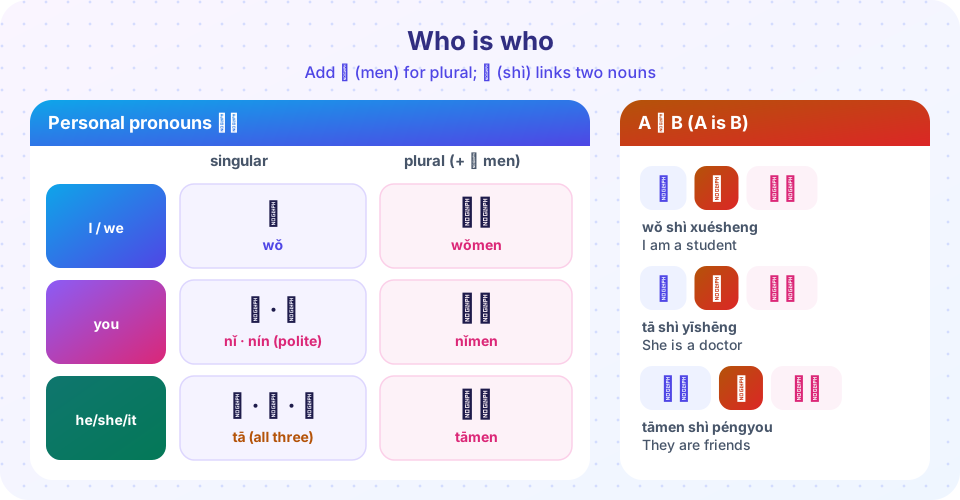
| 1st person | 我 wǒ (I, me) | 我们 wǒmen (we, us) |
| 2nd person | 你 nǐ (you) / 您 nín (you, polite) | 你们 nǐmen (you, plural) |
| 3rd person | 他 tā (he) / 她 tā (she) / 它 tā (it) | 他们 tāmen / 她们 tāmen / 它们 tāmen |
The same word serves as subject and object. 我 is both "I" and "me": 我爱你 (wǒ ài nǐ, I love you) and 你爱我 (nǐ ài wǒ, you love me). The word order shows who does what. There is no separate "my": you add 的 (de), which chapter 4 covers: 我的 (wǒ de, my, mine).
他, 她, 它 sound identical. All three are tā. The difference is only in writing: 他 has the person radical 亻 and is "he" (and a general "he or she" in older texts), 她 has the woman radical 女 and means "she", and 它 is for animals and things. In speech you rely on context. 他们 (tāmen) is used for a mixed group or all men, 她们 (tāmen) for a group of only women.
Plural 们 (men). Add 们 after a pronoun to form its plural: 我们, 你们, 他们. It is also used with some nouns for people, such as 同学们 (tóngxuémen, classmates) and 孩子们 (háizimen, children), but it is optional there, and it is not used together with a number: 三个学生 (sān gè xuésheng, three students), not "三个学生们".
您 (nín) is the polite "you" for one person. It has no plural form in everyday speech (you say 你们 for a group). Use it for elders, teachers, customers and anyone you want to treat with respect.
咱们 (zánmen) is "we, including you", used mainly in the north: 咱们走吧 (zánmen zǒu ba, let's go). 我们 (wǒmen) can include or exclude the listener, so 咱们 is a precise "you and I (and others)". Beginners can safely use 我们.
The verb 是
The word 是 (shì) means "to be" in the sense of "A equals B". It links two nouns or noun phrases.
| Chinese | Pinyin | English |
|---|---|---|
| 我是学生。 | Wǒ shì xuésheng. | I am a student. |
| 她是医生。 | Tā shì yīshēng. | She is a doctor. |
| 他们是我的朋友。 | Tāmen shì wǒ de péngyou. | They are my friends. |
| 这是中文书。 | Zhè shì Zhōngwén shū. | This is a Chinese book. |
The pattern is A + 是 + B. 是 never changes: "am, is, are, was, were" are all 是. Tense comes from context or from time words.
Negative: 不是. Put 不 (bù) in front of 是. Because 是 has the fourth tone, 不 changes to bú: 我不是老师 (wǒ bú shì lǎoshī, I am not a teacher).
Questions. There are two ways, which chapter 4 develops. Add 吗 (ma) at the end: 你是学生吗? (nǐ shì xuésheng ma?). Or ask with the verb-not-verb form: 你是不是学生? (nǐ shì bu shì xuésheng?). Mandarin has no word for "yes". You answer with the verb: 是 (shì, it is so) or 不是 (bú shì, it is not so).
Nationalities and jobs. A nationality is the country name plus 人 (rén, person): 中国人 (Zhōngguórén), 美国人 (Měiguórén), 英国人 (Yīngguórén), 加拿大人 (Jiānádàrén), 澳大利亚人 (Àodàlìyàrén), 法国人 (Fǎguórén), 德国人 (Déguórén), 日本人 (Rìběnrén), 韩国人 (Hánguórén), 印度人 (Yìndùrén), 巴西人 (Bāxīrén). Some jobs: 老师 (lǎoshī, teacher), 学生 (xuésheng, student), 医生 (yīshēng, doctor), 工程师 (gōngchéngshī, engineer), 律师 (lǜshī, lawyer), 经理 (jīnglǐ, manager).
Also and all: 也 and 都
Adverbs in Mandarin sit after the subject and before the verb. That is true of 也 and 都.
| Chinese | Pinyin | English |
|---|---|---|
| 我也是学生。 | Wǒ yě shì xuésheng. | I am a student too. |
| 我们都是学生。 | Wǒmen dōu shì xuésheng. | We are all students. |
| 他们也都是老师。 | Tāmen yě dōu shì lǎoshī. | They are also all teachers. |
| 我们都不是老师。 | Wǒmen dōu bú shì lǎoshī. | None of us is a teacher. |
When both appear, 也 comes before 都. Notice 我们都不是 (all not = none) vs 我们不都是 (not all of us are): the position of 不 relative to 都 changes the meaning. Beginners can just learn the first form for now.
Two short dialogues
Dialogue 1
| Speaker | Chinese | Pinyin | English |
|---|---|---|---|
| A | 你是中国人吗? | Nǐ shì Zhōngguórén ma? | Are you Chinese? |
| B | 不是,我是美国人。你呢? | Bú shì, wǒ shì Měiguórén. Nǐ ne? | No, I'm American. And you? |
| A | 我是加拿大人。他是谁? | Wǒ shì Jiānádàrén. Tā shì shéi? | I'm Canadian. Who is he? |
| B | 他是我朋友。他也是学生。 | Tā shì wǒ péngyou. Tā yě shì xuésheng. | He's my friend. He's a student too. |
Dialogue 2
| Speaker | Chinese | Pinyin | English |
|---|---|---|---|
| A | 她是谁? | Tā shì shéi? | Who is she? |
| B | 她是我姐姐。 | Tā shì wǒ jiějie. | She is my older sister. |
| A | 她是学生吗? | Tā shì xuésheng ma? | Is she a student? |
| B | 不是,她是医生。 | Bú shì, tā shì yīshēng. | No, she's a doctor. |
When not to use 是
English speakers overuse "to be". In Mandarin, adjectives do not need 是. You say 我很高 (wǒ hěn gāo, I am tall), not "我是高". Chapter 3's next lesson covers this. And 是 is not used to say where something is: for location you use 在 (zài), as in 我在家 (wǒ zài jiā, I am at home). Also, 是 is not needed with "I am hungry" (我饿 wǒ è) or "I am thirty" (我三十岁 wǒ sānshí suì).
Try it
First, a sentence builder. Choose a pronoun and a noun, then toggle negative, "also" and "all". The tool builds the Chinese, the pinyin and the English.
Second, a Python generator for all the forms of one pattern. It applies the rule that 不 becomes bú before 是.
Press Run (or Ctrl + Enter) to see the result here.
Program input · what you'd type while the program runs
Type the answers before you press Run, one per line. Each time the program reads a line (with input()), it gets the next line from this box.
Common misconceptions
"是 is the word for 'yes'." 是 means "to be". "Yes" is expressed by repeating the verb of the question: 你是学生吗? — 是。(Yes, I am.) For other verbs: 你喜欢吗? — 喜欢。
"他 is always male." In speech, tā is gender-neutral because you cannot hear the difference. In writing, 他 is "he", 她 is "she" and 它 is "it".
"We add 们 to every plural." It works for pronouns and sometimes for people nouns. Things and animals do not take 们, and numbers rule it out.
"我是高" is fine. It is not. With adjectives, use 很: 我很高.
Check your understanding
Quick check · 6 questions
of 6 answered You scored / 6 · perfect!
-
1. How do you say 'We are students'?
Pronoun + 们, then 是, then the noun: 我们是学生. -
2. What is the polite form of 你?
您 (nín) is the polite 'you' for one person. -
3. Which sentence means 'He is not a teacher'?
不 goes right before 是, and 不 becomes bú before the fourth tone: tā bú shì lǎoshī. -
4. Where does 也 go in 'I am a student too'?
Adverbs go after the subject and before the verb. -
5. Which is wrong?
With an adjective you do not use 是: 我很高. -
6. How do you say 'I am Canadian'?
Nationalities are country + 人: 加拿大人.
Summary
- Pronouns: 我, 你/您, 他/她/它; add 们 for plural people.
- 是 links two nouns (A 是 B); it never changes; negative is 不是 (bú shì).
- 也 (also) and 都 (all) sit after the subject and before the verb, with 也 before 都.
- Nationality = country + 人. Do not use 是 before adjectives.
Track your progress
Create a free account to tick off lessons and pick up where you left off on any device.
of Mandarin Chinese for Beginners lessons completed