


















Lesson 24 of 44 · Daily Life and Numbers
Chapter 5 Review: Daily Life and Numbers
Review chapter 5: number patterns, 万 and 亿, money words, shopping phrases and restaurant Chinese, with flashcards and a ten-question quiz.
You can now count, price, shop and order food. This review gathers the whole chapter in one picture, one table and one quiz, plus two small tools for practice. If a row in the table feels shaky, follow the link back to its lesson and read that section again before you take the quiz.
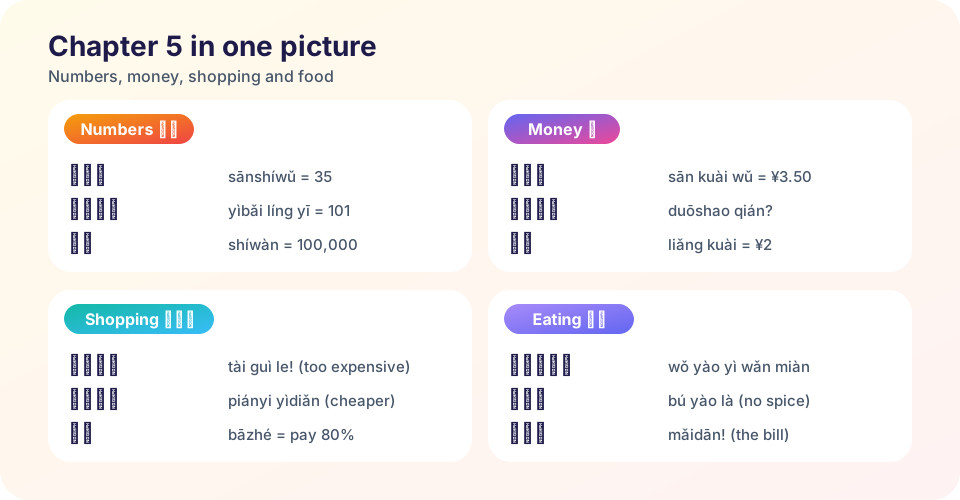
Recap table
| Topic | What to remember | Example | Lesson |
|---|---|---|---|
| Digits | 零 to 十 are the whole alphabet of numbers | 三十五 sānshíwǔ (35) | Numbers |
| Zero rule | Say 零 once for a gap in the middle, not at the end | 一百零一 yìbǎi líng yī (101) | Numbers |
| Big units | 万 is 10,000 and 亿 is 100,000,000; count in fours | 十万 shíwàn (100,000) | Numbers |
| 二 and 两 | 两 before measure words and 百, 千, 万, 亿 | 两个人 liǎng ge rén | Numbers |
| Tone change | 一 and 不 change before a fourth tone | 一个 yí ge, 不是 bú shì | Numbers |
| Digit by digit | Years, phones, rooms; 幺 for 1 | 二零二六年 èr líng èr liù nián | Numbers |
| Money | 块 / 元, 毛 / 角, 分 | 三块五 sān kuài wǔ | Money |
| Price question | 多少钱, 一共, 怎么卖 | 这个多少钱? | Money |
| Discount | 折 gives the share you pay | 八折 bāzhé = 80% | Money |
| Weight | 一斤 = 500 g | 八块一斤 bā kuài yì jīn | Money |
| Restaurant | 几位, 菜单, 我要…, 不要辣, 买单 | 我要一碗面。 | Money |
Three habits worth keeping
First, read numbers aloud as you see them. A bus number, a price in a video, a date: say it in Mandarin. Second, learn quantity phrases as complete units, such as 一碗面, 两杯茶 and 三十五块, not as separate words. Third, when you are unsure about a tone, say the sentence slowly. Native speakers will usually understand a slow sentence with a slightly wrong tone far better than a fast one.
If you can say the numbers 1 to 10 without hesitation, you can say any price. Spend two minutes each day on a random number generator until sì and shí stop confusing you.
Worked example: a small shopping trip
Putting the chapter together is easiest with a concrete trip. You are at a market stall. You want two jin of apples at 8 yuan a jin, and a bottle of water for 3 yuan.
- Ask and order.
苹果怎么卖?(Píngguǒ zěnme mài?) "How are the apples sold?" The seller answers八块一斤。(Bā kuài yì jīn.) You say我要两斤,还要一瓶水。(Wǒ yào liǎng jīn, hái yào yì píng shuǐ.) Notice两斤with 两, because a measure word follows. - Work out the total. Two jin at 8 yuan is 16 yuan, plus 3 yuan for the water, which makes 19 yuan:
十九块(shíjiǔ kuài). The seller says一共十九块。 - Pay. You hand over a 50 yuan note:
我用现金。(Wǒ yòng xiànjīn.) The change is 31 yuan, so the seller says找您三十一块。(Zhǎo nín sānshíyī kuài.) Or you scan a code:可以扫码吗? - Be polite.
谢谢,再见!Whoever sells to you will usually answer不客气or慢走.
Say the whole exchange aloud, then change the numbers: three jin, a different price, a different bill. Changing the numbers is the quickest way to find out whether you control the number system or only recognize the sample sentences.
Self-check
You are ready for the next chapter if you can do these without looking:
- Say any number from 0 to 99 and a number such as 101, 1,005 and 100,000.
- Explain when to use
两and when to use二. - Read your phone number and the year digit by digit.
- Ask a price, bargain once, and say
太贵了. - Understand
八折and一斤. - Order a dish, say you do not want spice and ask for the bill.
If you hesitated on any of these, go back to the matching section of the lesson and drill that one point for five minutes.
Try it
Press Run (or Ctrl + Enter) to see the console output here.
No output.
Check your understanding
Quick check · 10 questions
of 10 answered You scored / 10 · perfect!
-
1. How do you say 2,000?
Before 千 you normally use 两: 两千 (liǎng qiān). 二零零零 would be read digit by digit, for a year or code. -
2. What is 一百零五?
一百 (100) + 零 (empty tens place) + 五 (5) = 105. -
3. Which number is 十万?
万 = 10,000; ten of them is 100,000. -
4. How do you read the year 2026?
Years are read digit by digit: 二零二六年 (èr líng èr liù nián). -
5. How is 一 pronounced in 一天 (one day)?
天 (tiān) has a first tone, so 一 becomes yì. -
6. What is ¥3.50 in spoken Chinese?
3 yuan and 5 máo: 三块五. 三十五块 is ¥35. -
7. What do you pay with a 七折 sign?
折 states the tenths you pay, so 七折 means 70 percent of the price. -
8. Which request means 'the bill, please' in a restaurant?
买单 (mǎidān) asks for the bill. 打包 means 'to go' and 几位 asks how many people. -
9. How much is one 斤?
One jin is 500 grams; a kilogram is two jin. -
10. Which sentence orders a bowl of noodles?
我要… is the direct way to order: 'I would like ...'.
Summary
- Numbers: digits plus 十, 百, 千, 万, 亿, the zero rule, 两 versus 二.
- Money: 块, 毛, 多少钱, 折, 斤.
- Phone numbers and years are read digit by digit, with 幺 for 1.
- Restaurant script: 几位, 菜单, 我要, 不要辣, 买单, 打包.
- Next chapter moves to time, dates and the little words that mark when and how an action happens.
Track your progress
Create a free account to tick off lessons and pick up where you left off on any device.
of Mandarin Chinese for Beginners lessons completed