


















Lesson 13 of 44 · Characters and Basic Grammar
Word order, negation and adjectives
Build basic Mandarin sentences: subject-verb-object, time and place before the verb, negating with 不 and 没, and describing things with adjectives and 很.
Mandarin grammar is famously compact, and this lesson shows why. You will build whole sentences with just a few ingredients: a subject, a verb, an object, a time word, a place phrase, and the words 不, 没 and 很. There are no endings to memorize. The order of the words does the work, and the order is quite consistent. Once you see the pattern, you can say hundreds of sentences by swapping words in and out.
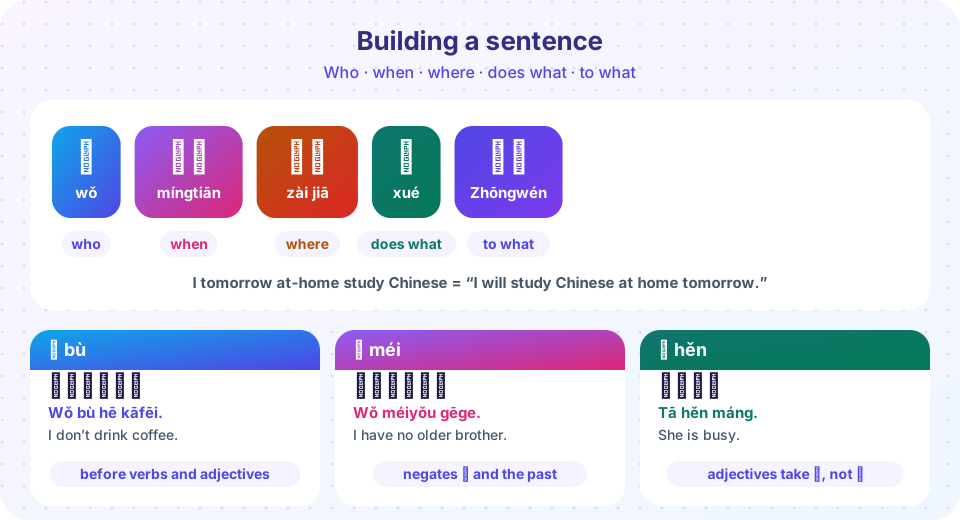
What you will learn
- the basic order: subject, time, place, verb, object
- how to negate with 不 and with 没
- how adjectives work as verbs, and what 很 does
- degree words: 太, 非常, 真, 有点儿, 不太
Key terms
Subject (主语, zhǔyǔ) is who or what does the action; object (宾语, bīnyǔ) receives it.
Adverbial means a word or phrase that says when, where or how: 明天 (tomorrow), 在家 (at home).
Stative verb is a verb that describes a state: in Mandarin, adjectives behave like this.
Particle (助词, zhùcí) is a small word with a grammatical job and no stand-alone meaning, such as 吗 or 的.
Basic order: subject, verb, object
The core is the same as in English: subject + verb + object.
| Chinese | Pinyin | English |
|---|---|---|
| 我喝茶。 | Wǒ hē chá. | I drink tea. |
| 她学中文。 | Tā xué Zhōngwén. | She studies Chinese. |
| 他们吃米饭。 | Tāmen chī mǐfàn. | They eat rice. |
| 我们看电视。 | Wǒmen kàn diànshì. | We watch TV. |
| 我有一个姐姐。 | Wǒ yǒu yí gè jiějie. | I have an older sister. |
The verb has only one form. 我去, 你去, 他去, 我们去, 他们去: the same verb 去 (qù, go) for everyone. There is no -s in "he goes" and no "went". When it matters, a time word tells you when.
Time and place come before the verb
This is the most important difference from English. In Mandarin, time words and place phrases go before the verb, not after.
S + Time + Place + Verb + Object
| Chinese | Pinyin | Literal order | English |
|---|---|---|---|
| 我明天在家学中文。 | Wǒ míngtiān zài jiā xué Zhōngwén. | I tomorrow at-home study Chinese | I will study Chinese at home tomorrow. |
| 我们今天在学校吃饭。 | Wǒmen jīntiān zài xuéxiào chī fàn. | We today at-school eat | We are eating at school today. |
| 她每天喝茶。 | Tā měitiān hē chá. | She every-day drinks tea | She drinks tea every day. |
The time word can also come at the start of the sentence for emphasis: 明天我在家学中文. Both are correct. But it always comes before the verb, never at the end: "我学中文明天" is wrong. The place phrase is built with 在 (zài, at, in): 在家 (at home), 在学校 (at school), 在北京 (in Beijing).
Useful time words: 今天 (jīntiān, today), 明天 (míngtiān, tomorrow), 每天 (měitiān, every day), 现在 (xiànzài, now), 早上 (zǎoshang, morning), 晚上 (wǎnshang, evening). To talk about the past you also need the particle 了, which chapter 6 teaches. For now, stay with habits, the present and the future.
Practice the order with the puzzle below. Click the blocks in the correct order. The skeleton is always who, when, where, does what, to what.
Negation: 不 and 没
Mandarin has two common negative words, and the choice depends on the verb.
不 (bù) negates most verbs and adjectives, for habits, general truths, the present and the future. It goes right before the verb or adjective.
| Chinese | Pinyin | English |
|---|---|---|
| 我不喝咖啡。 | Wǒ bù hē kāfēi. | I don't drink coffee. |
| 他不去学校。 | Tā bú qù xuéxiào. | He isn't going to school. |
| 她不是老师。 | Tā bú shì lǎoshī. | She isn't a teacher. |
| 今天不热。 | Jīntiān bú rè. | It isn't hot today. |
Recall the tone rule: 不 becomes bú before a fourth tone (去 qù, 是 shì, 热 rè).
没 (méi) negates 有 (yǒu, to have): there is no 不有. You say 没有 (méiyǒu), often shortened to 没 in speech.
| Chinese | Pinyin | English |
|---|---|---|
| 我没有哥哥。 | Wǒ méiyǒu gēge. | I don't have an older brother. |
| 他没有钱。 | Tā méiyǒu qián. | He has no money. |
| 你有书吗? — 没有。 | Nǐ yǒu shū ma? — Méiyǒu. | Do you have a book? — No. |
没 also negates completed actions in the past, which you will meet in chapter 6: 我没吃 (I didn't eat). For now, the rule of thumb is: 有 uses 没; everything else uses 不. 是 uses 不: 不是, never 没是.
Adjectives are verbs
In Mandarin, an adjective describes a state, and it works like a verb: no 是 is needed. You say "She busy" instead of "She is busy": 她忙 (tā máng). In a plain statement, you normally add 很 (hěn) before the adjective:
| Chinese | Pinyin | English |
|---|---|---|
| 她很忙。 | Tā hěn máng. | She is busy. |
| 咖啡很贵。 | Kāfēi hěn guì. | Coffee is expensive. |
| 中文很难。 | Zhōngwén hěn nán. | Chinese is difficult. |
| 这个很好。 | Zhège hěn hǎo. | This is good. |
Here 很 means "very" only when stressed. In an ordinary sentence it is a light linking word, and without it the sentence feels unfinished: a bare 她忙 suggests a comparison ("she is busy, [he isn't]"). When you negate, drop 很: 她不忙 (tā bù máng, she is not busy), 咖啡不贵 (kāfēi bú guì).
Other degree words:
| Word | Pinyin | Meaning | Example |
|---|---|---|---|
| 非常 | fēicháng | extremely | 非常好 fēicháng hǎo |
| 太……了 | tài ... le | too, so (often admiring) | 太好了! tài hǎo le! |
| 真 | zhēn | really | 真漂亮 zhēn piàoliang |
| 有点儿 | yǒudiǎnr | a bit (usually negative) | 有点儿贵 yǒudiǎnr guì |
| 不太 | bú tài | not very | 不太忙 bú tài máng |
Some useful adjectives: 好 (hǎo, good), 大 (dà, big), 小 (xiǎo, small), 多 (duō, many), 少 (shǎo, few), 忙 (máng, busy), 累 (lèi, tired), 高 (gāo, tall), 贵 (guì, expensive), 便宜 (piányi, cheap), 新 (xīn, new), 旧 (jiù, old, used), 热 (rè, hot), 冷 (lěng, cold), 难 (nán, difficult), 容易 (róngyì, easy), 高兴 (gāoxìng, happy), 漂亮 (piàoliang, pretty), 好吃 (hǎochī, tasty).
The Python tool below makes the "很" form and the negative form for each adjective, and picks bù or bú for you based on the tone.
Press Run (or Ctrl + Enter) to see the result here.
Program input · what you'd type while the program runs
Type the answers before you press Run, one per line. Each time the program reads a line (with input()), it gets the next line from this box.
Growing a sentence step by step
A good way to see the skeleton is to grow one sentence a piece at a time. Start with the smallest complete idea: 我学中文。 (I study Chinese.) Add a place: 我在家学中文。 (I study Chinese at home.) Add a time before the place: 我明天在家学中文。 (Tomorrow I'll study Chinese at home.) Add a frequency word in the same slot as the time: 我每天在家学中文。 (I study Chinese at home every day.) Negate: 我不在家学中文。 (I don't study Chinese at home.) Turn it into a question: 你每天在家学中文吗? (Do you study Chinese at home every day?)
Each step slots a new piece into a fixed place. Nothing else in the sentence changes: the verb stays 学, with no ending, and the pieces never reorder themselves. This is why Mandarin feels easy once the skeleton is in your head. When you build your own sentences, ask yourself in turn: who is doing it, when, where, what action, and to what? Then say the answers in that order.
Two short dialogues
Dialogue 1
| Speaker | Chinese | Pinyin | English |
|---|---|---|---|
| A | 你喝茶吗? | Nǐ hē chá ma? | Do you drink tea? |
| B | 我不喝茶,我喝咖啡。 | Wǒ bù hē chá, wǒ hē kāfēi. | I don't drink tea; I drink coffee. |
| A | 咖啡贵吗? | Kāfēi guì ma? | Is coffee expensive? |
| B | 不贵,很便宜。 | Bú guì, hěn piányi. | Not expensive, very cheap. |
Dialogue 2
| Speaker | Chinese | Pinyin | English |
|---|---|---|---|
| A | 你忙吗? | Nǐ máng ma? | Are you busy? |
| B | 我很忙。你呢? | Wǒ hěn máng. Nǐ ne? | I'm very busy. And you? |
| A | 我不忙。明天我在家学中文。 | Wǒ bù máng. Míngtiān wǒ zài jiā xué Zhōngwén. | I'm not busy. Tomorrow I'll study Chinese at home. |
| B | 太好了! | Tài hǎo le! | Great! |
Common misconceptions
"Time and place come at the end, like in English." In Mandarin they come before the verb: 我在家学中文, not "我学中文在家".
"很 always means very." In a plain statement it is just a link. Use 非常 or stress 很 when you mean "very".
"不 is the only negative." For 有, use 没有. For the past, 没 is also used (chapter 6).
"I need 是 before adjectives." You do not. 她很忙, not "她是忙".
"Verbs change with tense." They do not. Time words, context and particles carry the time.
Check your understanding
Quick check · 5 questions
of 5 answered You scored / 5 · perfect!
-
1. Which is the correct Chinese order for 'I eat at school every day'?
Time and place come before the verb: 我每天在学校吃 (饭). -
2. How do you say 'I don't have a sister'?
有 is negated with 没: 我没有姐姐. -
3. Which sentence is natural for 'The tea is hot'?
Adjectives take 很 and no 是: 茶很热. -
4. How is 不 pronounced before 贵 (guì, fourth tone)?
不 becomes bú before a fourth tone: bú guì. -
5. What does 有点儿贵 mean?
有点儿 means 'a bit' and usually carries a negative feeling.
Summary
- The core order is subject + verb + object; time and place words go before the verb.
- Verbs have one form; time words and context express time.
- 不 negates most verbs and adjectives; 没 negates 有 (and later the past).
- Adjectives act as verbs, so no 是: 她很忙; drop 很 when you negate: 她不忙.
Next: Chapter 3 review
Track your progress
Create a free account to tick off lessons and pick up where you left off on any device.
of Mandarin Chinese for Beginners lessons completed