


















Lesson 28 of 44 · Time, Aspect and Complements
Complements: Result, Degree, Direction and Ability
Learn Mandarin complements: result (听懂), degree (跑得快), direction (走进来), ability (看得懂) and duration (学了两年), with patterns and negation.
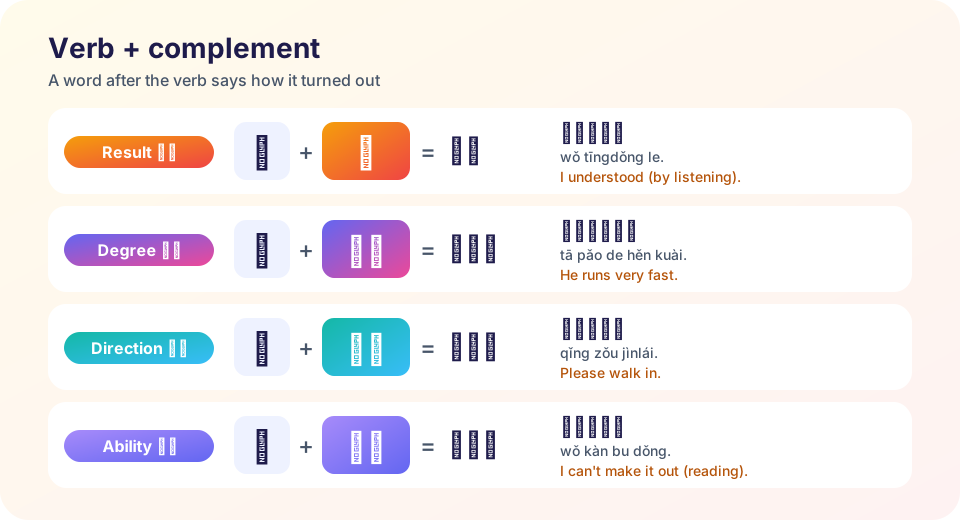
Chinese verbs often travel with a second word that tells you how the action turned out. In English you add this information in different places: "I finished eating", "he runs fast", "come in", "I can't make out the writing". In Mandarin all of these ideas follow the verb in one position, and a grammar term covers them: the complement (补语, bǔyǔ). Complements are the reason Chinese can say a lot with very short sentences. Learn the patterns here and you will understand many real sentences that otherwise look mysterious.
What you will learn
- The result complement: 吃完, 听懂, 找到.
- The degree complement with 得: 跑得很快.
- Direction complements: 进来, 出去, 回去.
- Potential complements: 看得懂 and 看不懂.
- Duration and frequency after the verb.
Key terms
补语 (bǔyǔ), complement: a word or phrase after the verb that completes its meaning.
结果补语 (jiéguǒ bǔyǔ): result complement, such as 完, 懂, 到.
程度补语 (chéngdù bǔyǔ): degree complement introduced by 得.
趋向补语 (qūxiàng bǔyǔ): direction complement, such as 进来, 出去.
可能补语 (kěnéng bǔyǔ): potential complement, V得C or V不C.
Result complements: 吃完, 听懂, 找到
A result complement is a short word that sits right after the verb and says what the action achieved. The two parts form a tight unit that behaves like one verb.
| Compound | Pinyin | Meaning |
|---|---|---|
| 吃完 | chī wán | finish eating |
| 做完 | zuò wán | finish doing |
| 听懂 | tīng dǒng | understand (by listening) |
| 看懂 | kàn dǒng | understand (by reading) |
| 听见 / 看见 | tīngjiàn / kànjiàn | hear / see (the sense reaches you) |
| 找到 | zhǎo dào | find (searching succeeded) |
| 买到 | mǎi dào | manage to buy |
| 写错 | xiě cuò | write wrongly |
| 记住 | jì zhù | remember firmly |
| 吃饱 | chī bǎo | eat until full |
The compound with 了 marks completion: 我做完了作业。 (Wǒ zuò wán le zuòyè.) "I finished the homework." The negative uses 没: 我没听懂。 (Wǒ méi tīng dǒng.) "I didn't understand." Notice how different this is from 我没听 ("I didn't listen"): the complement is what makes the sentence about success.
These pairs are not free combinations; each verb accepts specific complements. Learn them as units, the way you learn "give up" or "find out" in English. The explorer in the Try it section shows the common ones.
Degree complements: 跑得很快
When you want to describe how well, how fast or how much an action is done, add 得 (de) after the verb, then the description:
他跑得很快。 (Tā pǎo de hěn kuài.) "He runs very fast."
她唱得很好听。 (Tā chàng de hěn hǎotīng.) "She sings beautifully."
Notice 很 before the adjective: it is the neutral default in a plain statement, and a bare adjective after 得 often hints at a contrast. Negate by negating the adjective, not the verb: 他跑得不快。 (Tā pǎo de bù kuài.) "He doesn't run fast." To ask: 他跑得快吗? or 他跑得怎么样? (Tā pǎo de zěnmeyàng?) "How well does he run?"
When the verb has an object
If the verb takes an object, there are two natural ways:
| Pattern | Example | Pinyin |
|---|---|---|
| Repeat the verb | 他说中文说得很好。 | Tā shuō Zhōngwén shuō de hěn hǎo. |
| Move the object forward | 他中文说得很好。 | Tā Zhōngwén shuō de hěn hǎo. |
Both mean "He speaks Chinese very well". The second is shorter and common in speech. Never write 他说得中文很好 (the object cannot go after 得).
的, 得, 地
Three different words are pronounced de in the neutral tone and differ only in writing. 的 links a describing word to a noun (我的书, my book), 得 follows a verb to introduce a complement (跑得快), and 地 links an adverb to a verb (慢慢地走, mànmàn de zǒu, "walk slowly"). Casual writing and texting often swaps them, but in correct writing the three are not interchangeable.
Direction complements: 进来, 出去, 回去
Direction words after a verb tell which way something moves. The basic ones are 上 (up), 下 (down), 进 (in), 出 (out), 回 (back) and 过 (over), and they combine with 来 (lái, toward the speaker) or 去 (qù, away from the speaker):
| 来 (toward me) | 去 (away from me) | |
|---|---|---|
| 上 up | 上来 shànglái | 上去 shàngqù |
| 下 down | 下来 xiàlái | 下去 xiàqù |
| 进 in | 进来 jìnlái | 进去 jìnqù |
| 出 out | 出来 chūlái | 出去 chūqù |
| 回 back | 回来 huílái | 回去 huíqù |
| 过 over | 过来 guòlái | 过去 guòqù |
Examples: 请进来。 (Qǐng jìnlái.) "Please come in." 他跑出去了。 (Tā pǎo chūqù le.) "He ran out." 老师走过来了。 (Lǎoshī zǒu guòlái le.) "The teacher walked over." 我带来了一本书。 (Wǒ dài lái le yì běn shū.) "I brought a book." Whether to use 来 or 去 depends on where the speaker (or the point of view of the story) is: the same door is 进来 from inside the room and 进去 from outside.
Potential complements: 看得懂, 看不懂
Insert 得 (can) or 不 (cannot) between a verb and its result or direction complement, and you get a form that says whether the result is possible:
| Positive (can) | Negative (cannot) | Meaning |
|---|---|---|
| 听得懂 tīng de dǒng | 听不懂 tīng bu dǒng | can / cannot understand by listening |
| 看得见 kàn de jiàn | 看不见 kàn bu jiàn | can / cannot see |
| 吃得完 chī de wán | 吃不完 chī bu wán | can / cannot finish eating |
| 买得起 mǎi de qǐ | 买不起 mǎi bu qǐ | can / cannot afford |
| 来得及 lái de jí | 来不及 lái bu jí | there is / is not enough time |
| 进得去 jìn de qù | 进不去 jìn bu qù | can / cannot get in |
The negative form is much more common in everyday speech than the positive, and it is one of the most useful things a beginner can learn: 我听不懂。 (Wǒ tīng bu dǒng.) "I don't understand (what I hear)." Follow it with 请再说一遍。 (Qǐng zài shuō yí biàn.) "Please say it once more." Here 不 is neutral in tone (bu).
Duration and frequency
How long or how often an action happens also goes after the verb, never before it as in English. English says "I studied for two years"; Chinese puts the length right after the verb:
我学了两年中文。(Wǒ xué le liǎng nián Zhōngwén.) "I studied Chinese for two years."我等了一个小时。(Wǒ děng le yí ge xiǎoshí.) "I waited for an hour."我去过两次北京。(Wǒ qù guo liǎng cì Běijīng.) "I have been to Beijing twice."我学了两年中文了。(Wǒ xué le liǎng nián Zhōngwén le.) "I have been studying Chinese for two years (and still am)."
The last form, with a second 了 at the end, signals that the situation continues up to now. Negative sentences flip the order: 我三年没见他了。 (Wǒ sān nián méi jiàn tā le.) "I haven't seen him for three years."
Common misconceptions
"Any verb can combine with any complement." Combinations are set. 听懂 and 看懂 exist, but 吃懂 does not. Learn complements as pairs.
"Leave out 很 after 得." In a plain statement use 很 or another adverb in front of the adjective: 跑得很快. A bare adjective (跑得快) tends to suggest a contrast.
"Use 不 to negate 听懂." For an action that did not succeed in the past, use 没听懂. For "cannot", use 听不懂.
"Duration goes before the verb." It follows the verb: 学了两年, 等了一个小时.
Try it
Press Run (or Ctrl + Enter) to see the console output here.
No output.
Press Run (or Ctrl + Enter) to see the result here.
Program input · what you'd type while the program runs
Type the answers before you press Run, one per line. Each time the program reads a line (with input()), it gets the next line from this box.
Check your understanding
Quick check · 5 questions
of 5 answered You scored / 5 · perfect!
-
1. What does 我没听懂 mean?
听懂 means understand by listening; 没听懂 says that result was not achieved. -
2. Which sentence is correct for 'He speaks Chinese very well'?
Either repeat the verb (他说中文说得很好) or move the object forward (他中文说得很好). -
3. Which pair describes 'cannot afford it'?
买不起 means cannot afford. 买不到 means cannot manage to buy; 买不完 means cannot finish buying. -
4. 'Please come in' (speaker is inside the room) is:
进来 means in, toward the speaker. 进去 would be going in, away from the speaker. -
5. Where does duration go in Chinese?
Duration follows the verb: 我学了两年中文.
Summary
- Complements follow the verb and describe the result, degree, direction, ability, duration or frequency.
- Result complements (完, 懂, 到, 见, 错) are fixed pairs; negate the achieved result with 没.
- Degree complements use 得: 跑得很快; with an object, repeat the verb or move the object forward.
- Direction complements pair 上 下 进 出 回 过 with 来 or 去 depending on the speaker's view.
- Potential complements insert 得 or 不: 听得懂, 听不懂, 买不起.
- Duration follows the verb: 学了两年中文.
Next: Chapter 6 review
Track your progress
Create a free account to tick off lessons and pick up where you left off on any device.
of Mandarin Chinese for Beginners lessons completed