


















Lesson 10 of 44 · Characters and Basic Grammar
Chapter 3 overview: how Chinese characters work
A big-picture tour of Chinese characters: pictographs, meaning-and-sound compounds, radicals, how many you need, and the first sentence patterns this chapter teaches.
Chinese characters look like an impenetrable wall of ink until you see how they are built. They are not random squiggles, and they are not simply pictures. Most characters are assembled from smaller parts, and the parts follow patterns you can learn. This overview shows the big picture, then previews the three practical lessons of the chapter: strokes and radicals, the verb "to be" with pronouns, and the basic sentence.
What you will learn
- the main ways characters are built: pictures, meaning pairs, and meaning-plus-sound
- what a radical is and why it helps you guess meanings
- how many characters you really need to read
- how words are formed from characters
- what this chapter covers
Key terms
Character (汉字, hànzì) is one written symbol, normally one syllable.
Radical (部首, bùshǒu) is a component used to sort characters in a dictionary and often hints at the meaning.
Pictograph (象形字, xiàngxíngzì) is a character that began as a picture.
Phonetic-semantic compound (形声字, xíngshēngzì) is a character with one part for meaning and one part for sound.
From pictures to parts
Writing in China goes back at least 3,000 years. The earliest well-attested form, carved on turtle shells and animal bones in the Shang dynasty (about the 13th to 11th century BCE), included many pictures. Over centuries the shapes became more abstract and more regular. The style used today in print, called "regular script", took shape in the third and fourth centuries CE, and mainland China later simplified many forms in the 20th century.
Around the year 100 CE, the scholar Xǔ Shèn compiled the dictionary 说文解字 (Shuōwén Jiězì), which classified characters by their structure. His ideas still serve as a handy teaching framework:
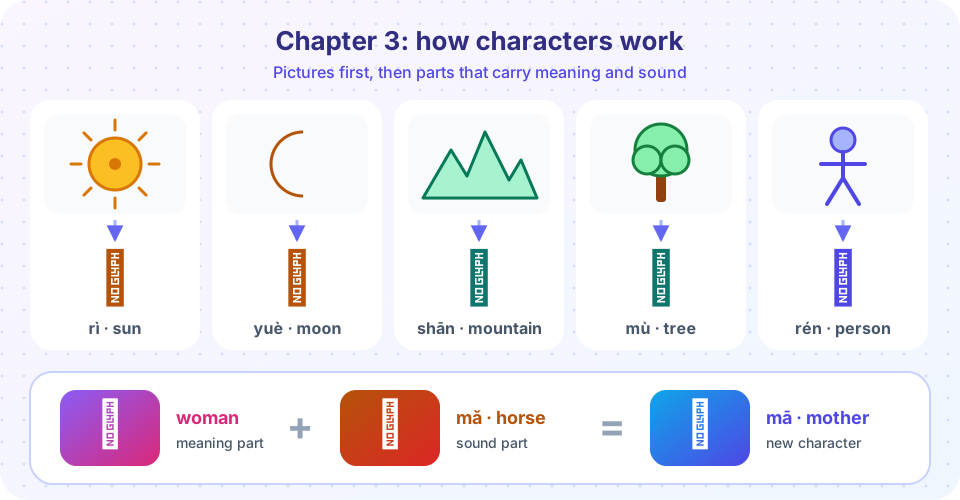
- Pictographs. Pictures of things: 日 (rì, sun), 月 (yuè, moon), 山 (shān, mountain), 木 (mù, tree), 人 (rén, person). These are few, but they are some of the most common building blocks.
- Indicative characters. Abstract ideas marked with a sign: 上 (shàng, up) and 下 (xià, down) put a mark above or below a line; 一, 二, 三 are lines counted.
- Meaning compounds. Two parts whose meanings combine: 明 (míng, bright) is sun 日 plus moon 月; 休 (xiū, rest) is a person 亻 beside a tree 木; 好 (hǎo, good) is a woman 女 with a child 子; 林 (lín, woods) is two trees and 森 (sēn, forest) three.
- Phonetic-semantic compounds. One part hints at meaning, the other at sound. This is the largest category, accounting for the clear majority of characters. 妈 (mā, mother) is 女 (woman, meaning) plus 马 (mǎ, sound). 河 (hé, river) is 氵 (water) plus 可 (kě, sound).
Phonetic hints are imperfect: sounds have drifted over centuries, so the hint may be off by a tone or a consonant. 请 (qǐng, please) has 青 (qīng) as its sound, and 清 (qīng, clear) uses the same hint. Still, the hint saves a lot of memorizing once you notice it.
Pictures
A small number of characters began as pictures.
Meaning pairs
Meaning + sound
Most characters are of this type.
Radicals
How many characters do I need?
Large dictionaries list tens of thousands of characters, but daily life needs far fewer. An educated adult knows several thousand. The official 2013 list of standard characters in mainland China has 8,105 characters in three tiers; the first tier holds 3,500 of the most common, enough to read most newspapers and books with a dictionary for rare words. A few hundred characters already let you read signs, menus and simple messages. In this course you learn them by building words, which makes them easier to remember.
Characters and words
A character is not always a word. Modern Mandarin words are mostly two characters long, and many are built from meaningful parts: 电话 (diànhuà, "electric speech" = telephone), 火车 (huǒchē, "fire vehicle" = train), 手机 (shǒujī, "hand machine" = mobile phone), 老师 (lǎoshī, "old master" = teacher). Because each character carries a meaning, a new word is often guessable from its parts. This is one reason characters get easier as you go on.
Chinese text has no spaces between words. Readers see the characters and group them into words automatically. In this course, pinyin spacing shows word boundaries.
What this chapter covers
- This overview.
- Strokes and radicals. The basic strokes, the rules of stroke order, and the most useful radicals.
- Pronouns and the verb 是. I, you, he, she, we, they, and how to say "A is B".
- Word order, negation and adjectives. Who does what when and where, how to say no, and how to describe things.
- Chapter 3 review. A cheat sheet and a quiz.
Common misconceptions
"Each character is a picture of an idea." Only a small number are pictures. Most contain a sound hint.
"One character, one word." Many words use two or more characters; many single characters are not independent words.
"Characters are the same in every Chinese-speaking place." Simplified and traditional forms differ for many characters, though they share the same roots.
"I can guess any meaning from the parts." Often you can guess roughly, but the combination is conventional. Treat parts as memory aids, not decoders.
Try it
First, a character-building game. Pick two components and see which character they build.
Second, a Python classification of ten characters by structure. Read the printout and notice how often a character has a sound hint.
Press Run (or Ctrl + Enter) to see the result here.
Program input · what you'd type while the program runs
Type the answers before you press Run, one per line. Each time the program reads a line (with input()), it gets the next line from this box.
Check your understanding
Quick check · 5 questions
of 5 answered You scored / 5 · perfect!
-
1. Which category makes up the largest share of Chinese characters?
Most characters combine a meaning part and a sound part. Pictographs are few. -
2. In 妈 (mā, mother), which part gives the meaning and which the sound?
女 means woman and points to the meaning; 马 (mǎ) hints at the sound. -
3. What is 明 (míng, bright) made of?
明 is a meaning compound of sun and moon. -
4. About how many characters does the first tier of the official 2013 list contain?
The first tier lists 3,500 common characters; the whole list has 8,105. -
5. How are most modern Mandarin words formed?
Words such as 电话 (telephone) combine meaningful characters.
Summary
- Characters were pictures at first, but most are built from a meaning part and a sound part.
- A few thousand characters cover everyday reading; words are usually two characters.
- Radicals are recurring parts that hint at meaning and organize dictionaries.
- This chapter covers strokes and radicals, pronouns and 是, and the basic sentence with negation and adjectives.
Next: Strokes and radicals
Track your progress
Create a free account to tick off lessons and pick up where you left off on any device.
of Mandarin Chinese for Beginners lessons completed