


















Lesson 11 of 44 · Characters and Basic Grammar
Strokes, stroke order and radicals
Learn the eight basic Chinese strokes, the rules of stroke order and the most useful radicals, with an animated stroke-order demo and a radical lookup tool.
Every Chinese character is built from a small set of strokes written in a fixed order. Knowing the strokes and the order makes characters easier to write, to remember and to recognize in messy handwriting. Knowing the radicals, the recurring parts, lets you read an unfamiliar character and guess what it is about. This lesson gives you both toolkits, and it keeps them practical: a few strokes, a few rules and about a dozen radicals will carry you a long way.
What you will learn
- the eight basic strokes and what they are called
- six stroke-order rules and how to apply them
- twelve radicals that carry meaning, with example characters
- how a dictionary uses radicals and stroke counts
Key terms
Stroke (笔画, bǐhuà) is one continuous line made without lifting the brush or pen.
Stroke order (笔顺, bǐshùn) is the standard sequence in which strokes are written.
Radical (部首, bùshǒu) is a component that helps classify a character and often hints at its meaning.
Component (部件, bùjiàn) is any recognizable part of a character.
The basic strokes
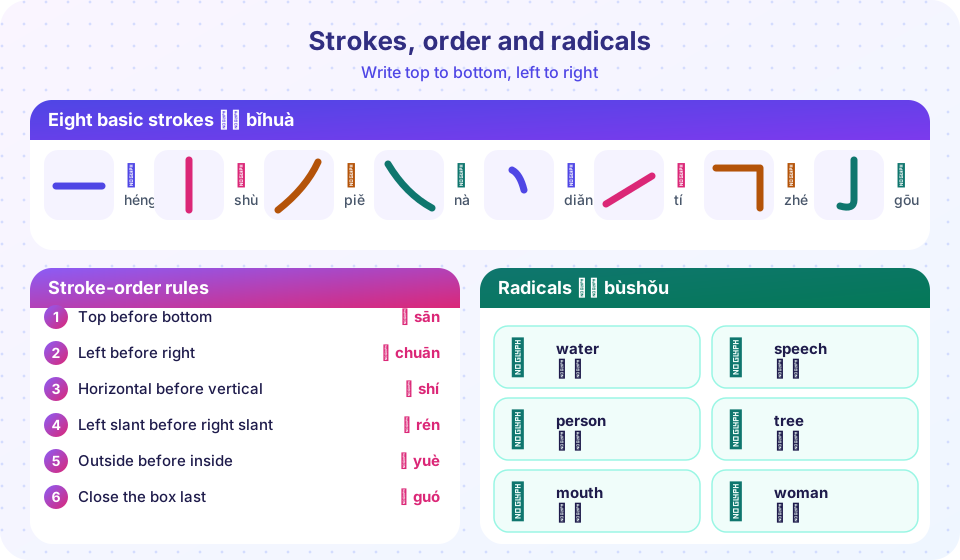
Chinese characters use eight basic strokes. Each has a name, and a few combine into compound strokes.
| Stroke | Name | Pinyin | Direction | In a character |
|---|---|---|---|---|
| 一 | horizontal | héng | left to right | 二 èr (two) |
| 丨 | vertical | shù | top to bottom | 十 shí (ten) |
| 丿 | left-falling | piě | top right to bottom left | 人 rén (person) |
| ㇏ | right-falling | nà | top left to bottom right | 人 rén (person) |
| 丶 | dot | diǎn | short, downward | 六 liù (six) |
| ㇀ | rising | tí | bottom left to top right | 打 dǎ (to hit) |
| 乛 | turn | zhé | a corner: go right, then turn down | 口 kǒu (mouth) |
| 亅 | hook | gōu | a short flick at the end | 小 xiǎo (small) |
Compound strokes combine these. 口 has a "horizontal-turn" 横折 (héngzhé), 月 (yuè) has a "horizontal-turn-hook" 横折钩 (héngzhégōu), 水 (shuǐ, water) has a "vertical-hook" 竖钩 (shùgōu), and 山 (shān, mountain) has a "vertical-turn" 竖折 (shùzhé). You do not need the names now. They show up in dictionaries and in teachers' words, and you will pick them up gradually.
The stroke count of a character is its number of strokes. 人 has 2, 大 has 3, 日 has 4, 好 has 6, 你 has 7, 是 has 9, 谢 has 12. When you look a character up in a dictionary without pinyin, you use its radical and its remaining stroke count.
Stroke order
Stroke order is not just tradition. It gives each character a consistent shape, helps you write fast without ugly tangles and lets handwriting apps recognize what you write. A short list of rules covers most characters.
- Top before bottom. 三 (sān): the top line first, then the middle, then the bottom.
- Left before right. 川 (chuān, river): three verticals, left to right.
- Horizontal before vertical when they cross. 十 (shí): the horizontal first, then the vertical.
- Left-falling before right-falling. 人 (rén): the left-falling stroke first, then the right-falling stroke.
- Outside before inside. 月 (yuè): the outer frame first, then the two short lines inside.
- Close the box last. 国 (guó): left side and top first, then the inside, then the bottom stroke seals the box.
Two more habits help. Center before wings for symmetrical characters: in 小 (xiǎo) you write the middle stroke first, then the left dot, then the right. And dots last or first by place: a dot at the top comes first (六 liù), but a dot inside or at a corner usually comes last (玉 yù, jade).
Writers practice on a square grid called 田字格 (tiánzìgé, "rice-field character grid"), a square with a cross through the middle. Each character should fill the square with balanced proportions. Do not worry about beauty at first. Regular, readable and correctly ordered is the goal.
Watch the stroke order below, then click a button to replay another character. The strokes are drawn in order and numbered at their starting points. The shapes are simplified line versions of the standard forms, enough to learn the order, not a calligraphy model.
Radicals: the meaning parts
Dictionaries have long organized characters under about 200 radicals. You do not need all of them. A dozen common ones already unlock hundreds of characters, because the radical usually sits on the left, top or bottom of the character and points to a meaning area.
| Radical | Meaning | Examples |
|---|---|---|
| 氵 | water | 河 hé river, 海 hǎi sea, 汤 tāng soup |
| 讠 | speech | 说 shuō speak, 请 qǐng please, 谢 xiè thank |
| 亻 | person | 你 nǐ you, 他 tā he, 们 men (plural) |
| 木 | tree, wood | 树 shù tree, 桌 zhuō table, 椅 yǐ chair |
| 口 | mouth | 吃 chī eat, 喝 hē drink, 吗 ma |
| 女 | woman | 好 hǎo good, 妈 mā mother, 姐 jiě elder sister |
| 艹 | grass, plant | 茶 chá tea, 花 huā flower, 药 yào medicine |
| 扌 | hand | 打 dǎ hit, 找 zhǎo look for, 把 bǎ hold |
| 饣 | food | 饭 fàn meal, 饿 è hungry, 饱 bǎo full |
| 忄 / 心 | heart, feeling | 忙 máng busy, 快 kuài fast, 想 xiǎng think |
| 钅 | metal | 钱 qián money, 银 yín silver, 铁 tiě iron |
| 日 | sun, day | 明 míng bright, 晚 wǎn evening, 时 shí time |
The radical hints at the category of meaning, not the exact word. 吃, 喝 and 吗 all have the mouth radical: eating, drinking and a question particle that a mouth says. When you meet a new character with 氵, you can already guess it is about water, liquid or rivers. Together with the sound hint on the other side, you often get a good guess.
The lookup tool below holds the radicals from the table. Type or paste a character to see its radical and meaning. It only knows the characters in its small list.
Press Run (or Ctrl + Enter) to see the result here.
Program input · what you'd type while the program runs
Type the answers before you press Run, one per line. Each time the program reads a line (with input()), it gets the next line from this box.
Practical writing tips
- Write a character three to five times when it is new, saying it aloud, then move on and come back to it later through review.
- Say the stroke names at first, for example "héng, shù, héng" for 土 (tǔ, earth). Many schoolchildren do.
- Handwriting apps let you draw a character with your finger and then show candidates, a great way to look up characters you cannot type.
- Typing is not a replacement for writing for beginners, but it is what most people do daily. In time, learn to type with pinyin, which you already know.
- Do not rush to learn all 200 radicals. Learn them as you meet them in words.
Common misconceptions
"Stroke order is just for artists." It matters for legibility and for handwriting recognition. Two characters written in the wrong order can look quite different on a page.
"The radical always tells you the meaning." It gives a hint about a meaning area. The character 明 sits under the sun radical 日, but its meaning is "bright", not "sun". Use radicals as clues, not as translations.
"If I can type, I do not need to learn strokes." You still use strokes to recognize characters, sort dictionary entries and write by hand when your phone is not nearby.
Check your understanding
Quick check · 6 questions
of 6 answered You scored / 6 · perfect!
-
1. In which order are the two strokes of 十 written?
Rule 3: when a horizontal and a vertical stroke cross, the horizontal comes first. -
2. Which radical suggests water, as in 河, 海, 汤?
氵 is the water radical. 讠 is speech and 亻 is person. -
3. In 人 (rén), which stroke comes first?
撇 comes before 捺, as in the rule 'left-falling before right-falling'. -
4. What does the radical 口 (mouth) hint at in 吃 and 喝?
口 suggests mouth-related meanings: eat, drink, say, ask. -
5. Which rule explains why 国 closes its box with the last stroke?
You write the outer frame and the inside first, and the bottom stroke seals the box. -
6. What is the stroke count of 好 (hǎo)?
女 has 3 strokes and 子 has 3, so 好 has 6.
Summary
- Characters are built from eight basic strokes plus compound strokes, written in a standard order.
- Six rules cover most order questions: top before bottom, left before right, horizontal before vertical, 撇 before 捺, outside before inside, close the box last.
- Radicals are recurring parts that hint at meaning; a dozen of them unlock hundreds of characters.
- Use stroke counts and radicals for dictionary lookup, and handwriting or pinyin input for everyday use.
Next: Pronouns and the verb 是
Track your progress
Create a free account to tick off lessons and pick up where you left off on any device.
of Mandarin Chinese for Beginners lessons completed