


















Lesson 9 of 44 · Pinyin, Tones and Greetings
Chapter 2 review: pinyin, tones and greetings
Review chapter 2 of the Mandarin course: initials, finals, spelling rules, the four tones, tone changes and greetings, with a one-page cheat sheet and a 10-question quiz.
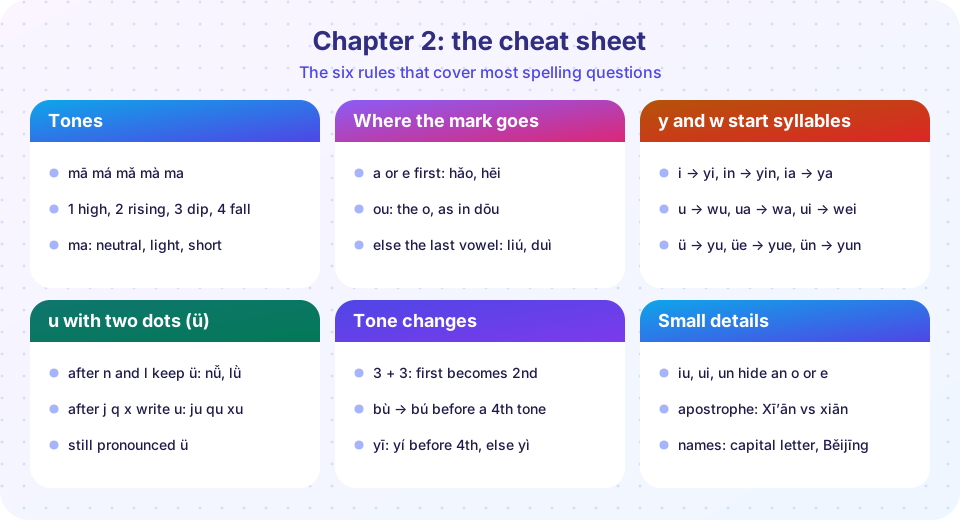
Chapter 2 gave you the sound system of Mandarin and your first phrases. This page packs the chapter on one sheet, lets you test your reflexes with a tone-mark trainer, and ends with a ten-question quiz across all four lessons. If you miss a question, the explanation tells you which lesson to revisit.
What you will learn
- a quick recap of every rule in chapter 2
- how well you can place tone marks and apply tone changes
- which topics to revisit before moving on to characters
Recap table
| Topic | Rule or fact | Example |
|---|---|---|
| Syllable | optional initial + final + tone | m + a + ˉ = mā |
| Aspiration | b/p, d/t, g/k, zh/ch, z/c, j/q differ by a puff of air | bà (爸) vs pà (怕, afraid) |
| Place groups | flat tongue j q x; curled zh ch sh r; tongue tip z c s | jī 鸡, zhī 知, zī 资 |
| Tone marks | on a or e; on o in ou; otherwise on the last vowel | hǎo, xiè, dōu, liú, duì |
| y and w | no bare i, u, ü at the start | yi, wu, yu, yue |
| ü | dots dropped after j, q, x | jù, qù, xù; but nǚ, lǜ |
| Hidden vowels | iou, uei, uen shrink to iu, ui, un | liù, duì, chūn |
| Tones | 1 high level, 2 rising, 3 dip-rise, 4 falling, neutral light | mā má mǎ mà ma |
| Sandhi | 3+3 → 2+3; 不 → bú before tone 4; 一 → yí / yì / yī | ní hǎo, bú shì, yí gè, yì tiān |
| Greetings | 你好 / 您好, 谢谢 / 不客气, 对不起 / 没关系, 再见 | |
| Names | family name first | 王明 Wáng Míng |
Key terms
Initial, final, tone: the three parts of a syllable.
Aspiration: the puff of air after p, t, k, q, ch, c.
Sandhi: regular tone changes in context.
Neutral tone: a light, short syllable such as the second one in māma.
The shape of the chapter
You started with the claim that a Mandarin syllable has three parts, then took the parts one at a time: initials and finals in lesson 2, tones in lesson 3 and then used all of them in the lesson on greetings. The pinyin spelling rules (y, w, ü, hidden vowels) look like arbitrary exceptions, but each exists for one reason: so that syllable boundaries and sounds are always unambiguous on the page. If a rule seems odd, ask what confusion it prevents. For example, without the y in yi and the apostrophe in Xī'ān, you could not tell where syllables end.
You also learned a few phrases. The sounds are the point, though. A learner with fifty perfectly pronounced words sounds far better than one with five hundred blurry ones. In this course, review your pronunciation regularly, not only your vocabulary.
How to use this review
Pinyin is a skill of the mouth and the ear, so treat this page as a warm-up for speaking. Read the cheat sheet picture aloud, saying each example with its tone. Then pick five words from earlier lessons, say them without looking and check yourself against the page. If any tone or sound feels shaky, return to the lesson that taught it. Plan to revisit this review in three days and again in a week. If you have a speaking partner, ask them to listen to you say the sixteen tone pairs and correct any that sound off.
Common misconceptions
"Spelling in pinyin shows tone changes." Pinyin shows the original tone for third-tone sandhi (nǐ hǎo), but the changed tone for 不 and 一 (bú shì, yí gè). Your ear and mouth must know the rule.
"The neutral tone is a fifth tone with a fixed pitch." It has no fixed pitch; it depends on the syllable before.
"Pinyin is only for beginners." Native speakers use pinyin to type, and learners at every level use it to look up words and check pronunciation.
Try it
The trainer shows a syllable and a tone. Click the vowel that should carry the tone mark. The rules: a or e first; in "ou" the o; otherwise the last vowel.
Check your understanding
Quick check · 10 questions
of 10 answered You scored / 10 · perfect!
-
1. Which letters differ from each other by a puff of air rather than by voicing?
b is unaspirated and p is aspirated; both are unvoiced. This is true for d/t, g/k, zh/ch, z/c and j/q too. -
2. Where does the tone mark go in 'liu' (六)?
With no a, e or ou, the mark goes on the last vowel: liù. -
3. How is the syllable 'ü' written when it begins a syllable?
ü at the start of a syllable is written yu: 鱼 yú. ü-sounds after j, q, x are also written u. -
4. Which of these is a final?
uang is a final (u + a + ng). zh and q are initials. -
5. What tone changes does the phrase 不对 undergo?
不 changes to second tone before a fourth tone. -
6. How is 一 said in 一个 (one of something)?
一 becomes yí before a fourth tone (个 is gè, fourth tone). -
7. Which sound is a soft 'sh' with a flat tongue and a smile?
x [ɕ] is the soft one. sh is curled, and s is a flat tongue tip. -
8. Which reply fits the question 你叫什么名字?
The question asks your name. 我叫 + name answers it. -
9. Why does 你好 sound like 'ní hǎo' when spoken?
This is third-tone sandhi. Pinyin keeps the written tone nǐ, but the voice rises on the first syllable. -
10. What is the neutral tone?
The neutral tone has no contour of its own; examples are 吗, 的 and the second syllable of 妈妈.
Summary
- A syllable is an optional initial, a final and a tone; initials contrast by aspiration and by tongue position.
- Spelling rules: y/w at the start, ü loses dots after j, q, x, hidden vowels in iu, ui, un.
- Tones: high level, rising, dip-rise, falling, neutral; sandhi affects third tones, 不 and 一.
- Greetings combine these sounds into real phrases; practice them aloud.
Track your progress
Create a free account to tick off lessons and pick up where you left off on any device.
of Mandarin Chinese for Beginners lessons completed