


















Lesson 20 of 44 · Measure Words and Questions
Chapter 4 review: measure words and questions
Review chapter 4 of the Mandarin course: measure words, numbers, yes/no questions, question words, 这, 那 and 的, with a cheat sheet and a 10-question quiz.
You have now learned the machinery that makes everyday Mandarin work: counting with measure words, asking every kind of question without moving a single word, and pointing and possessing with 这, 那 and 的. This is also the end of the first part of the course. After this review, you can introduce yourself, describe things, count what you have and ask the questions you need to get to know someone.
What you will learn
- a one-page recap of every pattern in chapter 4
- a mixed drill covering all five lessons
- how to prepare for chapter 5
Recap table
| Topic | Pattern | Example |
|---|---|---|
| Numbers 1–10 | 一 二 三 四 五 六 七 八 九 十 | yī, èr, sān, sì, wǔ, liù, qī, bā, jiǔ, shí |
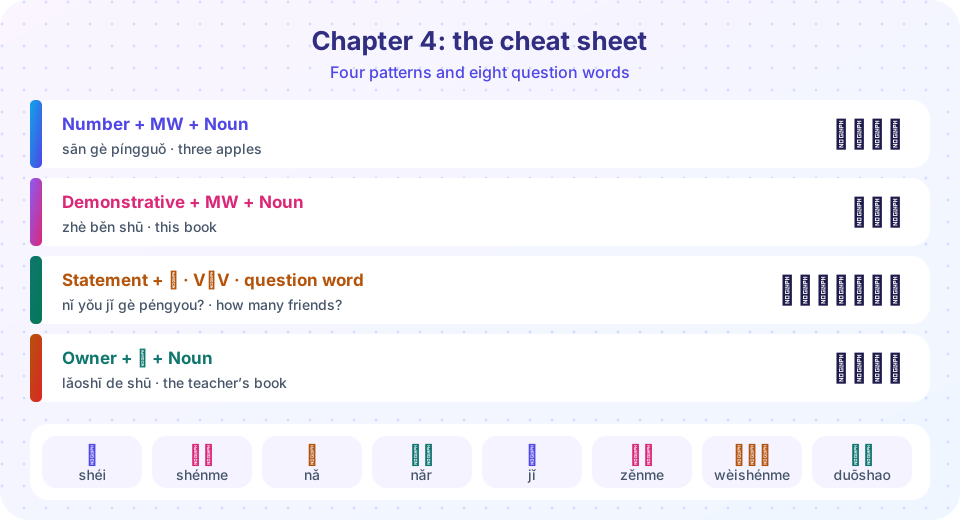
| Counting | number + measure word + noun | 三个苹果 sān gè píngguǒ |
| "Two" | 二 in counting; 两 before a measure word | 两杯茶 liǎng bēi chá |
| Tone of 一 | yí before 4th tone; yì before 1st, 2nd, 3rd | yí gè, yì běn, yì zhāng |
| Core measure words | 个 本 张 杯 只 条 件 位 辆 | 一本书, 一只猫, 一条鱼 |
| Yes/no question | statement + 吗 | 你是学生吗? |
| V不V | repeat the verb with 不 (没 for 有) | 你是不是学生? 你有没有手机? |
| Guess, follow-up, choice | 吧, 呢, 还是 | 你是学生吧? 你呢? 茶还是咖啡? |
| Question words | in the answer's slot; no 吗 | 你叫什么名字? 你住在哪儿? |
| Which number word | 几 for small counts; 多少 for any | 几个人? 多少钱? |
| Pointing | 这 / 那 + measure word + noun | 这本书, 那个人, 这些, 那些 |
| Possession | owner + 的 + noun; drop 的 for close relations | 我的书, 我妈妈 |
| "Mine" | owner + 的 alone | 这是我的。 |
Key terms
Measure word: the counting word between number and noun.
V不V: the verb-not-verb question.
Question particle: 吗, 吧, 呢.
Demonstrative: 这, 那, 哪.
的: the particle of belonging and description.
Putting the chapter together
Look at how the patterns combine. 这三本书是我的。 (Zhè sān běn shū shì wǒ de. These three books are mine.) contains a demonstrative, a number, a measure word, a noun, the verb 是 and a possessive with the noun dropped. 你有几个朋友? (Nǐ yǒu jǐ gè péngyou?) uses a question word in the slot of a number and a measure word. 我们喝茶还是咖啡,好吗? (Wǒmen hē chá háishi kāfēi, hǎo ma?) packs a choice and a tag question into one sentence.
Everything stays in plain subject, verb, object order. The skeleton from chapter 3 never moved. What changed is that you now have small tools that plug into the skeleton: a counting tool, four question tools and two pointing tools. In the next chapter, you add numbers beyond ten, money and shopping, family words and food, using exactly these patterns.
If a pattern feels shaky, return to the lesson that taught it: measure words for counting mistakes, yes/no questions for particles and V不V, question words for slot problems, and 这, 那 and 的 for possession.
How to use this review
Build five sentences that each use a different tool from the chapter: one with a measure word and a number, one with 吗, one with V不V, one with a question word and one with 的. Then write the question that would produce each one as an answer. For example, 我有两只猫 answers 你有几只猫? Say each pair aloud. If you have a friend learning too, trade sentences and answer each other's questions without looking at the text. When you can do this smoothly, you are ready for the vocabulary of daily life in the next chapter.
Common misconceptions
"Measure words are a detail I can skip." Without them, most counted phrases are wrong.
"A question needs a different word order." It does not. Same order, plus a particle or a question word.
"吗 goes with every question." Not with question words, not with V不V, not with 还是.
"的 is the English 's and always required." Close relations drop it, and short adjectives often skip it.
Try it
A mixed translation drill for the whole chapter. Choose the correct Chinese for each English sentence.
Check your understanding
Quick check · 10 questions
of 10 answered You scored / 10 · perfect!
-
1. Which is the correct way to say 'two cups of coffee'?
Use 两 before the measure word 杯. -
2. Which measure word goes with 鱼 (fish)?
条 is for long, thin things such as fish, roads and rivers. -
3. How do you turn 你有手机。 into a V不V question?
有 is negated with 没, giving 有没有. -
4. Which sentence is wrong?
吗 cannot be added to a question that already has a question word. -
5. Which is the best choice for 'How much is this?'
多少钱 asks the price. -
6. Which word asks 'which one?'
哪 means which; 那 is that and 这 is this. -
7. How do you say 'It is my mom's book'?
Owner + 的 + noun: 我妈妈的书. -
8. What does 你是学生吧? express?
吧 shows you think the answer is yes: 'You're a student, right?' -
9. How is 一 pronounced in 一本书?
本 is third tone, so 一 becomes yì: yì běn shū. -
10. What is the best answer to 你有哥哥吗? if you have none?
You repeat the verb 有 with the negative 没: 没有.
Summary
- Count with number + measure word + noun; use 两 for two and mind the tone of 一.
- Ask with 吗, V不V, 吧, 呢, 还是, or a question word in the answer's slot; never mix 吗 with these.
- Point with 这 and 那, and link owner and thing with 的, dropping it for close relations.
- You have finished part one: you can introduce yourself, count, ask and answer simple questions.
Next: back to the course page
Track your progress
Create a free account to tick off lessons and pick up where you left off on any device.
of Mandarin Chinese for Beginners lessons completed