


















Lesson 2 of 44 · Getting Started
What is Mandarin Chinese?
Where Mandarin fits among the Chinese languages, what 普通话, 国语 and 华语 mean, how simplified and traditional characters differ, and what makes Mandarin unusual.
"Chinese" is a bigger word than most learners expect. It covers a family of spoken varieties that have grown apart over many centuries, a shared writing tradition that is thousands of years old, and a standard language that most schools in the Chinese-speaking world teach today. When you study "Mandarin", you are learning that standard language. This lesson draws the map so you know where you are standing.
What you will learn
- how Mandarin relates to Cantonese, Shanghainese, Hokkien and other varieties
- the names 普通话, 国语 and 华语 and where each is used
- the difference between simplified and traditional characters
- the four big features that make Mandarin feel different from English
Key terms
Mandarin (官话, Guānhuà) is the largest group of Chinese varieties, spoken across northern, central and southwestern China.
Standard Mandarin (普通话, Pǔtōnghuà) is the official standard of mainland China, based on Beijing pronunciation.
Sinitic languages is the linguists' name for the Chinese language family.
Simplified / traditional characters (简体字 jiǎntǐzì / 繁體字 fántǐzì) are two standardized sets of written forms.
One language or many?
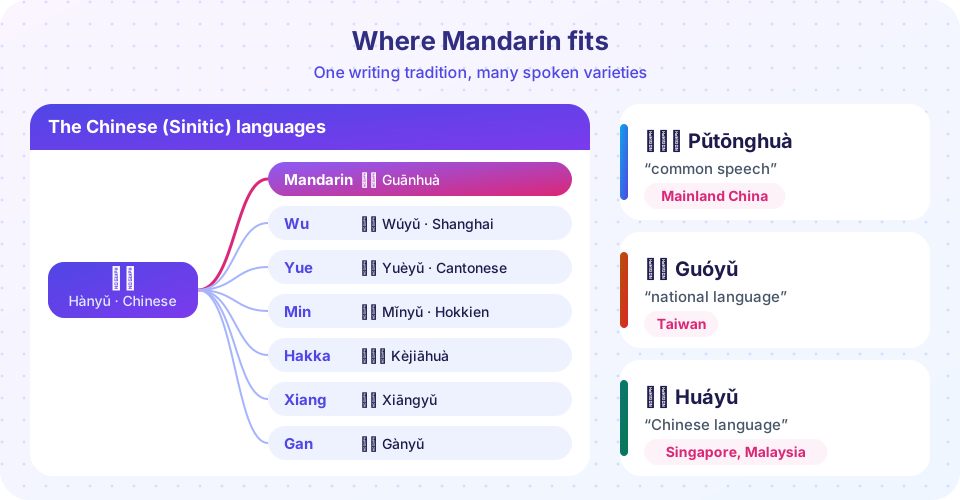
Speakers of Chinese say they share one language, and they share one writing tradition. Yet the spoken varieties differ so much that a person from Guangzhou speaking Cantonese and a person from Beijing speaking Mandarin cannot understand each other without training. Linguists therefore describe Chinese as a family of related languages, often called the Sinitic languages. The best-known branches are:
| Branch | Chinese | Where you hear it |
|---|---|---|
| Mandarin | 官话 Guānhuà | northern, central and southwestern China, Taiwan, Singapore |
| Wu | 吴语 Wúyǔ | Shanghai and the surrounding region |
| Yue (Cantonese) | 粤语 Yuèyǔ | Guangdong, Hong Kong, Macau, many overseas communities |
| Min | 闽语 Mǐnyǔ | Fujian, Taiwan, Southeast Asia (Hokkien and others) |
| Hakka | 客家话 Kèjiāhuà | scattered communities in southern China and overseas |
| Xiang, Gan | 湘语, 赣语 | Hunan and Jiangxi provinces |
Mandarin is by far the largest branch. Around 900 million people speak a form of it as their first language, which is more than any other language on Earth, and hundreds of millions more speak it as a second language. That is one reason why it is also the language that schools, television, government and business use as a common ground.
Whether you call Cantonese a language or a dialect is partly a political question and partly a linguistic one. The simple, honest summary is this: the spoken varieties are different enough to be mutually unintelligible, but speakers feel united by writing, history and culture.
The same characters, different sounds
Because Chinese characters stand for meanings and syllables rather than sounds alone, speakers of different varieties can often read the same text while pronouncing it very differently. Try the demonstration below to see one word in three varieties. The Cantonese uses Jyutping, a romanization of Cantonese in which the numbers 1 to 6 mark tones, and the Hokkien uses Pe̍h-ōe-jī, a romanization that grew out of missionary work in Fujian and Taiwan.
Three names for one standard
The standard form of Mandarin has a different name depending on where you are.
- 普通话 (Pǔtōnghuà, "common speech") is the name in mainland China. The official definition is that its pronunciation follows that of Beijing and its grammar follows modern written northern Chinese.
- 国语 (Guóyǔ, "national language") is the name in Taiwan. It is very close to Pǔtōnghuà, with some differences in vocabulary and a few sounds.
- 华语 (Huáyǔ, "Chinese language") is the name often used in Singapore, Malaysia and among overseas Chinese communities.
For a beginner, the differences are small. This course teaches the Pǔtōnghuà standard and mentions common variations, such as different words for "taxi", only when they matter. Many mainland speakers also pronounce Mandarin with a regional accent, so do not worry if a real speaker sounds different from a textbook.
Simplified and traditional characters
In the 1950s and 1960s, mainland China standardized a set of simpler character forms with fewer strokes to make literacy easier. These are the simplified characters. Singapore adopted them too. Taiwan, Hong Kong and Macau continue to use the older traditional forms. Many characters are the same in both sets. Others differ, and a few traditional characters were merged into one simplified character.
The next tool prints a few pairs for comparison. You do not need to memorize them. The goal is to see that the two sets are close relatives, so learning one makes the other much easier to recognize later.
Press Run (or Ctrl + Enter) to see the result here.
Program input · what you'd type while the program runs
Type the answers before you press Run, one per line. Each time the program reads a line (with input()), it gets the next line from this box.
Four features that make Mandarin different
Compared with English, four things stand out. You will meet each one properly in the chapters ahead, but it helps to know the shape of the road.
- Tones. Every syllable has a pitch pattern, and the pattern is part of the word. Mandarin has four tones plus a light, "neutral" syllable. The syllable ma can mean mother, hemp, horse or scold, depending on the tone. This is the single biggest adjustment for English speakers.
- Characters. Instead of an alphabet, Chinese writing uses characters. Each character stands for one syllable and, usually, one meaningful unit. You learn them gradually, and a few thousand cover almost everything you meet in daily reading. Many are built from smaller parts, so they are less random than they look.
- Short, regular grammar. Verbs do not conjugate. "I go, you go, he goes, they went" use the same verb 去 (qù). Nouns have no plural endings and no genders. Time is shown by time words (明天 míngtiān, tomorrow) and by small particles rather than by tenses.
- Word order and measure words. Basic order is subject, verb, object, like English, but time and place words come before the verb. When you count things, you place a measure word between the number and the noun: 三个苹果 (sān gè píngguǒ, three apples). Chapter 4 explains this.
Pinyin: the bridge
Chinese characters do not tell you how to say them. In 1958 mainland China approved Hànyǔ Pīnyīn, "Chinese spelling-sound", a scheme that writes Mandarin sounds in Latin letters. It became an international standard later and is now used in dictionaries, school textbooks, phone keyboards and street signs. When you type Chinese on a phone, you usually type pinyin and choose the character from a list. Chapter 2 teaches pinyin from scratch.
Common misconceptions
"Cantonese and Mandarin are just accents." They are different enough in sound, vocabulary and some grammar that speakers cannot understand each other without learning. They share a writing tradition, though Cantonese-speaking regions also write some colloquial words with extra characters.
"Chinese characters are little pictures." A few early characters began as pictures, such as 日 (sun) and 山 (mountain), but most characters combine a meaning part and a sound part. Chapter 3 shows how.
"Chinese has no grammar." It has plenty of grammar. It simply expresses it with word order, particles and measure words rather than with endings.
Check your understanding
Quick check · 5 questions
of 5 answered You scored / 5 · perfect!
-
1. What does 普通话 (Pǔtōnghuà) refer to?
Pǔtōnghuà means 'common speech' and is the official name of standard Mandarin in mainland China. -
2. Which pair is correctly matched?
国语 means 'national language' and is the usual name in Taiwan. 官话 is the Mandarin branch of Chinese. -
3. Why can two Chinese speakers who cannot understand each other's speech sometimes still read the same text?
Characters are tied to meanings and a long shared written tradition, so different varieties can read the same text while saying it differently. -
4. Which statement about Mandarin grammar is true?
Mandarin verbs do not conjugate. You say 我去, 你去, 他去 with the same verb. -
5. Where are traditional characters mainly used today?
Taiwan, Hong Kong and Macau use traditional characters. Mainland China and Singapore use simplified characters.
Summary
- Chinese is a family of related languages; Mandarin is the largest branch and the basis of the standard taught everywhere.
- The standard has several names: 普通话 (mainland China), 国语 (Taiwan), 华语 (Singapore, Malaysia and overseas).
- Simplified characters are used in mainland China and Singapore; traditional characters in Taiwan, Hong Kong and Macau.
- Mandarin has tones, characters, short regular grammar and measure words, and pinyin is the bridge to the sounds.
Next: How to study Chinese
Track your progress
Create a free account to tick off lessons and pick up where you left off on any device.
of Mandarin Chinese for Beginners lessons completed